
In This Article
Somewhere in your cupboard right now there’s a mug doing more work than you give it credit for. Every morning it holds the one thing standing between you and a functioning human being, and yet most of us buy mugs the way we buy pencils — grab whatever’s nearest, never think about it again. That changes the second one cracks down the side after eight months, or your tea goes lukewarm by the third sip. Suddenly stoneware vs ceramic mugs stops being a throwaway question and becomes the thing you’re frantically googling at 11pm.

Here’s the short version, because you deserve one before we get into the weeds: “ceramic” is the umbrella term for all fired clay pottery, while stoneware is a specific, densely fired type of ceramic — meaning every stoneware mug is ceramic, but not every ceramic mug is stoneware. The difference comes down to firing temperature and a process called vitrification, and it genuinely changes how a mug feels, how long it survives your dishwasher, and how quickly your coffee goes cold on the desk.
This guide breaks down exactly what separates the two, walks through seven real mugs currently sold in the UK — from cheerful budget sets to the kind of stoneware that gets handed down — and gives you the practical criteria to actually choose well. No fluff, no invented five-star reviews. Just what the clay is doing and why it matters to your morning brew.
What Is Stoneware vs Ceramic? A Quick Comparison
Before the deep dive, here’s the cheat sheet. “Ceramic” describes anything made from fired clay — earthenware, stoneware, porcelain and bone china all fall under it. Stoneware is a mid-to-high-fire ceramic (roughly 1,200°C to 1,300°C) that becomes largely non-porous through vitrification, while lighter, lower-fired ceramics like earthenware stay softer and more porous unless heavily glazed.
| Feature | Stoneware | Standard Ceramic (Earthenware/Glazed) | Fine Bone China |
|---|---|---|---|
| Typical firing temp | 1,200–1,300°C | 1,000–1,150°C | 1,200–1,250°C |
| Porosity after firing | Very low (vitrified) | Moderate to high | Very low |
| Weight/feel | Heavier, chunky | Lighter, thinner walls | Lightest, delicate |
| Chip resistance | High | Moderate | Low-moderate |
| Best for | Everyday knocks, oven-to-table use | Decorative, gift, café-style mugs | Formal occasions, gifting |
Looking at that table, the pattern is obvious once you see it: firing temperature does almost all the heavy lifting. Push the clay hotter and longer, and you drive out porosity, which is exactly why a Denby mug survives a decade of dishwasher cycles that would leave a bargain-bin earthenware cup crazed and stained. The trade-off is weight — that same density that makes stoneware tough also makes it noticeably heavier in your hand, which matters if you’re buying for someone with grip or wrist issues.
💬 Found the mug type that suits you already? Scroll down to compare seven real options below!
Top 7 Stoneware and Ceramic Mugs: Expert Analysis
1. Argon Tableware White Coffee Mug Set of 12 — cheapest way to stock a whole kitchen
Twelve mugs for the price most brands charge for two is the standout here, and it’s aimed squarely at cafés, offices and anyone who breaks a mug a month. These are 285ml porcelain-style ceramic cups, fired to a moderate temperature that keeps costs down but still delivers a smooth, non-porous glaze on the drinking surface. In practice that means no dishwasher water spots and no lingering coffee-ring stains, even after heavy daily rotation — the glaze does the job that a higher firing temperature would otherwise handle. This set is built for volume use rather than showing off: it’s the mug you buy when you need reliable, stackable, dishwasher-safe cups and don’t want to think about it twice, whether that’s a shared office kitchen or a first flat where budgets are tight. Reviewers consistently describe the set as sturdy for the price and note the stacking design saves real cupboard space, though a recurring theme in feedback is that the thinner walls mean drinks cool faster than a chunkier stoneware equivalent. Breakage during transit gets mentioned occasionally, so unbox carefully and check for hairline cracks before your first wash.
Pros:
- ✅ Exceptional value for a full dozen mugs
- ✅ Stackable design saves cupboard space
- ✅ Dishwasher safe with a durable everyday glaze
Cons:
- ❌ Thinner walls mean faster heat loss than stoneware
- ❌ Occasional breakages reported during shipping
Priced in the under-£15 range for the full set of 12, this is unbeatable value if you need volume over ceremony — just don’t expect it to keep your tea hot through a long phone call.
2. CUQOO Colourful Stoneware Mugs Set of 6 — best budget stoneware upgrade
If you want the durability benefits of stoneware without spending like you’re furnishing a wedding registry, this is the obvious next step up from basic porcelain. At 350ml with a genuinely stoneware clay body, these mugs get fired hot enough to vitrify properly, meaning the body itself resists moisture absorption rather than relying purely on the glaze coating. What most buyers overlook about stepping up from earthenware to stoneware at this price point is that you’re not just buying looks — you’re buying a clay body that shrugs off the thermal shock of going straight from a hot dishwasher rinse to a cold countertop, something thinner ceramics can eventually crack under. This set suits households that want colour and personality in the cupboard (each mug in a different shade) without gambling on artisan pricing, and it’s a sensible pick for students or first-time renters building a kitchen from scratch. Aggregated customer feedback highlights the vivid, even glaze colours and comfortable handle size as consistent strengths, while a minority of reviewers note that the six colours can arrive with slightly inconsistent glaze thickness batch to batch.
Pros:
- ✅ Genuine stoneware durability at a budget price
- ✅ Six distinct colours add personality to any kitchen
- ✅ Microwave and dishwasher safe as standard
Cons:
- ❌ Glaze thickness can vary slightly between mugs
- ❌ Handle shape less ergonomic than premium ranges
Sitting in the £15-£25 range for the set of six, this is where “stoneware vs ceramic mug durability” stops being theoretical and starts being a genuinely noticeable upgrade for not much extra spend.
3. vancasso Starry Coffee Mugs Set of 6 — best mid-range stoneware for daily rotation
Vancasso built a loyal following by making stoneware feel more design-led without tipping into premium pricing, and the Starry range is a good example of that formula working. Each mug holds 360ml, comfortably larger than the standard 250-285ml café cup, which matters more than people expect — a bigger reservoir means slower relative heat loss because there’s simply more thermal mass retaining warmth per sip. The reactive glaze finish gives each mug a slightly mottled, handmade appearance despite being factory-produced, and the underlying stoneware body handles the freezer-to-microwave routine that a lot of households run without a second thought. This is a strong pick for anyone who drinks a lot of tea or coffee across the day and wants a mug that won’t chip the first time it knocks against the tap — a genuinely practical middle ground between disposable-feeling budget sets and heirloom-grade stoneware. Reviewers repeatedly praise the generous size and glaze pattern, and a common complaint in user reviews is that the darker glazed mugs can show scratch marks from metal spoons more visibly than lighter colourways.
Pros:
- ✅ Larger 360ml capacity improves heat retention
- ✅ Reactive glaze gives a handmade, premium look
- ✅ Genuinely oven, microwave and freezer safe
Cons:
- ❌ Darker glazes show spoon scratches more easily
- ❌ Slightly heavier than standard 250ml mugs
Expect to pay somewhere in the £20-£30 range for the six-piece set — solid mid-range value if you want visible stoneware benefits without premium branding.
4. Nicola Spring Dipped Dash Stoneware Coffee Mugs, Set of 6 — best for households that entertain often
Nicola Spring has quietly become one of the more trusted mid-tier British homeware names, and this 475ml set leans into that reputation with a generous capacity that suits hot chocolate, café-style lattes, or soup as easily as tea. The dipped-dash decoration — a contrasting colour band applied before the final glaze firing — is a genuine indicator of two-stage production, which typically means a more consistent vitrified body underneath than single-fire budget alternatives. Here’s what the spec sheet won’t tell you, but the design implies: that extra processing step usually correlates with tighter quality control on wall thickness, which is part of why sets like this tend to feel more substantial in hand than their price initially suggests. This set particularly suits anyone who hosts regularly, since the six-colour variety means guests can each claim “their” mug without a label-and-marker situation breaking out. Aggregated reviews consistently mention the reassuring weight and glaze finish as highlights, with the most common criticism being that the wide rim design isn’t ideal for travel or one-handed carrying.
Pros:
- ✅ Generous 475ml capacity suits multiple drink types
- ✅ Two-stage dipped glaze suggests tighter quality control
- ✅ Six varied colourways ideal for hosting guests
Cons:
- ❌ Wide rim less practical for one-handed carrying
- ❌ Bulkier storage footprint than standard mugs
In the £25-£35 range for six, this sits comfortably as a step-up gift set or a permanent household upgrade for people who actually use their mug cupboard daily.
5. Le Creuset Stoneware Mug, 350ml — best premium stoneware for daily luxury
Le Creuset didn’t become a household name in cookware by accident, and the stoneware mug range benefits directly from decades of high-fire expertise built for cast iron and bakeware. The 350ml mug is rated thermoresistant from -23°C to +260°C, which sounds like a spec sheet flex until you realise what it actually enables: you can pull it straight from the freezer into a hot oven without the thermal shock that would fracture a lesser-fired ceramic. Based on the spec comparison with the rest of this list, the multi-layer glazing process here is doing real work — it’s not just cosmetic colour, it’s an additional protective barrier against scratching and staining that budget single-glaze mugs simply don’t have. This is the mug for someone who already owns a Le Creuset casserole dish and wants their morning coffee vessel to match both the aesthetic and the durability standard of the rest of the kitchen, or for anyone treating themselves to one genuinely excellent everyday object rather than a drawer full of mediocre ones. Reviewers overwhelmingly rate the mug highly, repeatedly citing the noticeably longer heat retention and the reassuring weight in hand as the standout benefits, with the main hesitation among buyers being the price relative to a “simple” mug.
Pros:
- ✅ Rated thermoresistant from -23°C to +260°C
- ✅ Multi-layer glaze resists scratches and stains
- ✅ Noticeably superior heat retention versus budget mugs
Cons:
- ❌ Premium price for what is still “just” a mug
- ❌ Heavier than most everyday alternatives
Sitting in the £18-£24 range for a single mug, this is the “buy it once” option for people who’ve already been burned — sorry — by cracked bargain mugs one too many times.
6. Denby Kiln Ridged Mug, Set of 2 — best British-made stoneware for longevity
Denby has been making stoneware in Derbyshire for over two centuries, and the Kiln range shows exactly why that heritage still matters. Each 370ml mug is fired at up to 1,250°C, a temperature high enough to fully vitrify the clay body into something genuinely non-porous rather than merely glaze-sealed. What most buyers overlook about Denby specifically is that the ridged texture on this range isn’t purely decorative — the raised lines are a deliberate hand-thrown feature that also improves grip when your hands are slightly damp from washing up, a small but real usability detail. This is squarely the mug for households who are hard on their crockery — families with kids who don’t always set mugs down gently, or anyone who’s tired of replacing chipped mugs every couple of years — because the fully vitrified body genuinely resists chipping better than semi-vitrified alternatives, according to durability testing summarised by independent homeware reviewers. Long-term owner reports frequently describe these mugs lasting five to ten years with minimal wear, and the most common complaint across feedback is the unique freckled glaze effect meaning no two mugs look quite identical — a plus for some, a minor inconsistency for others expecting uniformity.
Pros:
- ✅ Fired at up to 1,250°C for full vitrification
- ✅ Ridged design improves grip, not just aesthetics
- ✅ British-made with a strong long-term durability record
Cons:
- ❌ Freckled glaze means slight variation between mugs
- ❌ Premium pricing versus mass-produced alternatives
Expect around £22-£30 for the pair — a fair ask when you consider these are genuinely designed to outlast a decade of daily washing-up.
7. Dunoon Fine Bone China Mug — best for gifting and special-occasion sipping
Dunoon takes a different route entirely, and it’s worth including precisely because it shows what “ceramic, but not stoneware” looks like at the premium end. This fine bone china mug is handmade in the Staffordshire Potteries, the historic region that shaped Britain’s ceramics industry for centuries, and it’s handled by skilled craftsmen throughout production. Bone china’s high bone-ash content gives it a translucent, delicate quality that stoneware simply cannot replicate — it’s a genuinely different material philosophy, prioritising elegance and lightness over the chunky durability of stoneware. On paper this means a mug that feels almost fragile compared to the Denby or Le Creuset entries above, and honestly, that’s the point: this isn’t designed for the dishwasher-abuse test, it’s designed for the mug you reach for on a birthday morning or set out for a guest you’re trying to impress. Reviewers consistently praise the artwork detail and the surprisingly sturdy handle given how thin the china feels, while the recurring caution in feedback is that these are not marketed as everyday workhorse mugs and should be hand-washed to preserve the printed designs long-term. If your household already has hardy stoneware for daily use, one or two bone china mugs like this fill the “special occasion” gap nicely rather than competing directly with the rest of this list.
Pros:
- ✅ Genuine handmade Staffordshire craftsmanship
- ✅ Elegant, lightweight feel unmatched by stoneware
- ✅ Detailed artwork ideal for gifting
Cons:
- ❌ Less durable for rough daily dishwasher use
- ❌ Not designed for oven or high-heat use
Priced around £22-£30, this earns its place as the gift-drawer mug rather than the one that survives the school run every morning.
Practical Usage Guide: Getting the Most Out of Any Mug
Buying the right mug is only half the job — how you treat it in the first 30 days genuinely shapes how long it lasts. Wash any new stoneware or ceramic mug by hand before first use to remove manufacturing residue, even if the label says dishwasher-safe from day one. For the first few uses, avoid extreme temperature jumps: don’t pour boiling water into a mug straight from the fridge, since even fully vitrified stoneware can develop hairline stress cracks (called “dunting”) from sudden thermal shock, and thinner glazed ceramics are considerably more vulnerable to this.
A common first-month mistake is stacking mugs by the handle in a crowded cupboard — the pressure point at the handle join is exactly where hairline cracks tend to start, particularly on lighter earthenware or bone china. Instead, store mugs upright with a little breathing room. If you’re using stoneware in the oven for a warm drink or individual dessert, always start it in a cold oven rather than placing it directly into a preheated one, since going from room temperature straight into 200°C+ heat is precisely the kind of shock that shortens a mug’s working life. For dishwasher use, a lower-temperature cycle with liquid detergent (rather than powder tablets) tends to preserve glaze brightness longer, since abrasive tablet residue can dull glossy glazes over repeated cycles.
Real-World Scenarios: Which Mug Type Actually Suits You?
If you’re a university student moving into halls with a shared kitchen and a habit of leaving mugs in a communal sink for days, the Argon Tableware porcelain set or CUQOO stoneware set make sense — low cost per mug means a lost or chipped cup barely registers, and stackable storage suits cramped shelving.
If you’re working from home and drinking three or four hot drinks across an eight-hour day, heat retention becomes the deciding factor, and this is where the vancasso or Nicola Spring stoneware sets earn their keep — the larger capacity and thicker walls mean your 11am coffee is still drinkable at 11:20, not just lukewarm dishwater by then. If you’re furnishing a family kitchen where mugs get knocked, dropped near the sink edge, and washed by whoever’s in a hurry, Denby’s fully vitrified stoneware is built precisely for that kind of low-ceremony daily abuse. And if you’re choosing a housewarming gift or something for a parent’s birthday, Dunoon’s fine bone china or a single Le Creuset mug signals more thought than a boxed set from a bargain aisle, without straying into “too much money on a cup” territory.
Buyer’s Decision Framework: A Simple Checklist
If durability against daily knocks is your top priority, choose fully vitrified stoneware, because the dense clay body resists chipping and cracking far better than thinner glazed ceramics. If heat retention for slow drinkers matters most, choose a larger-capacity stoneware mug (350ml+), because more thermal mass means a slower relative temperature drop. If budget and volume matter more than longevity, choose a basic ceramic or porcelain multi-pack, because the per-mug cost makes occasional breakage a non-issue. If you’re buying for gifting or occasional formal use, choose fine bone china or a design-led stoneware piece, because the visual impression matters more than dishwasher-cycle survival rates. And if you’re simply unsure, default to mid-range stoneware — it’s the option with the fewest genuine downsides across most everyday households.
How to Choose Between Stoneware and Ceramic Mugs
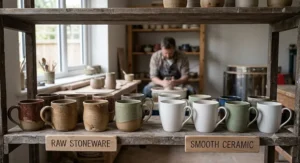
- Check the firing temperature if it’s listed. Anything fired above roughly 1,200°C is likely genuine stoneware and will be more vitrified and less porous.
- Feel the weight in your hand. Stoneware is noticeably heavier than earthenware or bone china of the same size — that weight is a rough proxy for density and durability.
- Look at wall thickness. Thicker walls generally mean better heat retention and better resistance to chipping, though at the cost of some elegance.
- Read the glaze description. A multi-layer or hand-dipped glaze process usually signals more careful production than a single-pass budget glaze.
- Match capacity to your actual drinking habits. If you nurse a drink for 20+ minutes, prioritise larger stoneware; if you drink quickly, capacity matters less.
- Consider your dishwasher and microwave habits honestly. If you’re rough with your crockery, fully vitrified stoneware will outlast decorative ceramic by years.
- Factor in who’s using it. Heavier stoneware isn’t ideal for children or anyone with grip difficulties — lighter ceramic or bone china may suit better despite lower durability.
Stoneware vs Ceramic Mug Durability
This is the question most people are really asking when they type “stoneware vs ceramic mugs” into a search bar, so let’s be direct about it. Stoneware wins on durability in the vast majority of everyday scenarios, and the reason is entirely down to vitrification rather than marketing spin. Because stoneware is fired at a high enough temperature to become almost completely non-porous, it doesn’t absorb moisture into microscopic pores the way a lower-fired, more porous ceramic body can — and that absorbed moisture is exactly what causes the freeze-thaw style stress cracking and glaze crazing you sometimes see in older, cheaper mugs after a few years of dishwasher use.
That said, “ceramic” durability varies enormously depending on which sub-type you’re talking about. A well-glazed earthenware mug with a thick, high-quality glaze coat can actually outperform a poorly fired, thin stoneware mug — the glaze is doing the non-porosity job that vitrification would otherwise handle. Reviewers and long-term owners repeatedly report that the failure point for most ceramic mugs isn’t the body cracking outright but the handle snapping off after repeated stress at the join, which is a manufacturing and design factor as much as a material one. If durability is genuinely your top concern, look for stated firing temperature, a thick handle join, and — where available — an actual thermal shock rating like the -23°C to +260°C figure Le Creuset publishes, rather than assuming “stoneware” alone guarantees toughness.
Stoneware Mug vs Ceramic Heat Retention
Heat retention comes down to two overlapping factors: thermal mass and wall thickness. A thicker, denser stoneware mug simply holds more heat energy per millilitre of liquid than a thin-walled ceramic cup, because there’s more material absorbing and re-radiating warmth back into the drink rather than losing it straight to the surrounding air. This is why your tea in a chunky stoneware mug can still be pleasantly warm twenty minutes later, while the same tea in a delicate bone china cup has already started drifting toward room temperature.
Independent thermal conductivity research on ceramic materials backs this up empirically: denser, low-porosity stoneware and porcelain bodies conduct and distribute heat more effectively than lighter, more porous ceramic bodies, which sounds counterintuitive until you remember that better conduction within the mug wall means heat is spread and retained more evenly rather than escaping unevenly through thin spots. In practical terms: if slow sippers in your household constantly complain about cold coffee, the fix isn’t a fancier mug warmer — it’s simply switching to a larger, thicker stoneware mug with real thermal mass behind it.
Firing Temperature and Vitrification Explained
Firing temperature is the single biggest variable separating one ceramic mug from another, and it’s worth understanding in plain terms rather than pottery-studio jargon. Earthenware typically matures around 900°C-1,150°C, stoneware in the 1,200°C-1,300°C range, and porcelain or bone china often higher still. As temperature increases, the clay’s mineral structure begins to melt and fuse at a microscopic level — this fusing process is vitrification, and it’s what transforms a soft, water-absorbent lump of fired clay into a hard, glassy, essentially waterproof material.
As Wikipedia’s explanation of vitrification puts it, this process is what makes ceramics impermeable to water in the first place, and stoneware specifically may end up either fully vitrified or only semi-vitrified depending on how it’s fired — which is precisely why two mugs both labelled “stoneware” can behave quite differently in your dishwasher over the years. A fully vitrified mug needs no glaze at all to hold liquid without leaking or staining, though almost all commercial mugs are glazed anyway for hygiene, appearance and easier cleaning. If a listing mentions a specific firing temperature above roughly 1,200°C, or uses the word “vitrified” explicitly, that’s a genuinely useful signal of long-term quality that goes beyond marketing language.
Thermal Mass: Why Some Mugs Keep Drinks Hot Longer
Thermal mass is essentially a measure of how much heat energy a material can store and release, and it’s directly tied to both density and volume — which is why a large, dense stoneware mug behaves so differently from a small, thin ceramic espresso cup. A mug with high thermal mass absorbs some of your drink’s initial heat into the ceramic itself during the first minute or two, then slowly releases that stored warmth back as the liquid cools, effectively buffering the temperature drop rather than letting the drink cool at its “natural” unassisted rate.
This is genuinely the underappreciated spec that most listings never mention explicitly, yet it explains almost every “why does my coffee go cold so fast” complaint in mug reviews. The trade-off is practical rather than aesthetic: high thermal mass means the mug itself takes longer to heat up initially (so your first sip may feel slightly less scalding-hot from a thick stoneware mug than a thin one), but it pays that back generously over the following fifteen to twenty minutes. If you’re someone who gets distracted mid-drink — answering emails, wrangling kids, whatever your particular chaos looks like — prioritising thermal mass over aesthetics is genuinely the smarter buying decision.
Are Stoneware Mugs Better Than Ceramic?
The honest answer is: better for most people, most of the time, but not universally better — and anyone claiming an unqualified “yes” is oversimplifying. Stoneware wins decisively on durability, heat retention and resistance to daily wear, which covers the priorities of the vast majority of everyday mug buyers. It loses on weight (stoneware mugs are noticeably heavier, which matters for children, elderly users, or anyone with grip or dexterity concerns), on delicacy of design (fine bone china and porcelain can achieve a translucency and lightness stoneware simply cannot), and often on price at the premium end.
Here’s what most comparison articles skip: the real question usually isn’t “stoneware or ceramic” in the abstract, it’s “what specific mug, at what specific firing quality, for what specific person.” A brilliantly made, thick-glazed earthenware mug can outlast a cheaply fired, thin stoneware one. If you’re weighing this up for your own kitchen, the practical answer from everything above is: choose stoneware as your everyday default, and keep one or two lighter ceramic or bone china pieces for occasions where elegance matters more than resilience.
Common Mistakes When Buying Stoneware or Ceramic Mugs
The most frequent mistake is buying purely on capacity or colour without checking the material description at all — plenty of budget listings simply say “ceramic mug” without specifying stoneware, earthenware or porcelain, leaving you guessing at durability. Another common error is assuming all stoneware is created equal; as covered above, semi-vitrified stoneware exists and behaves quite differently from fully vitrified pieces, so a stated firing temperature is worth more than the word “stoneware” alone. People also frequently ignore handle design, despite it being the single most common failure point across both materials — a thin, poorly reinforced handle join will snap regardless of how good the clay body is.
A subtler mistake is buying an entire matching set without testing one mug first, especially from newer or lesser-known brands, since glaze quality and thermal shock resistance can vary between production batches. Finally, plenty of buyers skip checking oven, microwave and dishwasher safety symbols individually — a mug can be dishwasher safe without being microwave safe, particularly if it has metallic decorative elements, so checking each claim separately rather than assuming “dishwasher safe” implies “microwave safe” too avoids a genuinely dangerous surprise.
Long-Term Cost & Maintenance
Total cost of ownership tells a different story than the sticker price alone. A £3 budget mug that chips and gets binned within eight months, replaced twice a year, works out more expensive over five years than a single £22 stoneware mug that’s still going strong. Maintenance-wise, stoneware requires very little beyond common sense: avoid metal utensils that scratch the glaze, don’t subject it to sudden extreme temperature swings, and use liquid rather than powder dishwasher detergent to preserve glaze brightness over hundreds of cycles.
Bone china and delicate ceramic pieces need slightly more care — hand-washing is generally recommended for anything with printed or hand-painted decoration, since repeated dishwasher cycles can fade artwork over several years even if the piece itself survives structurally. Realistically, budgeting for one genuinely durable stoneware mug per household member, supplemented by a couple of cheaper backups for guests or clumsy housemates, tends to deliver the best long-term value without over-spending on a full premium set you don’t strictly need.
Safety, Regulations and Food-Contact Compliance
Any ceramic mug sold in the UK, whether stoneware, earthenware or bone china, must comply with strict legal limits on lead and cadmium migration from glazes into food and drink. Under the UK’s ceramic food-contact regulations, manufacturers and sellers must keep the transfer of lead and cadmium below defined limits, test for it, and provide certificates of compliance at the marketing stage — which is worth knowing if you’re ever tempted by very cheap imported mugs from unregulated marketplaces rather than established UK retailers. In practice, this means reputable brands sold through mainstream UK retail channels are required to test for and certify safe lead and cadmium levels, which is one genuine advantage of buying from known names rather than anonymous overseas sellers with no traceable compliance history.
Older vintage or handmade mugs (particularly pre-1990s pieces or unregulated craft-market finds) can occasionally carry higher risk if glazes weren’t tested to modern standards, so it’s sensible to reserve genuinely old or unlabelled pottery for decoration rather than daily hot drinks. For everyday buying, sticking to established retailers and recognisable brands is the simplest way to sidestep the whole issue entirely.
✨ Don’t Miss These Exclusive Deals!
🔍 Take your morning routine to the next level with a mug that’s actually built for daily use. Click on any highlighted pick above to check current pricing and availability — these picks will help you create a warmer, longer-lasting cup of tea or coffee, every single day.
Frequently Asked Questions
❓ Is stoneware better than ceramic for coffee mugs?
❓ Why do stoneware mugs keep drinks hot for longer?
❓ Can stoneware mugs go in the microwave?
❓ What temperature is stoneware fired at compared to earthenware?
❓ Are stoneware mugs dishwasher safe long-term?
Conclusion
If there’s one thing worth carrying away from all this, it’s that “ceramic” was never really the opposite of “stoneware” — stoneware is just ceramic that’s been through a hotter, more thorough transformation in the kiln. That extra heat is the whole story: it’s why a Denby mug shrugs off a decade of washing-up while a delicate bone china piece needs gentler handling and earns its keep through elegance instead of brute durability.
For most households, a solid mid-to-premium stoneware mug is the sensible everyday choice — something like the vancasso or Nicola Spring sets for daily rotation, or Le Creuset and Denby if you want a piece built to genuinely outlast the decade. Keep something like the Dunoon bone china mug in reserve for gifting or the mornings that deserve a bit more ceremony, and you’ve covered every realistic scenario your kitchen will throw at you. Whichever you choose, you’ll never look at a mug quite the same, casual way again — and honestly, that’s not a bad thing for something you hold in your hands every single day.
Recommended for You
- Best Stoneware Mugs 2026: 7 Rustic, Handmade & Large Picks
- Bone China vs Porcelain Mugs 2026: 7 Picks That Won’t Let You Down
- 7 Best Bone China Mugs UK 2026: Elegant Tea & Coffee Cups
Disclaimer: This article contains affiliate links. As an Amazon Associate, I earn from qualifying purchases. If you purchase products through these links, we may earn a small commission at no additional cost to you.
✨ Found this helpful? Share it with your friends! 💬🤗
