In This Article
Here’s a scene every commuter knows: you’ve made a decent coffee, slotted it into the cup holder with a satisfying click, pulled out of the driveway, and then — clunk — it topples the second you touch the brakes. Nine times out of ten, that’s not a bad coffee habit. It’s a mug that was never built with your car in mind. A genuine travel mug that fits car cup holder dimensions properly should disappear into the holder and stay there, through roundabouts, speed bumps and everything else the school run throws at it.
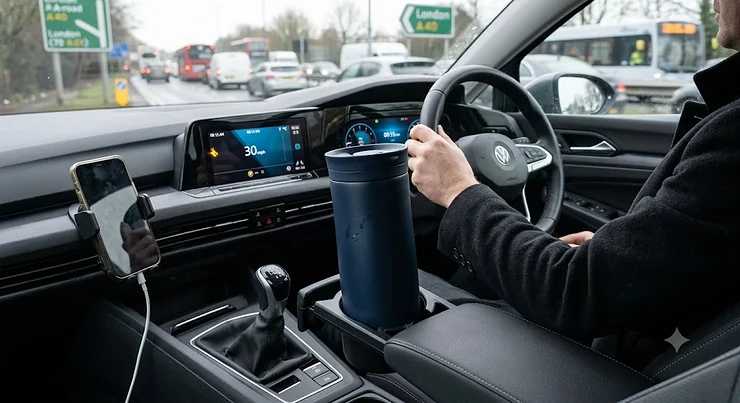
The trouble is, “fits most cup holders” is one of the most abused phrases on any product page, and the get-out clause “most” is doing a lot of quiet work. Car cup holders in the UK range from a snug 64mm up to a generous 90mm-plus in some SUVs, and a mug that glides into a Range Rover’s holder can rattle around uselessly — or simply not go in at all — in a Fiat 500 or a Ford Fiesta. That’s why dimensions matter more than marketing copy.
This guide cuts through it with seven real, currently available mugs, each measured, each honestly assessed against genuine buyer feedback, and each slotted into a clear use case — from the narrowest options for tiny holders to bigger tumblers for drivers who don’t compromise on capacity. Independent testers at Which? have reached a similar conclusion after putting rival mugs through leakproof and insulation testing: fit and function vary far more between brands than glossy packaging ever admits. We’ll cover the actual base diameters, what “slim” really means in millimetres, and how to read a listing so you don’t end up gifting your cup holder a coaster instead of a coffee.
Quick Comparison: Travel Mugs at a Glance
| Mug | Base Diameter | Capacity | Best For |
|---|---|---|---|
| rCUP | 64mm | 227ml / 340ml | Narrowest holders, eco-conscious buyers |
| Lifeventure Thermal Mug | 68mm | 300ml | Budget workhorse, tight cup holders |
| Regatta Thermulate Insulated Tumbler | ~72mm | 600ml | Best value, big drinkers on a budget |
| Lifeventure One-Touch Thermal Mug | ~72mm | 350ml | One-handed sipping, updated seal |
| Contigo Byron SnapSeal | 74mm | 470ml | Mid-range all-rounder, single-serve brewers |
| Chilly’s Series 2 Coffee Cup | 77mm | 340ml | Style-led buyers who double-check dimensions |
| Stanley Adventure Quencher H2.0 | ~79mm | 887ml (30oz) | Maximum capacity that still clears most holders |
Just one click — help others make better buying decisions too!😊
Looking at the spread above, the pattern is obvious: base diameter and capacity pull in opposite directions. The rCUP and Lifeventure Thermal Mug sit at the narrow end because they’re designed around a takeaway-cup silhouette, while the Stanley Adventure Quencher H2.0 trades some cup-holder margin for nearly triple the liquid. If your car has the more common 70-76mm holder, the Contigo Byron SnapSeal or Lifeventure One-Touch give you the best balance of room and capacity without living dangerously close to the edge.
✨ Don’t Miss These Exclusive Deals!
🔍 Take your morning commute to the next level with these carefully selected travel mugs. Click on any highlighted item to check current pricing and availability. These slim-fit mugs will help you create a spill-free daily routine your dashboard will thank you for!
What Is a Travel Mug That Fits a Car Cup Holder?
A travel mug that fits a car cup holder is an insulated drinking vessel with a tapered or narrow base — typically between 64mm and 79mm — engineered to sit snugly and stably inside a UK vehicle’s built-in holder, rather than the wider tumbler shapes designed primarily for the desk or the gym bag.
That definition matters because most drinkware brands design first for the American market, where cup holders tend to run wider and deeper. Automotive research generally puts standard car cup holder diameters somewhere between roughly 64mm and 89mm, a range built to comfortably hold coffee cups, cans and small bottles across a huge span of vehicle types. UK superminis and hatchbacks often sit at the tighter end of that window, which is exactly why the narrowest mugs on this list earn their place.
Top 7 Travel Mugs That Fit Car Cup Holders: Expert Analysis
1. rCUP — narrowest base on the market
Made from recycled disposable coffee cups and holding either 227ml or 340ml, the rCUP has the tightest base of anything in this roundup, and that single spec explains most of its popularity with small-car owners. Its 64mm base diameter and 84mm lid mean it drops into even the pinched cup holders found in city cars and vans, while the wider lid still gives you a proper mouthful rather than a thimble. The push-button lid opens and closes with one hand, which matters more than it sounds like it should when you’re also indicating and checking a mirror.
Based on the spec comparison, this is the mug to reach for if you’ve already tried two or three “universal fit” tumblers that rattled loose — the narrow base isn’t a happy accident, it’s the entire design brief. Reviewers consistently note that the 360° drinking rim removes the fiddly business of hunting for a specific sip-spot, and the recycled-material story appeals strongly to buyers who want their choice of travel mug to say something about their values, not just their commute.
Pros:
- ✅ Genuinely the narrowest base tested here
- ✅ Made from recycled single-use cups
- ✅ One-handed 360° drinking lid
Cons:
- ❌ Smaller capacity than most rivals
- ❌ Less insulation stamina than premium steel mugs
At around £12-£18, the rCUP is a smart, low-risk buy for anyone whose main complaint has been “nothing fits my car.” If your holder is on the small side, this is very likely the fix.

2. Lifeventure Thermal Mug — no-nonsense workhorse for tight holders
The original Lifeventure Thermal Mug has been a fixture of British car doors and rucksack side-pockets for years, and its 68mm base diameter, drawn from a 70 x 70 x 164mm footprint, puts it firmly in narrow-fit territory. The copper-coated double wall keeps drinks hot for around three hours, which is modest next to some rivals, but the flip-top lid is refreshingly simple — no seals to misalign, no rotating collar to fumble with at a red light.
What most buyers overlook about this model is that its narrow, straight-sided shape (rather than a flared or tapered profile) is precisely what makes it so reliable across different holder shapes; it doesn’t rely on a snug taper to stay upright, it’s just consistently slim from top to bottom. Aggregated review sentiment on major retail sites is strongly positive on durability, with buyers regularly mentioning years of daily use and dishwasher cycles without the seal degrading.
Pros:
- ✅ Consistently slim profile, not just tapered base
- ✅ Simple flip-lid with fewer failure points
- ✅ Years of proven daily-use durability
Cons:
- ❌ Shorter heat retention than vacuum tumblers
- ❌ Smaller 300ml capacity for bigger drinkers
Priced in the £15-£20 range, this is the mug for buyers who’d rather have something predictable and cheap to replace than a feature-packed lid that eventually leaks.
3. Regatta Thermulate Insulated Tumbler — unbeatable value, road-test approved
The 0.6-litre Regatta Thermulate Insulated Tumbler punches well above its price bracket, and it isn’t just brand loyalty saying so. Independent testing found the tapered shape “fitted snugly in all our cup-holders,” and the same test crowned it the overall winner among seven rival mugs precisely because it balanced size, insulation and value so well, as reported by Auto Express’s travel mug test.
Here’s what to weigh: the flip-top straw lid keeps both hands mostly off the steering wheel during a sip, since a straw needs less tilting and searching than an open-drink spout. On paper this means less time with your eyes off the road at each mouthful, though obviously no drinking vessel makes it advisable to sip while actively steering through a bend. Reviewers consistently note that the stainless steel body shrugs off scuffs from being lobbed in and out of door pockets, and at this price point that durability is genuinely impressive.
Pros:
- ✅ Independently rated best-in-test for cup holder fit
- ✅ Large 600ml capacity at a budget price
- ✅ Flip-top straw reduces hand movement while sipping
Cons:
- ❌ Bulkier footprint than the narrowest options here
- ❌ Straw lid needs more frequent cleaning
Typically found in the under-£25 range, and often discounted further, this is the pick for anyone who wants Stanley-style capacity without the Stanley-style price tag.
4. Lifeventure One-Touch Thermal Mug — 360° spout for one-handed sipping
The newer Lifeventure One-Touch Thermal Mug builds on the brand’s original formula with a 350ml capacity and a push-click lid offering a 360° drinking spout, so there’s no rotating to find the right angle before you drink. At roughly 72mm across the base, it’s a touch wider than its older sibling but still comfortably inside narrow-holder territory, and the copper-coated double wall now holds heat for up to six hours rather than three — a genuinely useful upgrade for early starts.
Based on the spec comparison, the redesigned seal is the standout change: it locks closed until pressed, rather than relying purely on a lid position, which is exactly the kind of detail that matters when the mug is being jostled in a moving vehicle rather than sat still on a desk. One long-form owner review noted it’s “1mm wider than a standard can” and still clears every cup holder they tried except an aircraft flightdeck mount — a useful, if slightly extreme, benchmark for just how compact this mug really is.
Pros:
- ✅ Improved leakproof push-click seal
- ✅ Doubled heat retention versus the original model
- ✅ Genuinely near-universal cup holder fit
Cons:
- ❌ 350ml is modest for all-day hydration
- ❌ Premium colours cost more than base models
Sitting around £18-£24, this is the natural upgrade pick for existing Lifeventure fans who want better thermal performance without giving up the brand’s narrow-fit reliability.
5. Contigo Byron SnapSeal — one-handed lid, big capacity
The Contigo Byron SnapSeal is one of the most recognisable shapes in UK supermarket drinkware aisles, and its 470ml version measures roughly 74mm across the base — right at the midpoint most UK cup holders are built around. The SnapSeal lid flips open with a single thumb push and needs no twisting or unscrewing, which genuinely changes the calculus for one-handed use compared with screw-top rivals.
The spec sheet won’t tell you this, but user reports suggest fit varies more by vehicle than the marketing implies: several owners note it drops neatly into most modern hatchbacks and saloons, while at least one flagged that in an older MPV the base doesn’t quite reach the bottom of a deeper, narrower holder, occasionally allowing it to tip on sharper corners. That’s a useful reminder that “fits most car cup holders” is a genuine claim on average, not a guarantee for every model. Where it lands well, though, THERMALOCK double-wall insulation keeps drinks hot for roughly six to seven hours, which comfortably covers a full working day.
Pros:
- ✅ Genuine one-handed SnapSeal operation
- ✅ Six-to-seven-hour heat retention
- ✅ Widely available in multiple sizes and colours
Cons:
- ❌ Fit varies more by vehicle than average
- ❌ Lid seal needs periodic replacement over time
Usually priced in the £18-£25 range depending on size and colourway, this is a safe, well-reviewed mid-range choice — just worth double-checking your specific holder depth before buying, especially in older or smaller cars.
6. Chilly’s Series 2 Coffee Cup — style icon, check before you buy
Chilly’s Series 2 Coffee Cup mugs are arguably the trendiest option here, and the 340ml size measures 7.75cm (77.5mm) wide with a 14.45cm height. That’s noticeably wider than the narrowest mugs on this list, and it’s worth stating plainly because Chilly’s own customer support team has openly confirmed that the 340ml cup measures roughly 9cm wide at the top and 7cm wide at the bottom, with the same-diameter 230ml variant, meaning fit depends heavily on where your particular holder is narrowest.
Reviewers consistently note that Chilly’s own community forum contains a steady trickle of frustrated buyers whose cup holders simply won’t accept the base, alongside plenty of happy owners for whom it fits perfectly — a genuinely mixed picture rather than a universal win. What most buyers overlook is that the brand itself now proactively warns customers to check dimensions before a road trip rather than assume compatibility, which is refreshingly honest for a lifestyle brand and worth taking seriously rather than dismissing as small print.
Pros:
- ✅ Market-leading colour and finish range
- ✅ Confirmed hot retention up to several hours
- ✅ Brand transparency about fit limitations
Cons:
- ❌ Wider base than most dedicated car mugs
- ❌ Documented compatibility issues in some vehicles
At around £20-£28, this is the pick for buyers prioritising desk-and-café style as much as car use — just measure your holder first, because this is the one mug on this list where “it depends” is the honest answer.
7. Stanley Adventure Quencher H2.0 — biggest capacity that still fits
For drivers who consider 300-470ml a warm-up rather than a full drink, the Stanley Adventure Quencher H2.0 in its 30oz (887ml) size offers a genuinely different proposition: a roughly 79mm base diameter paired with nearly triple the capacity of the narrowest mugs here. Stanley’s own spec sheet states the design is built to comfortably fit most car and truck cup holders up to this size, and the tapered lower profile is doing the heavy lifting to make that claim credible at this volume.
Key specs with real-world meaning: the rotating FlowState lid offers a straw position, a wide drink opening and a sealed cover, so you can switch between sipping styles depending on whether you’re stationary or moving. Reviewers consistently praise the vacuum insulation for keeping cold drinks icy for the better part of a working day, though several also note that at 40oz (1.18 litres) — one size up from the model recommended here — the base genuinely won’t fit smaller UK cup holders, which is exactly why the 30oz version, not the 40oz, is the sensible car-specific pick.
Pros:
- ✅ Largest usable capacity that still clears most holders
- ✅ Versatile three-position FlowState lid
- ✅ Strong, well-documented insulation performance
Cons:
- ❌ Widest base among the mugs recommended here
- ❌ Heavier and bulkier than sip-and-go options
Typically priced in the £35-£45 range for the 30oz model, this is the premium choice for anyone who values capacity and versatility over squeezing into the very tightest cup holder.
Travel Mug Dimensions and Cup Holder Fit: The Numbers That Matter
Base diameter is the single most useful spec on any listing, yet it’s often buried below capacity and colour options. As a rough working rule, a slim travel mug cup holder compatible with the majority of UK cars needs a base somewhere between 64mm and 76mm; go much beyond that and you’re relying on a wider, deeper holder to make up the difference. A useful reference point that keeps coming up across owner discussions and manufacturer specs is 74mm diameter — roughly where the Contigo Byron SnapSeal sits — because it’s wide enough for a proper grip while still clearing the overwhelming majority of factory-fitted holders.
It’s also worth separating “narrowest travel mug” claims from actual measured data. Several brands describe products as slim without publishing a base measurement at all, which forces buyers to guess. Where a listing gives you height, width and base diameter separately — as Lifeventure and rCUP both do — treat that as a good-faith signal; where a listing only says “fits most cup holders” with no numbers, treat it with more caution, particularly if you drive a smaller hatchback or an older model with shallower moulded holders.
Practical Guide: Setting Up Your New Travel Mug for Car Use
Getting the first few weeks right prevents most of the common complaints. Start by hand-washing before first use, even on dishwasher-safe lids — factory residue can affect the initial seal on push-button and SnapSeal designs. When you first fill it, don’t overfill past the internal fill line; vacuum-insulated mugs need a small air gap to seal properly, and overfilling is one of the most common causes of “leaking” complaints that are really just user error.
For the first 30 days, get into the habit of checking the lid alignment before every drive, not just after refilling. Twist-lock and rotating lids can loosen slightly with vibration over a long journey, and a five-second check at a red light is far cheaper than a lapful of coffee. If your mug uses a silicone gasket, a light smear of food-safe silicone grease every couple of months keeps the seal supple and prevents the small drips that eventually convince people their mug “doesn’t work anymore.” Finally, resist the urge to leave the lid fully sealed for storage between uses — letting it air out between the wash and the next fill avoids the musty smell that’s the most common long-term complaint across nearly every brand on this list.
Real-World Scenarios: Which Mug Fits Your Journey
Consider three drivers with genuinely different needs. First, the daily commuter in a compact hatchback with a factory cup holder barely 70mm across: for them, the rCUP or Lifeventure Thermal Mug removes the daily anxiety of watching a too-wide mug teeter at every roundabout. Second, the long-distance rep who lives in the car for hours at a stretch and wants a single fill to last the whole morning: the Stanley Adventure Quencher H2.0 or Regatta Thermulate Tumbler trade a little cup holder margin for genuinely useful extra capacity and stronger insulation. Third, the parent doing the school run in an SUV with generously sized rear holders for the kids’ bottles but a tighter front console: the Contigo Byron SnapSeal hits a sensible middle ground, wide enough for a proper coffee, narrow enough for most front consoles, and quick enough to open one-handed while checking mirrors.
How to Choose a Travel Mug That Fits Your Car Cup Holder
- Measure your cup holder first, not the mug. Use a tape measure at the narrowest point of the holder, not just the top rim, since many tapered holders are noticeably tighter lower down.
- Treat base diameter as the deciding spec. Capacity and colour are personal preference; base diameter is the only measurement that determines whether the mug physically sits flush.
- Favour straight-sided or gently tapered mugs over flared ones. A mug that’s narrow at the base but flares out sharply above it can still wobble if the holder itself has a deep, narrow well.
- Match capacity to your actual journey length, not your ambition — a 600ml tumbler is wasted if you only ever drink 200ml before it goes cold.
- Check the lid mechanism against your driving style. One-handed push or flip lids suit stop-start urban driving; screw-top lids suit longer, steadier motorway runs where fewer stops mean fewer chances to fumble.
- Read genuine reviews for fit complaints, not just insulation praise. As this guide has shown with the Chilly’s Series 2, brand reputation doesn’t guarantee cup holder compatibility.
- Budget for the lid, not just the mug. Replacement seals and lids vary hugely in price and availability between brands, and that’s a genuine long-term cost most buyers never factor in upfront.
Common Mistakes When Buying a Travel Mug for Your Car
The most frequent error is buying based on capacity alone, assuming a bigger mug is automatically a better one — as we’ve seen, bigger almost always means wider, and wider is the enemy of a snug cup holder fit. A close second is ignoring the base shape: two mugs with an identical stated diameter can behave very differently if one has a flat base and the other a slightly domed or ribbed one that catches on holder ridges. Buyers also frequently skip checking whether their specific car has one universal-sized holder or two different sizes (a common setup in many hatchbacks, with a smaller front holder and a larger rear one), which leads to buying a mug that fits the passenger seat but not the driver’s.
Another overlooked mistake is assuming dishwasher-safe branding covers the whole mug; on most of the models here, only the lid is top-rack safe, and putting the insulated body through a dishwasher can damage the vacuum seal over time, quietly reducing heat retention without any obvious external sign of damage.
There’s a safety dimension buried in this too. Analysis from the Royal Society for the Prevention of Accidents notes that in-vehicle distraction, including fumbling with drinks, remains a contributory factor in thousands of recorded UK collisions each year — one more reason a mug that seats properly first time, without repeated adjustment, is worth the extra few pounds.
Long-Term Cost & Maintenance: What You’re Really Paying For
A £12 mug that needs replacing every eight months isn’t necessarily cheaper than a £35 mug that lasts five years, and this is where total cost of ownership becomes genuinely useful. The Lifeventure Thermal Mug and rCUP, priced at the lower end here, both have simple, low-part-count lids that are cheap to live with even without official spare parts, since there’s less to fail. The Stanley Adventure Quencher H2.0, despite its higher upfront price, benefits from a wide network of official spare lids and gaskets, which matters more over a five-year ownership period than it does in year one.
Where cost creeps up unexpectedly is with the Contigo and Chilly’s ranges, both of which use more complex sealing mechanisms; when they eventually degrade, official replacement parts aren’t always stocked continuously, and buyers sometimes end up replacing the entire mug rather than just the failed component. Factoring in a realistic three-to-five-year lifespan, the simplest mechanisms on this list generally offer the lowest true cost per year, even if their sticker price looks unremarkable next to flashier rivals.
Features That Actually Matter (And Those That Don’t)
Base diameter, lid mechanism reliability, and genuine (not marketing-only) insulation duration are the three specs worth prioritising, because they directly affect whether the mug works in your specific car every single day. Colour range, branded packaging, and capacity headline figures matter far less than they appear to on a product page; a 40oz capacity is meaningless if the base is too wide for your holder, and a striking colourway doesn’t change how the seal performs at 70mph over a pothole.
One feature that’s genuinely worth paying attention to, despite rarely being headline material, is whether the lid is designed for true one-handed operation or merely “easier than a screw cap.” The difference between a SnapSeal-style push lid and a rotating collar sounds trivial until you’re trying to operate either while indicating right at a roundabout — in that moment, the design difference is the whole point.
Driving Safely While Using a Travel Mug
Even the best-fitting mug doesn’t remove the responsibility to drive with full attention. Under the Highway Code, drivers are reminded that concentration is the foundation of safe driving, and the guidance is explicit that eating and drinking are among the distractions drivers should avoid whenever possible, as set out in the official Highway Code guidance. It isn’t specifically illegal to sip a drink at the wheel in most circumstances, but if that distraction contributes to a loss of control, careless driving charges are a real possibility.
Road safety research backs this up with hard numbers rather than vague caution. One widely cited American study found that eating, drinking or spilling occupied a notable share of total driving time among the drivers observed — more than many drivers would guess. A well-fitting mug reduces the physical fumbling that causes a driver’s eyes to leave the road, but it’s a risk-reduction tool, not a licence to treat every red light as coffee time.
Frequently Asked Questions
❓ What size travel mug fits most car cup holders?
❓ Does a wider travel mug always mean more insulation?
❓ Why doesn't my Chilly's cup fit my car cup holder?
❓ Is it legal to drink coffee while driving in the UK?
❓ How do I measure my car's cup holder correctly?
Conclusion
Chasing the right travel mug that fits car cup holder dimensions properly isn’t about finding the single “best” mug in the abstract — it’s about matching genuine measurements to your specific car. The rCUP and Lifeventure Thermal Mug solve the problem for tight, narrow holders; the Regatta Thermulate Tumbler and Stanley Adventure Quencher H2.0 solve it for drivers who want serious capacity without giving up fit entirely; and the Contigo Byron SnapSeal sits comfortably in the middle for most everyday cars. The one clear lesson from the Chilly’s Series 2 entry is that style and cup holder compatibility don’t always arrive together, so a five-minute tape-measure check before you buy is worth more than any amount of marketing copy.
Get the base diameter right, treat the lid mechanism as seriously as the insulation figures, and your next long drive can finally involve a coffee that stays exactly where you put it.
✨ Don’t Miss These Exclusive Deals!
🔍 Ready to upgrade your commute? Check current pricing and availability on the mug that matches your car’s cup holder, and make spilled coffee a thing of the past!
Recommended for You
- Best Commuter Mug in 2026: 7 Genuinely Spill-Proof Picks Reviewed
- How to Choose a Leakproof Travel Mug: 7 Tested Picks (2026)
- Leakproof Travel Mug 2026: 7 Picks That Won’t Betray Your Bag
Disclaimer: This article contains affiliate links. As an Amazon Associate, I earn from qualifying purchases. If you purchase products through these links, we may earn a small commission at no additional cost to you.
✨ Found this helpful? Share it with your friends! 💬🤗
