
In This Article
Open your cupboard. Go on. If the espresso cups are wedged behind the mixing bowls, balanced on a saucer that doesn’t match, or lurking in a cardboard box from a long-forgotten gift set, this article is for you.
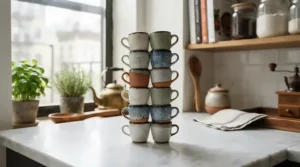
So, what are stackable espresso cups? They are small coffee cups, usually 60-100ml, built so each one nests or stacks neatly on the next. They save shelf height and cupboard footprint without giving up the ritual of a proper shot. Many sets add a rack or stand, so the whole collection can live on a worktop as a tidy tower instead of a jumble.
Why does that matter in a British kitchen? Because our kitchens are small. Between galley layouts, flats with a single wall of units and the quiet rise of minimalist kitchens, every centimetre of shelf has to earn its keep. Space-saving espresso cups are a modest fix, but modest fixes are often the ones people actually keep using.
A traditional demitasse, as Wikipedia’s entry on the demitasse notes, typically holds around 60-90ml, and the Italian Espresso Institute suggests a white china cup of 50-100ml for serving. That small, fixed size is exactly why stacking works so well here. Cups this tiny are uniform, light and easy to nest.
I’ve pulled together seven real options, from budget porcelain sets with a stand to café-grade stacking ranges and a stainless steel outlier. Each gets honest analysis of what the specs mean in practice, plus the review themes worth knowing. Availability on amazon.co.uk varies by model and seller, so check each listing before you buy.
Quick Comparison Table: Stackable Espresso Cups at a Glance
| Product | Material | Approx. Size | Format | Indicative Price Range | Best For |
|---|---|---|---|---|---|
| Sweese Stackable Espresso Cups | Porcelain | 2.5oz (~75ml) | 4 cups, saucers, metal stand | Budget (check current price) | Best all-rounder for small kitchens |
| Houseables Espresso Cup Set | Porcelain | 2.5oz (~75ml) | 6 cups, saucers, spoons, stand | Budget (check current price) | Hosting and dinner parties |
| RCR Cristalleria Caffè Stackable Espresso Cups | Crystal glass | 80ml | Pack of 12 | Mid-range (around £40-£50 at trade retailers at the time of research) | Watching the crema, big households |
| Olympia Whiteware Stacking Espresso Cups | Vitrified whiteware | 85ml (3oz) | Café-style multipacks | Mid-range | Durability, daily use |
| Steelite Simplicity White Stacking Espresso Cups | White ceramic | 100ml | Café-style multipacks | Mid to premium | Longevity, minimalist kitchens |
| Churchill Whiteware Stackable Maple Espresso Cups | Whiteware | 114ml | Café-style multipacks | Mid-range | Larger shots, lungos, small cortados |
| YETI Rambler 4 oz Stackable Cup | Stainless steel | 4oz (~118ml) | Individual cups | Premium per cup | Outdoors, camping, caravans |
Reading across this table, the Sweese Stackable Espresso Cups and Houseables Espresso Cup Set are the obvious entry points. They give you a complete, ready-to-use arrangement for a low outlay. If you care about heat retention and wear over years rather than months, the café-grade Olympia Whiteware Stacking Espresso Cups and Steelite Simplicity White Stacking Espresso Cups sit in a different category. The YETI Rambler 4 oz Stackable Cup is the wildcard, and it only makes sense if your espresso routine leaves the house.
💬 Just one click — help others make better buying decisions too!😊
Top 7 Stackable Espresso Cups: Expert Analysis
A quick note on method. I haven’t physically tested these cups, so you won’t find invented anecdotes here. What follows is analysis based on published specifications and listing details, plus the themes that tend to recur in buyer feedback for each type of product. Where I couldn’t verify a robust pool of reviews for a specific model, I say so.
1. Sweese Stackable Espresso Cups — best all-round starter set
The headline feature is the combination of porcelain cups, saucers and a metal stand, which means the “storage” part of the equation arrives in the box.
The cups hold 2.5oz (about 75ml), squarely in demitasse territory. That is enough for a single or a short double, but not enough for a long lungo. The metal stand is the real selling point for space-saving espresso cups: it lifts the whole set off the worktop footprint and puts it on display.
Based on the spec sheet, this is a set for home baristas who want a complete setup without buying pieces separately. It particularly suits someone in a flat with limited wall units, where a visible, tidy tower beats a cupboard shelf you have to excavate.
On reviews, I couldn’t verify a large, consistent pool at the time of research. For sets like this, buyers typically comment on the price-to-looks ratio and, occasionally, on the stand’s stability with a full load of saucers. Check the current ratings and recent reviews before ordering.
Pros:
- ✅ Cups, saucers and metal stand included
- ✅ Compact footprint suits small kitchens
- ✅ Classic porcelain look at a budget price
Cons:
- ❌ Only four cups, tight for entertaining
- ❌ 75ml too small for lungo drinkers
Price range and verdict: budget territory, so check the current price. For most single-person and couple households, it’s strong value.
2. Houseables Espresso Cup Set — best for hosting more than four
Where the Sweese Stackable Espresso Cups stop at four, this set brings six cups, six saucers, six spoons and a stand rack.
The cups are listed as 2.5oz porcelain, and the listing describes them as lead-free and microwave, oven and freezer safe. Treat those claims as manufacturer statements rather than gospel, and read the care instructions on the listing and the packaging. In practice, “microwave safe” is mostly useful for a quick top-up of a cooled shot, while freezer safety is a curiosity unless you make espresso ice cubes.
My take: the spoons are a thoughtful extra, since a demitasse spoon is precisely the sort of thing that goes missing from a kitchen drawer. The rack is the key to the compact kitchen storage angle, because it turns an awkward pile of crockery into a single vertical object.
Review sentiment was thin when I looked. The data I saw was a modest set of ratings, so I’d rather say that plainly than dress it up. Check the live listing for recent feedback on packaging and breakage in transit, which is the common worry for ceramic sets.
Pros:
- ✅ Six full place settings in one set
- ✅ Spoons included, rarely a given
- ✅ Rack keeps everything together
Cons:
- ❌ Rack needs worktop or shelf space
- ❌ Limited verified review data
Price range and verdict: budget-friendly, so check the current price. It’s good value if you actually entertain.
3. RCR Cristalleria Caffè Stackable Espresso Cups — crystal glass, 12 to a box
This is the glass option, and the standout is clarity. Crystal glass lets you watch the layers settle, which is half the theatre of a good shot.
According to the manufacturer’s description, the cups hold 80ml, have a thick base to help retain heat and a fine rim for comfortable drinking, and come with an ergonomic handle. They’re dishwasher safe and the range is described as 100% recyclable. The stackable body is aimed squarely at maximising storage.
Here’s what the spec sheet won’t tell you: thick-based glass is a trade-off. It holds heat better than thin glass, but it will never match ceramic’s warmth in the hand. If you drink your espresso quickly, the difference barely matters. Because it’s sold in packs of 12, it also suits households that host regularly, or anyone who simply breaks cups.
I couldn’t verify a trustworthy volume of independent reviews for this exact pack. General feedback on glass espresso cups tends to centre on visual appeal and the occasional chip or cloudiness after many dishwasher cycles.
Pros:
- ✅ Crystal clarity shows off the espresso layers
- ✅ Dishwasher safe, easy daily care
- ✅ Pack of 12 suits busy households
Cons:
- ❌ Glass can chip with rough stacking
- ❌ Less warmth in hand than ceramic
Price range and verdict: around £40-£50 for twelve at a trade retailer at the time of research, so expect Amazon pricing to vary. The cost per cup is low if you need quantity.
4. Olympia Whiteware Stacking Espresso Cups — café-proven durability
These are the sort of cups you’ll have seen in a thousand independent cafés, and that’s the point. Olympia’s stacking whiteware is designed to survive commercial service, so a domestic kitchen is a gentler life.
The listed capacity is 85ml (3oz). That sits neatly in the 60-100ml range the Italian guidance suggests for espresso, and it’s generous enough for a double ristretto. Whiteware designed for commercial use tends to be thicker and more chip-resistant than decorative sets, which is useful if your cups share a dishwasher with everything else.
My take: the reason to choose these is longevity, not looks. There’s no stand included, so storage depends on you. A simple stack on a shelf works fine, and you can add a small rack or tray yourself. Availability on amazon.co.uk can vary between sellers and pack sizes, so check which format you’re actually buying.
Review data specific to this model wasn’t something I could verify directly. The wider trade feedback on commercial whiteware is typically about reliability and ease of replacement, which matters when you want to add to a set years later.
Pros:
- ✅ Commercial-grade build tolerates daily dishwasher use
- ✅ 85ml suits singles and short doubles
- ✅ Easy to buy matching extras later
Cons:
- ❌ No stand or rack included
- ❌ Plain look, not very decorative
Price range and verdict: mid-range, so check the current price. It’s good value over years of use.
5. Steelite Simplicity White Stacking Espresso Cups — minimalist design with staying power
If your kitchen leans minimalist, this is the cup that disappears into the aesthetic. Plain white, clean lines, nothing shouting for attention.
The listed capacity is 100ml, at the upper edge of the espresso range. That makes it a flexible choice: roomy for a double, comfortable for a small macchiato, and still sensible for a standard shot. The stacking design is built for hospitality storage, which in a domestic setting translates to tall, stable piles that don’t topple.
What most buyers overlook is how much a plain, repeatable design helps a small kitchen. When every cup is identical, there is no puzzle about which saucer goes where. For minimalist kitchens and open shelving, that visual calm is worth real money.
I couldn’t confirm detailed independent review data. For professional-grade Steelite ranges, the common refrain is durability, though also a price premium over homeware-brand sets. Treat that as a general theme, not a verified verdict on this specific listing.
Pros:
- ✅ Clean, minimalist look suits open shelves
- ✅ 100ml handles doubles comfortably
- ✅ Hospitality-grade durability
Cons:
- ❌ Costs more than basic homeware sets
- ❌ No stand included
Price range and verdict: mid to premium, so check the current price. It’s worth it if you value longevity and a quiet aesthetic.
6. Churchill Whiteware Stackable Maple Espresso Cups — a bigger pour for long shots
At 114ml, this is the roomiest cup in the roundup. That sits above the classic demitasse range, so it’s best seen as a cup for people who like their coffee a little longer.
The extra volume is useful in three ways. It handles a lungo, it takes a small cortado, and it leaves headroom so you don’t slop a double over the rim while carrying it. The trade-off is that a 114ml cup holding a single 30ml shot will look and feel lost, and the coffee will cool faster in all that empty space.
My take: this suits people who are on the fence between espresso cups and small mugs. If you pull milky drinks occasionally, it’s the sensible compromise. If you only ever drink straight shots, step down to the Olympia Whiteware Stacking Espresso Cups or the Sweese Stackable Espresso Cups.
Verified review data was limited. As with other commercial whiteware, the typical praise is robustness, with the occasional note that the colour or glaze may differ slightly between batches if you reorder later.
Pros:
- ✅ 114ml handles lungos and small cortados
- ✅ Stackable whiteware stores compactly
- ✅ Sturdy build for daily use
Cons:
- ❌ Oversized for single shots
- ❌ Loses heat faster with small pours
Price range and verdict: mid-range, so check the current price. It’s good value if you drink longer coffees.
7. YETI Rambler 4 oz Stackable Cup — the stainless steel outsider
This is the odd one out, and it’s here deliberately. Stainless steel changes the question from “how does it look on the shelf?” to “how does it survive a rucksack?”
Per its name, it’s a 4oz (roughly 118ml) stackable cup. Stainless construction means it won’t shatter if dropped on a campsite or in a caravan, and the stacking design keeps a set compact in a camping box. Steel also means you lose the porcelain feel and the visual crema display of glass.
Here’s the honest analysis: unless you’re a regular camper, or a caravan, campervan or boat owner, it isn’t the right fit for a kitchen cupboard. For small kitchens at home, the porcelain and whiteware options are cheaper, quieter on a saucer and kinder to the palate. For outdoors, though, the logic flips.
I couldn’t verify a broad review base for this cup specifically. The YETI brand is generally noted for durability, but price per cup is high, so it’s a considered purchase.
Pros:
- ✅ Unbreakable, ideal for camping and travel
- ✅ Stackable body packs down small
- ✅ Tough enough for outdoor kitchens
Cons:
- ❌ Pricey per cup for home use
- ❌ Steel feels cold against the lips
Price range and verdict: premium per cup, so check the current price. It’s good value only if you take your coffee outdoors.
Stackable Espresso Cups Compared Side by Side
Now to line up what actually changes day to day. The table below translates the specs into storage and use.
| Product | Storage Style | Heat Retention | Durability | Best For |
|---|---|---|---|---|
| Sweese Stackable Espresso Cups | Stand included | Good (porcelain) | Moderate | Starter setups |
| Houseables Espresso Cup Set | Rack included | Good (porcelain) | Moderate | Hosting six |
| RCR Cristalleria Caffè Stackable Espresso Cups | Self-stacking | Moderate (thick-base glass) | Moderate | Crema watchers |
| Olympia Whiteware Stacking Espresso Cups | Self-stacking | Good (thick whiteware) | High | Daily use |
| Steelite Simplicity White Stacking Espresso Cups | Self-stacking | Good (thick whiteware) | High | Minimalist shelves |
| Churchill Whiteware Stackable Maple Espresso Cups | Self-stacking | Moderate (larger volume) | High | Longer shots |
| YETI Rambler 4 oz Stackable Cup | Self-stacking | Variable | Very high | Outdoors |
The pattern is clear. Sets that include a stand, such as the Sweese Stackable Espresso Cups and the Houseables Espresso Cup Set, buy you tidiness and display. Café-grade ranges, such as the Olympia Whiteware Stacking Espresso Cups and the Steelite Simplicity White Stacking Espresso Cups, buy you durability. If you only want one recommendation, a starter set with a stand covers most households, and a café-grade range is the long-term upgrade.
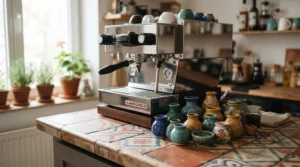
Transformation Guide: How to Set Up Compact Kitchen Storage Around Your Cups
Buying cups is the easy bit. Making them genuinely save space takes a little planning, and most listings won’t tell you how.
Step 1: Decide stand or stack. If you have a spare 15-20cm of worktop, use a stand and keep the cups visible. If worktop space is sacred, stack in the cupboard.
Step 2: Use vertical height. A stack of six cups typically takes up a very small footprint. Use that height by placing the stack on a shelf with headroom, rather than burying it beneath bowls.
Step 3: Add a shelf riser. A cheap two-tier riser doubles a cupboard shelf’s usable area. Put cups and saucers on the top tier and mugs on the bottom.
Step 4: Protect the glaze. Slip a small piece of kitchen paper or a thin felt pad between cups if you’re stacking ceramic. It stops the base ring scratching the interior glaze over time.
Step 5: Keep spoons with the stack. A small pot or dish by the stack stops teaspoons wandering.
A typical first-month mistake is stacking too high. Beyond about six to eight cups, a pile becomes top-heavy and one careless reach topples the lot. Two stacks of four are safer than one stack of eight.
Transformation Guide: Real-World Scenarios for Small Kitchens
Specs only matter in a real kitchen. Here are three buyer profiles and the sensible match for each.
The studio-flat solo drinker. One person, one wall of cupboards, an espresso machine on the worktop. The Sweese Stackable Espresso Cups are the natural fit: four cups is plenty, and the stand keeps the footprint predictable. If you drink daily, the saved shelf space is the real benefit.
The couple who entertain on Saturdays. Six guests is a normal dinner party, and four cups isn’t enough. The Houseables Espresso Cup Set covers six, with spoons. After dinner, you carry the whole rack to the table in one go, then stack it away again.
The design-conscious minimalist. Open shelves, a monochrome palette, nothing out of place. The Steelite Simplicity White Stacking Espresso Cups keep the look calm. If cost is a concern, the Olympia Whiteware Stacking Espresso Cups are a quieter alternative.
For budget, frequency and environment, the rule of thumb is simple. Buy a set with a stand if you’re short of cupboard space, and buy café-grade cups if you drink several a day.
Transformation Guide: Problems and Practical Solutions
Problem: The stack keeps toppling. Solution: limit stacks to six, use a rack, or stack cups on a small non-slip mat. A stand like the one with the Sweese Stackable Espresso Cups solves this by design.
Problem: Cups stick together after washing. Solution: let them dry fully before nesting. Trapped moisture between ceramic surfaces can create a suction effect and leave marks.
Problem: Saucers take up more room than cups. Solution: store saucers on their sides in a dish rack, or in a slim vertical organiser. Alternatively, choose a saucer-free range like the Churchill Whiteware Stackable Maple Espresso Cups.
Problem: Chips on the rim. Solution: commercial-grade options such as the Olympia Whiteware Stacking Espresso Cups resist chipping better than thin decorative porcelain, and a felt pad between cups helps further.
Problem: Cups go cold too quickly. Solution: warm them with hot water before pulling a shot. This works for every material, but thick whiteware and porcelain benefit most.
How to Choose Stackable Espresso Cups
Choosing the right stackable espresso cups comes down to six decisions, in roughly this order.
- Measure your storage first. Measure shelf height and depth before you fall for a design. A cup that nests beautifully is no use if the stack won’t fit under your shelf.
- Pick your volume. For straight shots and short doubles, 60-100ml is right. For lungos or small milky drinks, look at 100-115ml, like the Churchill Whiteware Stackable Maple Espresso Cups.
- Choose your material. Porcelain feels classic. Whiteware is tougher. Glass shows off the shot. Steel survives outdoors.
- Decide on a stand. Sets with racks, like the Houseables Espresso Cup Set, keep things tidy. Sets without them are better if you prefer to stack in cupboards.
- Check the care instructions. Look for dishwasher-safe claims, and microwave claims if you need them.
- Count your cups. Four suits a couple. Six suits a small dinner party. Twelve suits a regular host, like the RCR Cristalleria Caffè Stackable Espresso Cups pack.
One more tip: feature lists love to promise things that don’t matter. A decorative pattern won’t improve your espresso. A thick base, a comfortable handle and a stable stack will.
Common Mistakes When Buying Stackable Espresso Cups
Buying on looks alone. A gorgeous cup with a thin wall can chip within weeks. Check the material and thickness before you fall in love.
Ignoring handle size. Many demitasse handles are small, so check the handle will fit your fingers comfortably. If you have larger hands, look for a more generous, ergonomic handle.
Forgetting saucers. A set might look cheap until you realise you need to buy saucers separately. Always check what’s included.
Choosing the wrong volume. Too large, and a shot looks lost. Too small, and a double overflows. Match the cup to your usual drink.
Skipping the care label. “Microwave safe” and “dishwasher safe” are not universal. Read the listing, and the packaging, before you stick something in the machine.
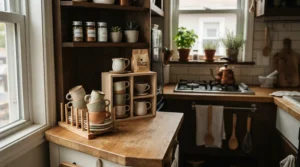
Stackable Espresso Cups for Small Kitchens and Minimalist Kitchens
If you live with small kitchens, you already know the rule: everything has to justify its place. Cups are a surprisingly easy win. A cup that stacks takes a fraction of the vertical space of cups on hooks or loose on shelves.
Cupboard storage is the first battleground. Standard mugs are wide, awkward and don’t nest. Compact demitasse cups, by contrast, can live in a single narrow stack. A single column of six cups can fit in a gap you’d otherwise waste.
For minimalist kitchens, the logic is aesthetic as well as practical. Plain white cups, like the Steelite Simplicity White Stacking Espresso Cups or the Olympia Whiteware Stacking Espresso Cups, keep sightlines clean. A stand like the one with the Sweese Stackable Espresso Cups makes the cups a deliberate display rather than clutter.
Consider the stacking cup design as well. The best designs have a recessed base that sits inside the rim of the cup below, which locks the stack in place. Cheaper designs sometimes just balance, which is why they topple. If you can see a shaped foot on the base in the product photos, that’s a good sign.
Stackable vs Traditional Espresso Cups
Are stackable cups better than a traditional set? It depends on what you value.
| Feature | Stackable | Traditional |
|---|---|---|
| Storage footprint | Compact | Bulkier |
| Display value | Often high with a stand | Varies |
| Durability | Often commercial-grade options | Often decorative |
| Matching extras | Easy to add (café ranges) | Often discontinued |
| Best For | Small kitchens | Gifting, collectors |
On storage and practicality, stackable cups clearly win. Traditional sets still have a role: they tend to be more decorative, and they make better gifts. If you’re choosing for daily use in a tight space, stackable is the sensible default, and a café-grade range like the Steelite Simplicity White Stacking Espresso Cups gives you the best chance of being able to buy matching cups years later.
Long-Term Cost and Maintenance
The cheapest set isn’t always the cheapest over five years. Cost per use matters, and so does replacement.
A budget set like the Sweese Stackable Espresso Cups has a low outlay, but thin porcelain may chip sooner. If a cup breaks every year, the cost climbs. A café-grade range like the Olympia Whiteware Stacking Espresso Cups costs more up front but is designed for commercial dishwashers, so the cost per use drops over time.
For glass, the RCR Cristalleria Caffè Stackable Espresso Cups pack of 12 works out cheaper per cup than most small sets, and the dishwasher-safe claim reduces hassle. Just note that repeated dishwasher cycles can cloud glass over time.
Maintenance is straightforward. Rinse promptly so coffee oils don’t stain, dry before stacking, and avoid abrasive scourers on glazes. If staining appears, a soak in warm water with a little baking soda usually lifts it.
Safety, Regulations and Compliance
Not every cup is made the same way, so it’s worth knowing the basics. In Great Britain, ceramic items that touch food are subject to rules that limit how much lead and cadmium can migrate from the ceramic into food. The relevant rules are set out in legislation, including the Ceramic Articles in Contact with Food regulations, which also require declarations of compliance as products move through the supply chain up to retail.
What does that mean for you? Practically, buy from reputable sellers who can show compliance. Be cautious with unbranded, very cheap ceramics, especially brightly glazed decorative pieces, and check that listings say the cups are intended for food and drink.
Also check the care guidance. “Oven safe” and “freezer safe” claims, like the ones on the Houseables Espresso Cup Set listing, are the manufacturer’s statements. Follow the instructions, avoid thermal shock, and don’t take any cup straight from freezer to boiling water.
FAQ
❓ Are stackable espresso cups worth it for a small kitchen?
❓ What size should stackable espresso cups be?
❓ Can stackable espresso cups go in the dishwasher?
❓ Do stackable espresso cups come with saucers?
❓ Are glass or ceramic stackable espresso cups better?
Conclusion
Stackable espresso cups are one of those small purchases that quietly improve a kitchen. They solve a genuine problem, the awkward, unstackable pile of tiny cups, without demanding a renovation or a new cupboard.
If you want a single, sensible starting point, the Sweese Stackable Espresso Cups give you cups, saucers and a stand at a budget price. If you entertain, the Houseables Espresso Cup Set covers six. If you want to watch the shot, the RCR Cristalleria Caffè Stackable Espresso Cups bring glass clarity in a pack of 12. For durability, the Olympia Whiteware Stacking Espresso Cups and Steelite Simplicity White Stacking Espresso Cups are the long-term picks. The Churchill Whiteware Stackable Maple Espresso Cups suit longer drinks, and the YETI Rambler 4 oz Stackable Cup is for those who take espresso outdoors.
Whichever you choose, measure your shelf, match the volume to your usual drink and check the care instructions. For more background on how the drink itself works, Wikipedia’s espresso article is a handy reference. Then enjoy that small, satisfying ritual, minus the cupboard chaos.
Recommended for You
- Espresso Cups Under £15: 7 Best Picks Worth Buying (2026)
- Espresso Cups For Home Baristas: 7 Ultimate UK Picks (2026)
- Porcelain vs Ceramic Espresso Cups: 7 Essential Picks (2026)
Disclaimer: This article contains affiliate links. As an Amazon Associate, I earn from qualifying purchases. If you purchase products through these links, we may earn a small commission at no additional cost to you.
✨ Found this helpful? Share it with your friends! 💬🤗
