In This Article
The best camping mugs are tough, food-safe drinking vessels designed for life outdoors. A good one balances three things: how long it keeps a drink hot, how much it adds to your pack weight, and how well it shrugs off drops, dents and campsite washing-up. Which of those matters most depends entirely on how you camp.
Here’s the thing. A mug is the cheapest item in your kit and the one you’ll touch most. Every dawn brew, every late-night hot chocolate, every “one more” cup by the stove. Get it wrong and you’ll nurse a lukewarm tea in a mug that scorches your fingers. Get it right and the whole trip feels a notch more civilised.
The clever bit is mostly physics. Double-walled insulation traces back to Sir James Dewar’s 1890s vacuum flask, where an evacuated gap between two walls slows heat escaping. Modern stainless steel camping mugs borrow that trick. Titanium and plastic mugs take a different route, trading warmth for lightness.
So this guide sorts the field properly. I’ve researched seven real mugs sold in the UK in 2026, spanning budget, mid-range and premium, and interpreted their specs against controlled test data published by outdoor testers. Along the way you’ll get a camping mug buying guide, a straight answer on campsite versus backpacking use, and a look at mug durability, pack weight and wider outdoor drinkware. Prices appear as ranges only, so check current listings before you buy.
Quick Comparison Table: Best Camping Mugs at a Glance
| Mug | Weight | Capacity | Construction | Price range | Best For |
|---|---|---|---|---|---|
| Lifeventure Insulated Mountain Mug | 258g | 350ml | Double-walled stainless steel | £15-£20 | All-round value |
| CamelBak Thrive 500ml | 412g | 500ml | Double-walled stainless steel | £30-£40 | Leakproof car camping |
| GSI Infinity Backpacker Mug | 106g | 518ml | Insulated polypropylene | £15-£20 | Big-capacity lightweight trips |
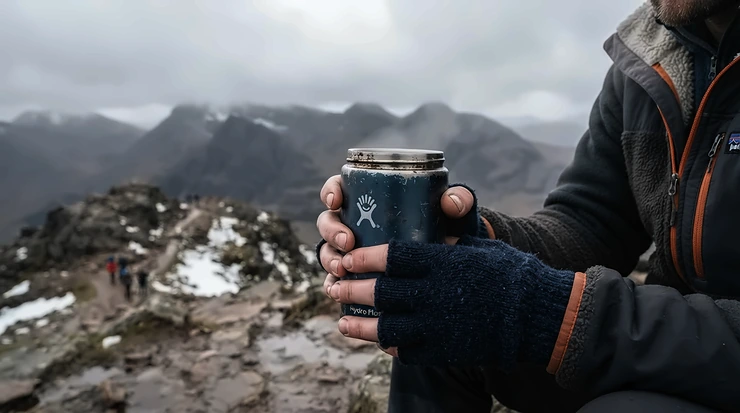
| Hydro Flask 12oz Coffee Mug | 328g | 355ml | Double-walled 18/8 stainless steel | £25-£35 | Best lid to drink from |
| Stanley Classic Legendary Camp Mug | 293g | 354ml | Double-walled stainless steel | £25-£35 | Easy cleaning, dishwasher-safe |
| Yeti Rambler 14oz Stackable Mug | 456g | 414ml | Double-walled stainless steel | £25-£35 | Toughness, family use |
| TOAKS Titanium 450ml Cup | 76g | 450ml (nominal) | Single-wall titanium | Check current listing | Ultralight trips and stove use |
Looking at the table, the Lifeventure Insulated Mountain Mug is the sensible all-rounder for most UK campers. The GSI Infinity Backpacker Mug and TOAKS Titanium 450ml Cup are what you’d choose when every gram counts. The CamelBak Thrive 500ml and Yeti Rambler 14oz Stackable Mug are car-camping heavyweights that trade weight for capacity and toughness. One honest caveat: I haven’t handled these mugs myself. Every figure here comes from manufacturer specs and published tests, chiefly Live for the Outdoors’ controlled comparison, and I couldn’t verify aggregate amazon.co.uk star ratings, so check those on the listing.
💬 Just one click — help others make better buying decisions too!😊
Top 7 Best Camping Mugs: Expert Analysis
1. Lifeventure Insulated Mountain Mug — best value double-wall for most campers
The standout here is a double-walled mug costing roughly half what several rivals do, while topping the heat-retention charts.
At 258g with a 350ml capacity, it’s among the lightest double-walled metal mugs in Live for the Outdoors’ test. That matters, because a lighter mug is one you’ll actually pack rather than leave in the boot. In that test, boiling water inside was still 41°C after two hours, the warmest of the insulated mugs measured, and 53°C after one hour. In practice, your brew stays properly hot for the time it takes to drink it, even if the fire distracts you.
Based on the spec comparison, this suits budget-conscious families, first-time campers and anyone who’d rather spend on a better sleeping bag. The trade-off is refinement. The handle is thin and the lid’s plastic tabs and seal look like possible long-term weak points.
Tester feedback is positive on performance and value, with the durability question flagged as a worry rather than a proven fault. The tester reported no problems across a couple of months of use.
Pros:
- ✅ Excellent heat retention for the price
- ✅ Light for a double-walled mug
- ✅ Lid slider clips off for cleaning
Cons:
- ❌ Thin handle, not the most comfortable
- ❌ Lid tabs and seal may age quickly
Price range: around £15-£20 at the time of research. Value verdict: superb, arguably the best cost-per-degree of warmth in this list.
2. CamelBak Thrive 500ml — only truly leakproof screw-in lid
If you’ve ever watched a rucksack pocket fill with cold tea, the screw-in lid is the headline. Every other mug in the Live for the Outdoors test simply presses into place.
The 500ml capacity is generous, and the spec sheet hides a sting: fill it and you’re carrying close to a kilogram. The mug alone weighs 412g. What you get for that weight is real thermal muscle. In the same test the water read 51°C after an hour and 40°C after two, just 1°C behind the Lifeventure. It also won the ice test, with 20g of ice left after three hours.
Then there’s the everyday stuff that spec sheets rarely mention. The soft handle is grippy and appears replaceable, since it unscrews. A protective bumper on the base adds grip and knock-resistance. The lid’s slider can be taken apart for cleaning, and the whole mug is dishwasher-safe.
Who’s it for? Car campers, van-lifers and anyone who wants a mug that survives being tossed in a tote bag. It’s less suited to multi-day hikes, where those extra grams add up quickly.
Reviewers in the test called out easy cleaning, sturdy grip and great thermal performance, with weight and cost as the main grumbles.
Pros:
- ✅ Genuinely leakproof screw-in lid
- ✅ Huge 500ml capacity
- ✅ Dishwasher-safe with a removable slider
Cons:
- ❌ Heavy once filled, nearly a kilogram
- ❌ Expensive compared with similar mugs
Price range: roughly £30-£40 at the time of research. Value verdict: fair if leakproofing and grip matter, overkill if they don’t.
3. GSI Infinity Backpacker Mug — lightest big-capacity option
Here’s the plot twist in the weight column: 106g for a mug that holds around 518ml. That’s a bigger capacity than any metal option in this list, wrapped in a foam-insulated sleeve of recycled plastic cloth.
The material is BPA-free polypropylene. It won’t match stainless steel for warmth, and the numbers show it. In Live for the Outdoors’ controlled test, the drink dropped to 60°C in ten minutes, 45°C at half an hour and 31°C after an hour. The lesson is to pour, sip and enjoy within 30-45 minutes. If you’re a slow, lingering drinker, look elsewhere.
What you gain is practicality. The lid stayed leak-free when closed, even upside down, though the tester wouldn’t recommend packing it full. Cleaning is simple, with few moving parts, but it’s hand-wash only. Two quirks stand out: the fabric handle wobbles under a full mug, and a bubble occasionally forms over the drinking hole, briefly stopping the flow.
I’d point this at ultralight walkers and cyclists who want a big, forgiving mug that barely registers in the pack.
Tester feedback praised the low weight and easy cleaning, and criticised the handle stability and heat retention.
Pros:
- ✅ Lightest mug in the test at 106g
- ✅ Large capacity of around 518ml
- ✅ Lid stays closed without leaking
Cons:
- ❌ Fabric handle isn’t stable when full
- ❌ Cools faster than double-walled steel
Price range: around £15-£20 at the time of research. Value verdict: excellent for weight-conscious trips.
4. Hydro Flask 12oz Coffee Mug — nicest lid to drink from
Some mugs are engineered. This one feels designed. The curved lip lets drinks flow smoothly into your mouth, and Live for the Outdoors’ tester named it one of their favourite lids.
At 328g with a 355ml capacity, it’s on the heavier side, but around 100g lighter than the CamelBak and Yeti. Thermal numbers were strong: 71°C after ten minutes, 49°C after an hour and 37°C after two. In the ice test, it kept 10g of ice after three hours. The construction is 18/8 stainless steel, which in practice means good rust resistance for damp UK campsites.
The handle is comfortable, like a standard kitchen mug. The lid isn’t fully leakproof, so treat it as splash-resistant while you potter round the pitch rather than something to leave on its side. Cleaning takes a little brute force to pop the slider off, and Hydro Flask recommends hand washing.
I’d recommend it to campers who care how a mug feels every single morning. Based on the spec comparison, the premium here buys refinement rather than raw performance, because the cheaper Lifeventure keeps drinks warmer.
Tester feedback was upbeat about the lid and handle, and lukewarm on price.
Pros:
- ✅ Lid is particularly pleasant to drink from
- ✅ Comfortable, conventional handle
- ✅ Strong two-hour heat retention
Cons:
- ❌ Not cheap for its capacity
- ❌ Hand wash only, fiddly slider
Price range: roughly £25-£35 at the time of research. Value verdict: good, but you’re paying for feel.
5. Stanley Classic Legendary Camp Mug — simple, sturdy, dishwasher-friendly
Stanley’s brand shot into the spotlight through social media. Its heritage, though, is rugged simplicity, and this mug shows it. There’s no sliding mechanism, just a lid with a permanent drinking gap.
That design has consequences. Tip it on its side and liquid dribbles out, so it isn’t spill-proof. The upside is cleaning: no crevices to harbour grime, and the whole mug is dishwasher-safe. The tester also noted a bubble forming over the opening now and then, which can send more tea out than you planned. Take care with hot drinks.
At 293g and 354ml, it sits comfortably mid-pack. Heat readings were 68°C after ten minutes, 57°C after 30 minutes, 45°C after an hour and 34°C after two. The tester noted it works well for cold drinks too, with 15g of ice left in the ice test. The handle’s harsh angles are the main comfort complaint.
For families who wash up in a campsite block or take the mug home to the dishwasher, that simplicity is a genuine selling point. Ultralight hikers can safely skip it.
Tester feedback: good heat retention and easy cleaning, with an inconsistent flow rate and a slightly harsh handle.
Pros:
- ✅ Good heat retention for its weight
- ✅ Simple lid is easy to clean
- ✅ Dishwasher-safe
Cons:
- ❌ Always-open lid dribbles when tilted
- ❌ Handle edges are a bit harsh
Price range: around £25-£35 at the time of research. Value verdict: solid if you value simplicity.

6. Yeti Rambler 14oz Stackable Mug — built like a tank
Yeti’s reputation rests on toughness, and this mug embodies it. Live for the Outdoors’ tester called it solid and durable, with an ergonomic handle that allows a stable grip.
The catch is weight. At 456g, it’s the heaviest mug in the test, and with its 414ml filled you’re pushing towards a kilogram. That’s fine on a car-camping pitch, and less fine on the Pennine Way. Thermal performance was strong: 69°C after ten minutes, 47°C after an hour, 35°C after two, and 8g of ice left after three hours.
The lid uses a magnetic slider that pulls off for cleaning, and the whole mug is dishwasher-safe. The tester found the ridges and channels around the seal awkward to clean, and the lid isn’t fully leakproof. Liquid dribbles out if you turn it upside down, though it’s more than adequate against tent spills. The stackable design is a useful bonus in a cluttered cupboard.
What most buyers overlook is that the heaviness is a feature for a certain camper: someone who wants one mug to last for years of family trips.
Reviewers called out durability and comfort, while asking whether it’s a lot to pay for a mug.
Pros:
- ✅ Very solid and durable build
- ✅ Comfortable, stable handle
- ✅ Dishwasher-safe with a magnetic slider
Cons:
- ❌ Heaviest mug in the test
- ❌ Premium price for a mug
Price range: roughly £25-£35 at the time of research. Value verdict: worthwhile for heavy-duty, long-term use.
7. TOAKS Titanium 450ml Cup — 76g and ready for the stove
This is the odd one out, and deliberately so. It’s a single-wall titanium cup weighing just 76g, with folding handles and engraved oz/ml graduations. It fits inside larger TOAKS pots and a 27oz Klean Kanteen bottle.
What single-wall means in practice is important. There’s no insulation, so drinks cool quickly, a point Packstack’s long-form review makes. But because it’s plain, uncoated titanium, you can heat water directly in it. It’s the only mug here suited to real stove work. TOAKS sells a separate double-wall version and warns that it shouldn’t be used for cooking.
There are limits. A Trailspace reviewer found the 450ml label optimistic, with 375-400ml usable before spillage. The same reviewer said the handles went slightly wonky after long daily use. Packstack’s review echoed the thin-wall trade-off, so mug durability is decent but not indestructible.
I’d choose this for solo backpackers who want one item that is both mug and cooking vessel. Keep in mind a lighter 0.3mm version exists, at around 48g.
Pros:
- ✅ Just 76g, barely noticeable in a pack
- ✅ Can heat water directly on a stove
- ✅ Foldable handles and internal graduations
Cons:
- ❌ Bare titanium cools drinks quickly
- ❌ Real capacity falls short of the label
Price range: UK pricing varies by seller, so check the current listing. Value verdict: superb for gram-counters, less so for slow sippers.
How the Seven Compare on Heat Retention
The table below uses figures from Live for the Outdoors’ controlled test, where 200ml of boiling water was left outside with lids fitted.
| Mug | After 10 minutes | After 1 hour | After 2 hours |
|---|---|---|---|
| Lifeventure Insulated Mountain Mug | 74°C | 53°C | 41°C |
| CamelBak Thrive 500ml | 70°C | 51°C | 40°C |
| Hydro Flask 12oz Coffee Mug | 71°C | 49°C | 37°C |
| Yeti Rambler 14oz Stackable Mug | 69°C | 47°C | 35°C |
| Stanley Classic Legendary Camp Mug | 68°C | 45°C | 34°C |
| GSI Infinity Backpacker Mug | 60°C | 31°C | 19°C |
| TOAKS Titanium 450ml Cup | Not in this test | Not in this test | Not in this test |
Look at the spread between best and fifth: just 7°C after two hours. That suggests the four premium-priced steel mugs offer marginal thermal gains over the Lifeventure, so you’re paying for lids, handles and brand. The GSI Infinity falls behind, but its 45°C reading at half an hour is still perfectly drinkable. And the TOAKS simply plays a different game, where weight and stove-safety matter more than warmth.
Camping Mug Buying Guide: How to Choose the Best Camping Mugs
Any camping mug buying guide should start by admitting that specs mislead. A “keeps hot for 12 hours” claim is a lab number. Live for the Outdoors’ buying advice rightly says such claims need a pinch of salt. So here’s how to choose the best camping mugs, step by step:
- Decide your trip type first. Car camping tolerates 400g+ mugs. Backpacking rarely does.
- Set a weight ceiling. A weight-conscious hiker might aim for under about 150g, which points to the TOAKS Titanium 450ml Cup or GSI Infinity Backpacker Mug.
- Judge the lid. It should not leak while drinking and it should pour steadily. The CamelBak Thrive 500ml is the only fully leakproof screw lid here.
- Match capacity to habit. A litre of tea weighs a kilogram before the mug. Ask whether you’ll really drink that.
- Match insulation to drinking speed. If you finish drinks in 15 minutes, big insulation numbers are wasted.
- Check handle and stability. Advnture notes that wider, squatter mugs with handles are more stable than tumblers.
- Consider washing. The Yeti Rambler 14oz Stackable Mug, CamelBak Thrive 500ml and Stanley Classic Legendary Camp Mug are dishwasher-safe. The Hydro Flask 12oz Coffee Mug and GSI Infinity Backpacker Mug are hand wash only.
✨ Ready to Upgrade Your Campsite Brew?
🔍 Take your camping mornings to the next level with these carefully selected mugs. Click on any highlighted item to check current pricing and availability. Whether you’re after a stove-safe cup or a leakproof workhorse, you’ll find a mug that keeps every brew worth drinking!

Campsite Versus Backpacking Use: Which Mug Belongs in Your Kit?
The phrase campsite versus backpacking use sounds like a technicality. It’s actually the main decision. Let’s run three profiles.
The weekend family. Two adults, two children, a campsite in the Lakes, six nights a year, a budget of around £60 for four mugs. Weight is irrelevant, breakages aren’t. Four Lifeventure Insulated Mountain Mugs would fit that budget, or a mix with the Stanley Classic Legendary Camp Mug for dishwasher-friendly duty at home.
The multi-day walker. Solo, twenty nights a year on long-distance paths, packing at the margin. Every gram counts, so the TOAKS Titanium 450ml Cup at 76g is the logical choice. Someone who prefers a bigger, gentler mug for slow mornings could swap in the GSI Infinity Backpacker Mug.
The van-lifer. Mugs live in a cupboard that bounces down A-roads. Here the CamelBak Thrive 500ml and Yeti Rambler 14oz Stackable Mug make sense, with the Hydro Flask 12oz Coffee Mug as a nicer-to-drink-from alternative.
Notice the pattern. Nobody is choosing the “best” mug in absolute terms. They’re choosing the mug whose weaknesses don’t matter to them.
Best Mugs for Campsite Cooking: What Can Actually Go on the Heat?
Searching for the best mugs for campsite cooking? The list narrows quickly. Most insulated mugs are strictly for drinking. They have sealed double walls, and the maker of the TOAKS double-wall version explicitly says it isn’t suitable for cooking or direct heat. Apply the same logic to any sealed double-wall design and check the manufacturer’s instructions first.
Plastic is out too. Live for the Outdoors poured boiling water into every mug in its test, including the plastic GSI Infinity Backpacker Mug, but pouring hot water is not the same as holding one over a flame.
That leaves single-wall titanium, and the TOAKS Titanium 450ml Cup is the clear pick among the seven. It’s uncoated and lightweight, and Packstack’s reviewer noted it boils fast.
Practical tips for cooking with it:
- Plan for around 375-400ml of usable volume rather than the 450ml label.
- Use a towel or glove when hot, since titanium cools quickly but the rim can bite.
- Pour into an insulated mug afterwards if you want the brew to stay hot.
Fires are a separate issue. The Countryside Code asks you to light fires or barbecues only where signs allow, so a stove is the safer bet.
Pack Weight: What Your Mug Really Costs You
Pack weight is a game of accumulation. The mug rarely breaks a rucksack, but it sits alongside your stove, pot, bottle and food. A useful measure is grams of mug per millilitre of drink.
| Mug | Price range | Mug weight | Grams per ml |
|---|---|---|---|
| TOAKS Titanium 450ml Cup | Check current listing | 76g | 0.17 |
| GSI Infinity Backpacker Mug | £15-£20 | 106g | 0.20 |
| Lifeventure Insulated Mountain Mug | £15-£20 | 258g | 0.74 |
| CamelBak Thrive 500ml | £30-£40 | 412g | 0.82 |
| Stanley Classic Legendary Camp Mug | £25-£35 | 293g | 0.83 |
| Hydro Flask 12oz Coffee Mug | £25-£35 | 328g | 0.92 |
| Yeti Rambler 14oz Stackable Mug | £25-£35 | 456g | 1.10 |
The insulated steel mugs cluster between roughly 0.7 and 1.1g per ml, while the titanium and plastic options are four to five times lighter. Put another way, the TOAKS and GSI Infinity cost you a fraction of the weight for every sip. Just remember what you give up: warmth.
99Boulders’ backpacking mug guide suggests double-wall titanium models typically cost more and weigh 1-2 ounces more than single-wall ones. That’s worth remembering if you’re tempted by a hybrid.
Mug Durability: What Survives a Season of Abuse?
Mug durability is really a question about the weakest part. In metal mugs, that’s rarely the metal. Live for the Outdoors points to lids as the likely failure point, with plastic tabs, seals and sliding parts all being candidates.
That makes the Lifeventure Insulated Mountain Mug an interesting case. Its tester said it was the metal mug they’d worry about most, given thinner walls and lid tabs, though nothing failed in months of testing. The Yeti Rambler 14oz Stackable Mug earned “solid and durable” in the same review. The CamelBak Thrive 500ml adds a base bumper and a replaceable-looking handle, both sensible longevity features.
Plastic options like the GSI Infinity Backpacker Mug are lighter, but the test notes plastic is more prone to cracking when jammed in a packed car.
Titanium is strong for its weight, but thin by design. Packstack’s long-term testing of a TOAKS pot found some warping after hundreds of meals, and while a mug isn’t a pot, the lesson is that thin metal ages. Treat the TOAKS Titanium 450ml Cup kindly and it should last.
Outdoor Drinkware Showdown: Mugs vs Flasks vs Tumblers
Outdoor drinkware is a crowded aisle, so which format fits which job? Advnture points out that an insulated mug with a handle holds less than a tumbler but is wider and more stable, and Live for the Outdoors suggests using an insulated flask, not a mug, for anything going in a bag.
| Type | Typical weight | Heat retention | Stove-safe? | Best For |
|---|---|---|---|---|
| Insulated steel mug | 290-460g in this list | Strong (34-41°C after 2 hours) | No | Car camping, e.g. Yeti Rambler 14oz Stackable Mug |
| Single-wall titanium | 76g | Weak | Yes | Backpacking and cooking, e.g. TOAKS Titanium 450ml Cup |
| Insulated plastic | 106g | Moderate (19°C after 2 hours) | No | Ultralight sipping, e.g. GSI Infinity Backpacker Mug |
| Flask or tumbler (not featured) | Varies | Usually stronger | No | Bags and long days out |
Looking at the table, mugs win on stability and social feel, while flasks win when the drink must travel. For many UK campers the best answer is one mug and one flask. The mug lives on the picnic table and the flask goes on the walk.

Practical Usage Guide: First Use, Cleaning and Care
A few habits will extend the life of any of these mugs.
Before first use: wash by hand, then rinse thoroughly. If your mug is insulated, pre-warm it with a splash of hot water for a minute, then tip it out. It’s an old trick that costs nothing, and it stops the metal absorbing the first burst of heat.
Cleaning: remove sliders wherever possible. The CamelBak Thrive 500ml‘s slider comes apart, the Yeti Rambler 14oz Stackable Mug‘s is magnetic, and the Lifeventure Insulated Mountain Mug‘s clips off. The Hydro Flask 12oz Coffee Mug needs a firmer tug. Dry everything fully before storing.
Dishwashers: trust the manufacturer. The Stanley Classic Legendary Camp Mug, Yeti Rambler 14oz Stackable Mug and CamelBak Thrive 500ml are described as dishwasher-safe in testing. The GSI Infinity Backpacker Mug and Hydro Flask 12oz Coffee Mug aren’t.
Common first-30-days mistakes:
- Filling to the brim, then sprinting across the pitch.
- Leaving milky tea in the mug overnight.
- Storing with the lid sealed, which traps odours.
- Assuming an insulated mug can go on the stove.
Problem → Solution Guide: Common Camping Mug Headaches
My tea goes cold too fast. Pre-warm the mug and keep the lid on. If you’re still losing heat, move up to something like the Lifeventure Insulated Mountain Mug or CamelBak Thrive 500ml.
It leaks in my bag. Most camping mugs aren’t meant to be packed full. Live for the Outdoors says as much. If leakproofing matters, the screw lid on the CamelBak Thrive 500ml is the safest bet.
The flow sputters. The test noticed a bubble forming over the opening on several lids, including the Stanley Classic Legendary Camp Mug, Yeti Rambler 14oz Stackable Mug and GSI Infinity Backpacker Mug. Tilt gradually and sip rather than gulp.
The lid is grimy. Choose a slider that comes off, as on the CamelBak Thrive 500ml, or a simple always-open lid like the Stanley Classic Legendary Camp Mug.
The mug is too hot to hold. That’s the trade-off with single-wall metal. The TOAKS Titanium 450ml Cup needs a towel or glove, while double-walled mugs stay cool on the outside.
Campsite Etiquette and Safety: Fire, Litter and the Countryside Code
A mug is a small thing, but the habits around it matter. The government’s Countryside Code asks visitors to take litter and food waste home, and it treats dropping litter as a criminal offence. Tea bags, coffee grounds and dregs count.
Hot drinks are also the most common scald risk in camp. Keep mugs away from tent doors and children’s paths, and choose stable, wide-based mugs where kids are involved.
On fires, the Code says to only use barbecues where signs say you can. A stove and a heat-safe mug like the TOAKS Titanium 450ml Cup is usually the more responsible choice.
Access rules vary across the UK, so check local guidance before wild camping. Scotland’s access rights differ from England and Wales, where landowner permission is generally needed outside Dartmoor.
Long-Term Cost and Value: What Each Mug Really Costs Per Use
Price tags mislead. Imagine a mug used on thirty nights a year for five years. That’s 150 uses. A £30 mug costs about 20p per use, and a £15 one costs about 10p. Even the priciest mug in this guide costs pennies per brew, so the real question is whether the extra features earn their keep.
For a family, the Lifeventure Insulated Mountain Mug wins on value per person. For someone who camps constantly and hates leaks, the extra outlay on the CamelBak Thrive 500ml is defensible. Its replaceable-looking handle and dishwasher compatibility also reduce the hassle over time.
The Yeti Rambler 14oz Stackable Mug is a purchase for people who want a mug they’ll never think about again. The Hydro Flask 12oz Coffee Mug and Stanley Classic Legendary Camp Mug sit between those poles.
Total cost of ownership also includes replacing lids and mugs that fail. That’s why mug durability, especially lids, is worth weighing when you compare price ranges. A cheaper mug that lasts three seasons can still beat a premium one bought for its badge.
FAQ
❓ What are the best camping mugs for the money?
❓ Can I put a camping mug on a stove?
❓ Are insulated camping mugs worth it over titanium?
❓ How heavy should a backpacking mug be?
❓ Which camping mugs are dishwasher-safe?
Conclusion
So, which of the best camping mugs should you buy in 2026? Here’s the short version.
For most UK campers, the Lifeventure Insulated Mountain Mug is the sensible answer: light for a double-wall mug, warm for hours and kind to the wallet. If leakproofing and grip matter more than weight, the CamelBak Thrive 500ml justifies its premium. The Yeti Rambler 14oz Stackable Mug rewards buyers who want something built to be ignored for years, while the Hydro Flask 12oz Coffee Mug and Stanley Classic Legendary Camp Mug appeal to those who value lid feel or easy cleaning.
If pack weight rules your life, the GSI Infinity Backpacker Mug brings capacity at 106g. The TOAKS Titanium 450ml Cup is the answer for campsite cooking and gram-counting, as long as you accept it won’t hold a brew’s warmth.
Remember the bigger picture. Match the mug to the trip, think about the lid, and treat mug durability as a lid question first. And whatever you choose, take your litter home. Prices and availability change often, so check current listings before you buy.
✨ Your Next Brew Awaits!
☕ Ready to find your perfect camping mug? Click on any highlighted product to check current pricing and availability, and make your next campsite morning a warm one!
Recommended for You
- Best Lidded Mugs for Office: 7 Spill-Proof Picks (2026)
- Best Colour Changing Mugs UK: 7 Top Heat Reveal Picks (2026)
- Best Novelty Mug Gift Set: 7 Top UK Picks for 2026
Disclaimer: This article contains affiliate links. As an Amazon Associate, I earn from qualifying purchases. If you purchase products through these links, we may earn a small commission at no additional cost to you.
✨ Found this helpful? Share it with your friends! 💬🤗
