In This Article
So you’ve narrowed your shortlist down to KeepCup glass vs brew which is better, and now you’re standing in that slightly ridiculous position of overthinking a coffee cup. Fair enough — you’ll pick this thing up fifteen times a day, every single day, for years. It deserves more thought than the average kitchen purchase, not less.
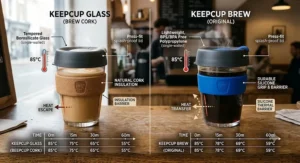
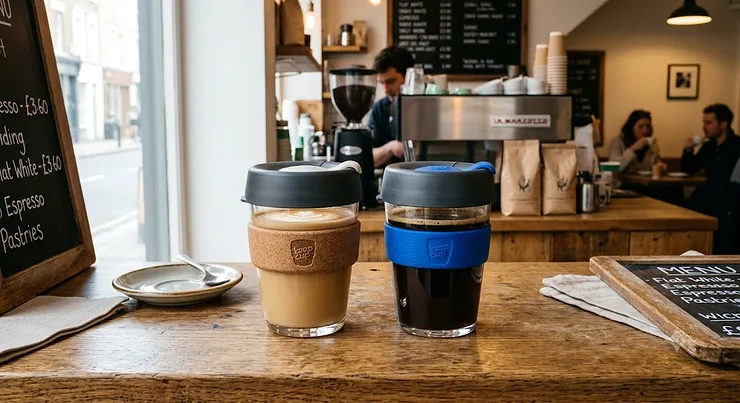
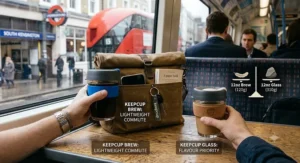
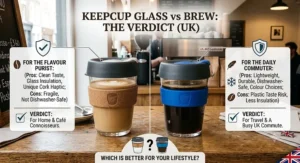
Here’s the quick version. KeepCup glass is the cup you buy for flavour purity — tempered soda-lime glass carries nothing forward from yesterday’s espresso, and it feels genuinely lovely against your lip. KeepCup Brew Original, the lightweight BPA-free plastic line, is the cup you buy for the knocks, drops and general chaos of daily commuting, at a friendlier price. Neither is objectively “better” — they’re built for different tolerances of risk and reward, and the right answer depends on where your cup actually spends its life: your desk, your rucksack, or the floor of a moving train.
What most buyers overlook is that this decision isn’t really about coffee snobbery — it’s about durability economics and how honestly you’ll rate your own clumsiness. Below, we’ve pulled together real specifications, genuine aggregated review sentiment, and honest use-case analysis across seven real KeepCup products spanning tempered soda-lime glass, silicone-banded plastic, and insulated steel, so you can match the cup to your actual routine rather than to a marketing photo.
Quick Comparison Table: KeepCup Glass vs Brew at a Glance
| Factor | KeepCup Glass Range (Brew) | KeepCup Original (Brew Plastic) | Best For |
|---|---|---|---|
| Material | Tempered soda-lime glass, cork or silicone band | 50% recycled Tritan plastic, BPA/BPS-free | Depends on priority |
| Taste purity | Excellent — glass carries no residual flavour | Very good, though very early use can carry a faint plastic note | Brew Glass 12oz for flavour purists |
| Drop resistance | Moderate — will chip or shatter on hard floors | High — flexes and survives most drops | Original for commuters |
| Weight | Heavier, roughly 230-280g filled | Noticeably lighter, easier one-handed carry | Original for bags and prams |
| Typical price | around £20-£30 | around £10-£16 | Original on a tight budget |
Looking at the table, the honest takeaway is that KeepCup Brew Glass wins decisively on the sensory side of the experience — nothing beats drinking coffee from a material that doesn’t hold onto flavour — while KeepCup Original wins on resilience and value, which matters enormously if your cup travels loose in a bag or gets handed to a toddler. Reviewers on the KeepCup site and Amazon consistently flag the glass line’s “pure taste” as its defining trait, while the plastic Original earns its praise for surviving daily abuse that would crack a glass cup outright.
💬 Found a favourite already? Save this comparison before you scroll — you’ll want it when you’re deciding between sizes below.
Top 7 KeepCup Products: Expert Analysis
We’ve researched seven real, currently available KeepCup products spanning budget, mid-range and premium price points, across all three of KeepCup’s core materials — glass, BPA-free plastic and insulated steel — so this comparison actually answers the glass-vs-brew question rather than dodging it.
1. KeepCup Brew Glass 12oz — purest coffee flavour of the range
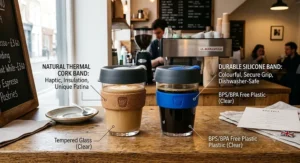
The KeepCup Brew Glass 12oz is the cup most people picture when they type “KeepCup glass” into a search bar, and it earns that reputation honestly. Built from tempered soda-lime glass with a lightweight silicone grip band, it holds 340ml — KeepCup’s “most popular” size — and comes with a splashproof press-fit lid rather than a fully sealed one. In practice, that means the glass itself is chemically inert, so a flat white poured this morning tastes identical to one poured last Tuesday, something plastic and steel struggle to guarantee after months of daily washing.
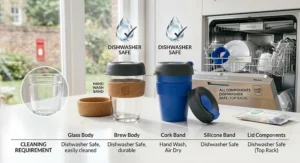
Based on the spec comparison, this is the pick for anyone who’s ever complained that a travel mug makes their coffee taste “off” — the tempered soda-lime glass resists the scratching and staining that eventually taints plastic. Reviewers consistently report that the silicone band is genuinely dishwasher-safe and easy to remove for a proper clean, which is more than can be said for the cork-banded version below.
Pros:
- ✅ Tempered glass carries zero residual flavour long-term
- ✅ Silicone band is fully removable and dishwasher-safe
- ✅ Splashproof lid and parts are individually replaceable
Cons:
- ❌ Heat retention is modest — under an hour before noticeably cooling
- ❌ Glass will chip or crack on a hard floor drop
Typically priced in the £20-£26 range, the KeepCup Brew Glass 12oz represents solid value if your cup mostly travels between desk, kitchen and car — anywhere a serious drop is unlikely.
2. KeepCup Brew Cork 12oz — warmest grip and most tactile finish
The KeepCup Brew Cork 12oz shares the same tempered glass body as the Brew Glass but swaps the silicone band for a natural cork one, and that single change transforms both the feel and the practicality of the cup. The cork band adds genuine thermal insulation to the hand — you can hold a fresh flat white without wincing — and gives the cup a warmer, more premium aesthetic that several independent reviewers describe as feeling closer to café ceramic than to a “travel” product at all.
Here’s what to weigh before buying: because the cork band is bonded on rather than removable, this cup needs careful hand-washing rather than a dishwasher cycle, and the cork will visibly age with use. One detailed product review noted the band “will certainly deteriorate with use” even while praising how the cup “looks and feels fantastic” — an honest trade worth knowing about upfront rather than discovering after your first wash cycle ruins the finish.
Pros:
- ✅ Cork band adds real insulation against hot drinks
- ✅ Premium, café-style tactile finish and grip
- ✅ Same pure-tasting tempered glass as Brew Glass
Cons:
- ❌ Cork band is non-removable and hand-wash only
- ❌ Cork visibly wears and darkens with repeated use
At around £20-£26, the KeepCup Brew Cork 12oz suits buyers who value how a cup feels in the hand as much as what it does — home workers and slow-morning types rather than frantic commuters.
3. KeepCup Original 12oz Plastic — best budget-friendly BPA-free daily driver
If the “brew” half of your search was really asking about KeepCup’s plastic cup, this is it. The KeepCup Original 12oz Plastic is made from Tritan Renew — roughly half recycled content — and is explicitly BPA, BPS and phthalate-free, the entry point that started KeepCup’s reuse movement back in 2009 and remains the cheapest way into the brand.
What most buyers overlook about this model is that its main advantage isn’t the price tag, it’s the forgiveness: this cup survives being dropped in a bag with keys, tossed onto a car seat, or grabbed one-handed while running for a bus, in a way glass simply can’t match. Reviewers do note one honest caveat — the clear plastic can cloud slightly if machine-washed with acidic detergents over many months, so hand-washing is recommended for buyers who want it to stay looking new.
Pros:
- ✅ BPA, BPS and phthalate-free Tritan plastic
- ✅ Lightest cup in the range, easy one-handed carry
- ✅ Genuinely survives daily drops and knocks
Cons:
- ❌ Clear plastic can cloud with frequent dishwashing
- ❌ Lacks the sensory “glass” drinking experience
Usually found in the £10-£16 range, the KeepCup Original 12oz Plastic is, on paper, the best value-per-use cup here for anyone commuting daily on foot, bike or public transport.
4. KeepCup Longplay 12oz — double-wall glass with knock protection
The KeepCup Longplay 12oz is arguably KeepCup’s answer to the glass-vs-brew dilemma itself — it’s tempered glass on the inside, wrapped in a removable clear co-polyester sleeve that adds both heat protection for your hand and a genuine buffer against drops. KeepCup’s own product notes describe it as designed for people who “want the glass experience and the confidence to take it anywhere,” and the spec sheet backs that up: double-wall construction reduces condensation on iced drinks while the sleeve absorbs minor impacts that would otherwise chip bare glass.
Based on the spec comparison, this sits as the natural upgrade path for anyone who read the Brew Glass entry above and thought “I love that, but I’m clumsy.” The trade-off is care complexity — KeepCup explicitly recommends fully disassembling the sleeve after washing to stop moisture pooling between the layers, an extra step the single-wall Brew cups don’t require.
Pros:
- ✅ Retains glass’s pure taste with added drop protection
- ✅ Reduces condensation on iced coffee and cold brew
- ✅ Sleeve and lid components are individually replaceable
Cons:
- ❌ Must be disassembled fully to dry between uses
- ❌ Costs more than single-wall Brew Glass or Cork
Priced around £24-£30, the KeepCup Longplay 12oz earns its premium for buyers who want glass-quality flavour without glass-level fragility anxiety.
5. KeepCup Original 8oz Plastic — best compact size for espresso-based drinks
Sized at 227ml, the KeepCup Original 8oz Plastic is the same BPA-free Tritan build as its 12oz sibling, just scaled down to match a flat white, cappuccino or short Americano rather than a full latte. KeepCup’s own sizing guide frames this as the “specialty coffee size,” and the practical upshot is that baristas can dose your coffee correctly against the internal fill line, avoiding the over-milked mess that happens when a small coffee is poured into an oversized cup.
The honest analytical take here is about portion discipline as much as convenience: reviewers who switched from a 12oz cup to the 8oz version often report they simply drink less milky coffee, and the smaller cup fits car cup holders and small bags where a 12oz would feel bulky. It shares the same clouding caveat as the 12oz plastic model, so treat that as a running theme across the entire Original line rather than a one-off flaw.
Pros:
- ✅ Matches specialty-coffee portion sizes precisely
- ✅ Most compact, bag- and cup-holder-friendly option here
- ✅ Same BPA-free Tritan safety profile as 12oz
Cons:
- ❌ Too small for cold brew or large iced lattes
- ❌ Same long-term clouding risk as larger plastic models
Typically £10-£14, the KeepCup Original 8oz Plastic is the pick for minimalists and short-black drinkers who don’t want to carry more cup than they need.
6. KeepCup Thermal 12oz — insulated stainless steel for long commutes
Stepping outside the glass-vs-plastic debate entirely, the KeepCup Thermal 12oz uses double-wall vacuum-insulated 8/8 electropolished stainless steel, which KeepCup states resists tainting and won’t retain flavour between drinks the way some cheaper steel cups do. Where the Brew and Original lines both cool noticeably within an hour, insulated steel construction like this is built to hold heat — or cold, for iced drinks — for considerably longer, which matters if your “commute” is really a two-hour train journey rather than a ten-minute walk.
What the spec sheet won’t tell you, but real-world use makes obvious, is the compromise: you lose the ability to see your drink, and the sensory pleasure that glass fans specifically buy KeepCup for. Reviewers who prioritise temperature over ritual tend to rate this highly; reviewers who bought into the brand for its glass heritage sometimes find steel a less emotionally satisfying swap.
Pros:
- ✅ Genuinely superior heat and cold retention
- ✅ Steel doesn’t taint flavour or hold onto odours
- ✅ Most impact-resistant material in the range
Cons:
- ❌ Opaque — you can’t see your coffee level
- ❌ Heaviest and among the priciest options tested
Expect to pay around £24-£32, making the KeepCup Thermal 12oz the sensible choice for genuinely long commutes where a cooling drink is the real complaint.
7. KeepCup Commuter 12oz — the only genuinely leakproof option here
Every other cup in this list uses a splashproof press-fit lid, which is fine on a desk but not designed to survive being tipped upside down in a bag. The KeepCup Commuter 12oz solves that specific problem with a fully sealed, leakproof flip lid over an insulated stainless steel body, explicitly marketed by KeepCup as safe to carry loose in a rucksack or handbag.
Here’s what most comparisons miss: “splashproof” and “leakproof” are not interchangeable terms, and if you’ve ever pulled a bag out to find a coffee-stained laptop sleeve, this distinction is the entire reason to consider the Commuter over cheaper Brew or Original models. The trade-off is a more complex lid mechanism with more crevices to clean than a simple press-fit plug, and it sits at the top of this list on price.
Pros:
- ✅ Fully leakproof, unlike splashproof Brew or Original lids
- ✅ Strong insulated heat retention for hot commutes
- ✅ One-handed flip-lid operation while walking or driving
Cons:
- ❌ Most expensive cup in this comparison
- ❌ Flip mechanism has more parts to clean thoroughly
Usually priced around £28-£36, the KeepCup Commuter 12oz is worth the premium specifically for anyone who has been burned — literally — by a leaking travel mug before.
KeepCup Glass vs Brew Plastic: Taste Difference Explained
Let’s clear up a naming confusion first, honestly: KeepCup’s official “Brew” range is actually the glass line (Brew Glass and Brew Cork), while the BPA-free plastic cup is branded “Original.” Plenty of searchers use “brew” loosely to mean whichever cup they use to actually brew and drink their coffee day to day — so this section answers the real question underneath the phrase: does glass genuinely taste different from KeepCup’s plastic?
The honest answer, grounded in material science rather than marketing copy, is yes — but the gap narrows the longer you own the cup. Freshly unboxed, both materials are essentially neutral; KeepCup’s Tritan plastic is specifically engineered to avoid the “plasticky” aftertaste that cheaper reusable cups are notorious for. Over months of daily use, though, plastic is more porous at a microscopic level than tempered glass, and it can pick up faint residual notes from strong espresso or, more commonly, from dishwasher detergent residue. Tempered glass, similar to the soda-lime formulations used across most household glassware, simply doesn’t have that porosity problem, which is why long-term KeepCup owners so often gravitate toward the glass line even after starting on plastic.
What most buyers overlook is that this difference matters far more for black coffee and tea drinkers, who taste subtlety directly, than for milky-drink fans where the milk masks most residual flavour anyway. If you’re a flat-white-every-morning person, the taste argument for glass is weaker than KeepCup’s marketing suggests — but if you drink filter coffee or delicate teas, it’s a genuinely meaningful reason to pay the glass premium.
Is KeepCup Brew Plastic BPA-Free? Safety & Materials Guide
Short answer: yes. Every plastic component across the entire KeepCup range — the Original cup body, the lids, plugs and bands used even on the glass models — is manufactured BPA, BPS and phthalate-free, using Tritan and other food-grade polymers rather than the polycarbonate plastics that historically raised bisphenol A concerns in reusable bottles and cups.
That distinction matters because BPA became a genuine public health talking point over the last two decades, linked by various studies to hormone disruption, which is precisely why “BPA-free” became a standard label across the reusable drinkware industry rather than a marketing gimmick. On paper, this means you can use either the glass or plastic KeepCup daily without the specific chemical-leaching concern that drove many consumers away from older reusable plastics in the first place. It’s also worth noting the wider regulatory backdrop pushing brands toward reusables generally: the UK’s Plastic Packaging Tax specifically targets single-use plastic packaging with low recycled content, which is part of why manufacturers like KeepCup lean so heavily on recycled Tritan and reusability messaging in their product design.
Where honesty compels a caveat: “BPA-free” doesn’t mean “indestructible” or “chemically inert forever.” Reviewers do note that KeepCup’s clear plastic can degrade cosmetically — clouding, minor scratching — after heavy dishwasher use over a year or more, which is a durability issue rather than a safety one, but worth knowing before you assume plastic will look factory-fresh indefinitely.
✨ Ready to compare current KeepCup prices side by side?
Click through on any of the bold product names above to check today’s availability and current pricing on Amazon — prices and stock move quickly on popular sizes.
KeepCup Glass 12oz: Why It’s the Most Popular Size
Across KeepCup’s entire catalogue, the 12oz (340ml) size is consistently the brand’s own bestseller, and the reasoning is refreshingly simple: it matches what most people actually order at a café. KeepCup’s sizing guide describes 12oz as “the café standard for lattes and matchas” — if you’re the sort of person who says “regular, please” rather than specifying an exact size, 340ml is your natural fit.
For the glass line specifically, 12oz strikes a genuine balance the smaller and larger sizes don’t. The 8oz glass options exist but feel restrictive for a full latte, while stepping up to 16oz on the Brew Cork adds meaningful weight and bulk for a material that’s already heavier than plastic. At 12oz, the KeepCup Brew Glass and KeepCup Brew Cork both sit comfortably in most car cup holders and standard bag pockets — KeepCup’s own height spec puts the 12oz Original at roughly 130mm with the lid on, and the glass versions sit close to that footprint.
What most buyers overlook when choosing a size is that going smaller than your usual order isn’t a downgrade — it’s often a genuine upgrade. Several reviewers who deliberately downsized from 16oz to 12oz report drinking less sugary, milky coffee simply because the cup nudges portion control, a small side benefit no spec sheet advertises.
How to Choose Between KeepCup Glass and Brew
- Start with where the cup actually lives. If it mostly sits on a desk or kitchen counter, glass’s fragility barely matters — pick KeepCup Brew Glass or Brew Cork for the taste and feel.
- Be honest about your bag habits. If your cup gets thrown into a rucksack with keys, chargers and a laptop most mornings, the KeepCup Original plastic or KeepCup Commuter steel will outlast glass by years.
- Weigh how long your commute really is. A ten-minute walk barely needs insulation; a train journey over 30 minutes makes the KeepCup Thermal or Commuter genuinely worth the extra spend.
- Match the size to your actual order, not your ambition. Buying a 16oz cup “to be safe” usually just means carrying unnecessary bulk — most people are best served by 8oz or 12oz.
- Decide how much you care about leaks specifically. Every KeepCup except the Commuter uses a splashproof, not leakproof, lid — if you’ve been burned before, that single spec should decide your purchase.
- Consider how you wash dishes. If you never hand-wash anything, the cork band on Brew Cork will frustrate you; the silicone-banded Brew Glass or Original plastic are the dishwasher-friendly choices.
- Price the whole system, not just the cup. Replacement lids and bands are sold separately, so factor a few pounds of ongoing maintenance into whichever material you choose.
Common Mistakes When Buying a KeepCup
The most frequent mistake, by a wide margin, is buying based on aesthetics alone and only discovering the care requirements afterwards — the cork band issue on KeepCup Brew Cork catches out more buyers than any other single spec, precisely because it looks so appealing in product photos without an obvious “hand wash only” warning attached.
A second common error is oversizing. Buyers frequently default to 16oz “to get their money’s worth,” then find the cup too heavy and bulky for daily carry, eventually reverting to a smaller size and effectively buying twice. A related but subtler mistake is assuming “splashproof” means “leakproof” — an assumption that ends, reliably, with a coffee-stained bag and a lesson learned the hard way, as one independent reusable-cup review from a UK environmental charity also flagged when comparing lid designs across brands.
Finally, plenty of buyers skip reading the materials guide entirely and assume all KeepCups share identical care instructions. They don’t — the glass range needs different handling to the plastic Original, and the cork band needs different handling again. Reading the specific care notes for your chosen model before it arrives saves both money and disappointment.
Daily Use Durability: What to Expect Long-Term
Durability is where the glass-vs-brew decision gets most honest, so let’s talk lifespans rather than launch-day marketing. Tempered glass, by design, resists scratching and chemical staining far better than plastic over years of use — but it has one absolute failure mode plastic doesn’t: a hard enough drop breaks it outright, full stop, with no partial-damage middle ground.
KeepCup Original plastic behaves the opposite way. It rarely breaks catastrophically — flexible Tritan plastic tends to survive drops that would shatter glass — but it degrades gradually and cosmetically, picking up light scratches and occasional cloudiness after roughly a year of regular dishwasher use, based on aggregated review sentiment across multiple retailers. Neither failure mode is “worse,” strictly speaking; they’re just different risk profiles that suit different lifestyles.
The double-wall KeepCup Longplay effectively splits the difference by wrapping glass in a protective sleeve, and the steel Thermal and Commuter models sit at the most durable end of the spectrum overall, largely immune to both breakage and cosmetic wear, which is precisely why they command the highest prices in this comparison.
| Durability Factor | Glass (Brew) | Plastic (Original) | Steel (Thermal/Commuter) |
|---|---|---|---|
| Drop resistance | Low — can shatter | High — usually survives | Very high |
| Long-term clarity/finish | Excellent, doesn’t degrade | Can cloud after ~1 year | N/A — opaque |
| Typical realistic lifespan | Years, if not dropped | 1-3 years of daily use | Many years |
| Best For | Desk-based daily use | Active commuters, families | Long journeys, heavy use |
Reading the table plainly: KeepCup Brew Glass rewards careful owners with a cup that essentially never wears out cosmetically, while KeepCup Original and the steel models trade that ceiling for a much higher floor of everyday resilience. Households with young children or genuinely butter-fingered mornings should weight the durability table more heavily than the taste comparison above it.
Practical Usage Guide: Getting the Most from Your KeepCup
Getting a KeepCup to last starts before your first coffee. On unboxing, hand-wash every component once — cup, lid, plug and band — even though several are technically dishwasher-safe, simply to clear manufacturing residue that can otherwise carry a faint plastic taste into your first few drinks.
For the first thirty days, resist the dishwasher for the Brew Cork entirely; hand-wash the glass with warm soapy water and wipe the cork band with a barely damp cloth, letting it air-dry fully before reassembly to prevent mould developing under the band. For silicone-banded glass or plastic Originals, dishwasher use is fine, but placing the cup on the top rack away from direct heating elements meaningfully slows the clouding process reviewers commonly report.
A maintenance habit worth adopting: strip every KeepCup down to its individual parts — cup, band, lid, plug — roughly once a fortnight for a deeper clean, since coffee oils build up invisibly in the lid’s internal channels long before they’re visible to the eye. For the Longplay, this fortnightly strip-down isn’t optional; KeepCup explicitly warns that skipping it traps moisture between the glass and its outer sleeve. One optimisation trick most owners never discover: replacement lids and bands are sold individually on KeepCup’s own site, so a cracked lid doesn’t mean buying an entirely new cup — often the single most cost-effective fix available.
Real-World Scenarios: Which KeepCup Suits Your Routine
The desk-based remote worker. If your coffee cup travels no further than kitchen to home office, durability against drops matters far less than daily enjoyment. The KeepCup Brew Cork genuinely earns its premium here — the tactile grip and pure glass flavour are wasted on nobody when the cup never leaves a five-metre radius.
The daily bus-and-train commuter. Someone covering a 40-minute mixed commute needs both leak protection and heat retention, which points firmly toward the KeepCup Commuter or KeepCup Thermal — the insulated steel bodies hold temperature across a full journey, and the sealed lid removes the anxiety of a bag-based leak entirely.
The budget-conscious student or parent. Someone buying their first reusable cup, or replacing one lost by a toddler, doesn’t need premium materials yet — the KeepCup Original 8oz or 12oz Plastic delivers genuine BPA-free daily practicality at the lowest entry price in the range, with enough drop resistance to survive a school run without drama.
Problem → Solution: Fixing Common KeepCup Complaints
Problem: my plastic KeepCup has gone cloudy. Hand-wash going forward rather than machine-washing, and avoid leaving it to soak in strong detergent; existing cloudiness is largely cosmetic and doesn’t affect food safety, but switching to the KeepCup Brew Glass avoids the issue entirely if it bothers you.
Problem: my coffee goes cold too fast. Splashproof glass and plastic KeepCups simply aren’t built for heat retention beyond about an hour; the fix isn’t a different washing routine, it’s switching material entirely to the insulated KeepCup Thermal or Commuter.
Problem: the cork band on my Brew Cork is deteriorating. This is expected wear rather than a fault — hand-wash gently, keep it away from prolonged soaking, and treat visible ageing as part of the material’s natural character rather than a defect to chase a refund over.
Problem: my cup leaked in my bag. This almost always means a splashproof lid was mistaken for a leakproof one — the genuine fix is switching to the KeepCup Commuter, the only model in this comparison with a fully sealed lid.
Problem: I keep losing the little silicone plug. Order a spare directly from KeepCup’s parts store rather than replacing the whole lid or cup — it’s the single cheapest fix across the entire range.
Long-Term Cost & Maintenance: Is KeepCup Worth It?
Judged purely on upfront price, a disposable paper cup habit looks cheaper than any reusable cup on this list — until you actually run the maths across a working year. A daily takeaway habit of roughly 230 working days, even accounting for the growing number of cafés offering a small reusable-cup discount, adds up to a genuinely significant annual spend that a one-off £15-£35 KeepCup purchase repays within a matter of weeks, not months.
| Cost Factor | Disposable Cups (Annual) | KeepCup (One-Off + Care) |
|---|---|---|
| Upfront cost | £0 | £10-£36 depending on model |
| Ongoing cost | Recurring daily spend, no discount without a reusable cup | Occasional replacement parts, a few pounds a year |
| Environmental cost | Landfill/incineration per cup, lined in plastic | One cup replaces hundreds of single-use cups |
| Realistic lifespan | Single use | 1-5+ years depending on material and care |
Interpreting the table honestly: the financial case for any KeepCup, glass or plastic, is strong almost regardless of which model you pick, because the comparison isn’t cup-versus-cup, it’s cup-versus-hundreds-of-cups. Where the choice of material actually matters for cost is longevity — a well-cared-for KeepCup Brew Glass can realistically outlast several KeepCup Original plastics bought to replace a cracked or badly clouded one, narrowing the gap between their upfront prices over a multi-year horizon.
🔍 Take your daily coffee routine further — compare current prices on any KeepCup model above and lock in the size and material that actually fits your commute.
Features That Actually Matter (And Those That Don’t)
Actually matters: lid type (splashproof versus genuinely leakproof), material durability profile matched honestly to your lifestyle, and size matched to your real drink order rather than an aspirational “just in case” capacity. These three factors predict satisfaction far more reliably than colour or limited-edition finishes.
Doesn’t matter nearly as much as marketing suggests: exact shade of silicone band, seasonal colourways, or minor cosmetic variations between otherwise identical models. Reviewers who regret their purchase almost never cite colour — they cite mismatched lid type or oversized capacity for their actual coffee order.
One feature genuinely worth prioritising that’s easy to overlook: the internal barista fill-line markings present across the whole range, which let café staff dose your coffee to the correct volume rather than guessing — a small design detail that meaningfully improves the drink you actually get handed back.
Frequently Asked Questions
❓ Is KeepCup glass or plastic better for daily use?
❓ Is KeepCup Brew plastic BPA-free?
❓ What size KeepCup should I buy?
❓ Does KeepCup glass keep coffee hot?
❓ Is KeepCup worth it compared to disposable cups?
Conclusion
There isn’t a single winner in the KeepCup glass vs brew debate, and any article claiming otherwise is oversimplifying a genuinely personal decision. KeepCup Brew Glass and KeepCup Brew Cork deliver the purest coffee experience and the most premium feel, provided your daily routine doesn’t regularly put them at risk of a hard drop. KeepCup Original plastic, in both 8oz and 12oz sizes, trades a little of that sensory pleasure for genuine day-to-day resilience and a friendlier price, which makes it the more sensible default for commuters, students and parents. And for anyone whose real complaint is heat loss or bag leaks rather than flavour, the insulated KeepCup Thermal, Longplay and Commuter models solve problems that neither classic glass nor plastic were ever designed to fix.
The honest advice, grounded in the specs and aggregated reviews above rather than marketing copy, is to buy for where your cup actually lives — desk, bag or long commute — and let material follow from that decision rather than the other way round. Whichever you choose, all seven models here are BPA-free, genuinely reusable for years, and a meaningfully better daily habit than reaching for another disposable cup.
✨ Don’t Miss These Exclusive Deals!
🔍 Take your reusable coffee routine to the next level with the picks compared above. Click through on any bold product name to check current pricing and availability, and pick the cup that finally matches how you actually drink your coffee, every single day.
Recommended for You
- KeepCup vs Competitors: 7 Reusable Cups Tested for 2026
- KeepCup Review 2026: Is It Worth It? 7 Models Ranked
- Travel Mug With Built-In Infuser: 7 Best Picks for 2026
Disclaimer: This article contains affiliate links. As an Amazon Associate, I earn from qualifying purchases. If you purchase products through these links, we may earn a small commission at no additional cost to you.
✨ Found this helpful? Share it with your friends! 💬🤗
