
In This Article
Somewhere between the fortieth disposable cup lid you’ve fished out of a coffee-scented jacket pocket and the fortieth time you’ve promised yourself “right, I’m getting a reusable one”, most of us end up asking the same question: KeepCup review is it worth it, or is it just another well-marketed bit of café furniture destined to live in a kitchen drawer? A KeepCup is a barista-standard reusable coffee cup, designed in Melbourne in 2009 to fit under commercial espresso machines exactly like a disposable cup would, made from glass, plastic or steel depending on the range. That’s the 40-second answer. The longer one — the one that actually matters if you’re spending your own money — depends on which of the seven-plus ranges you’re eyeing up, whether you take your coffee hot or iced, and how much you genuinely value not adding to Britain’s coffee cup mountain. This KeepCup review is it worth it deep dive pulls apart real specs, real aggregated review sentiment and honest use-case advice across seven current KeepCup models, so you’re not gambling £25 on a guess.
We’ll cover the Original plastic range through to the insulated Thermal and Helix lines, compare them head-to-head, and answer the two questions people search almost as often as the headline one: best KeepCup for your routine, and KeepCup which size to buy so you’re not stuck with a 6oz espresso cup when you actually drink 16oz flat whites. Let’s get into it.
Quick Comparison: Best KeepCup Models at a Glance
Before the full breakdown, here’s the short version for anyone short on time — or coffee.
| Model | Material | Best For | Price Range |
|---|---|---|---|
| KeepCup Original | BPA-free plastic | Budget first-timers | around £13-£17 |
| KeepCup Brew Cork | Tempered glass + cork | Best all-rounder | around £20-£25 |
| KeepCup Longplay | Double-wall glass | Hot drink insulation | around £26-£33 |
| KeepCup Thermal Press Fit | Stainless steel | All-day heat retention | around £28-£32 |
| KeepCup Cold Cup Helix | Insulated steel | Iced specialty coffee | around £32-£37 |
Reading across this table, a pattern emerges fast: price climbs in a fairly straight line with insulation performance, not with brand hype. The KeepCup Original wins on pure value and colour choice, but it won’t keep a flat white hot past the second bus stop. The KeepCup Brew Cork sits in the sweet spot most reviewers gravitate towards — glass purity, decent grip, sensible money. Anyone regularly buying iced oat lattes should skip straight to the KeepCup Cold Cup Helix, because none of the hot-drink-focused cups above it are built for condensation control.
💬 Found a size or style you like already? Have a browse of the current KeepCup range and check today’s price before it changes!
Top 7 KeepCup Models: Expert Analysis
1. KeepCup Original — the barista-standard original since 2009
The cup that started the whole reusable movement deserves the top spot, if only for seniority. Made from lightweight, BPA-free polypropylene and available in 4oz, 8oz, 12oz and 16oz, the KeepCup Original was engineered specifically to fit under commercial espresso group heads — which explains why it still slots into café counters better than most rivals launched a decade later. The splashproof press-on lid isn’t glamorous, but it’s genuinely fool-proof for a barista mid-rush.
Based on the spec comparison, what most buyers overlook here is the sizing flexibility: four sizes means you can match a macchiato-sized 4oz to an actual macchiato, rather than swimming a single shot in a mug built for a latte. Reviewers consistently report that the plastic can pick up light staining and odour after a year or two of daily espresso use, and a few note the lid seal loosens slightly over time — fair trade-offs for a cup this light and this cheap. It’s best suited to students, commuters buying their first reusable cup, or anyone who wants a spare knocking around the car.
Pros:
- ✅ Cheapest entry point into the whole range
- ✅ Four sizes to genuinely match your usual order
- ✅ Fits under virtually every café espresso machine
Cons:
- ❌ Plastic can stain and hold onto smells over time
- ❌ No insulation — coffee cools at roughly the same rate as a disposable cup
Priced around £13-£17 depending on size, the KeepCup Original remains the sensible “just try it” purchase — check current price before you commit, as colourways move in and out of stock.

2. KeepCup Brew Cork — best-selling glass-and-cork classic
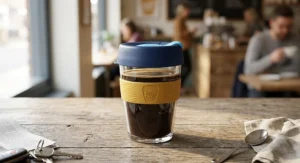
If one KeepCup shows up in every “best reusable coffee cup” roundup, it’s this one. Launched in 2014, the KeepCup Brew Cork pairs tempered soda-lime glass with a natural cork band sourced from Portuguese wine-industry offcuts — a detail that sounds like marketing fluff until you’re holding a 70°C flat white and your fingers are still comfortable.
What most buyers overlook about this model is that the cork isn’t just decorative — it’s doing genuine thermal insulation work, and it improves with age rather than degrading, which is unusual for a coffee accessory. On paper, the glass body means zero flavour transfer between drinks, something plastic cups can’t fully claim after months of espresso staining. Aggregated review sentiment on Amazon UK and KeepCup’s own site consistently praises the seal quality and the “feels like a proper café cup” experience, with the most common complaint being that the cork band can’t be removed for a deep clean, so hand-washing care matters. Available in 6oz, 8oz, 12oz and 16oz, it suits anyone who’s already sold on reusables and wants the one their barista secretly approves of.
Pros:
- ✅ Genuine tempered glass — no flavour transfer, ever
- ✅ Cork band gets more comfortable with use
- ✅ Ten-plus years as the reusable cup benchmark
Cons:
- ❌ Cork band can’t be removed for washing
- ❌ Glass adds weight versus the plastic Original
At around £20-£25, this is the model most “which KeepCup should I buy” searches ultimately land on — and reviewer sentiment backs that instinct.
3. KeepCup Brew (Silicone Band) — the sleek glass option for colour lovers
Take the Brew Cork’s glass body, swap the cork for a silicone band, and you get a slightly more colourful, slightly more washable sibling. The KeepCup Brew silicone range shares the same tempered glass construction but drops the 16oz size, because — per KeepCup’s own guidance — a silicone band doesn’t provide sufficient insulation at that larger volume without the drink cooling awkwardly fast.
Here’s what to weigh: the silicone band is fully dishwasher-safe and comes off for a proper scrub, addressing the one recurring gripe about the Cork version. Reviewers who’ve owned both tend to describe the silicone as “more practical, less charming” — a fair summary of the trade-off. Because the colour options rotate seasonally, this is the pick for anyone who treats their coffee cup as a bit of a style statement rather than a purely functional purchase. It’s a strong mid-range choice for people who want glass purity without the higher price of the insulated Longplay below.
Pros:
- ✅ Removable silicone band for easier cleaning
- ✅ Wider, more frequently refreshed colour range
- ✅ Same flavour-neutral tempered glass as Brew Cork
Cons:
- ❌ Capped at 12oz — no 16oz option available
- ❌ Less heat retention than the cork band, reviewers note
Sitting around £20-£24, it’s essentially a lateral move from the Cork version — pick based on aesthetics and washing habits, not performance.
4. KeepCup Longplay — double-wall glass for hot-drink insulation
For drinkers who linger over a flat white rather than necking it before a meeting, the KeepCup Longplay solves the Brew range’s biggest limitation: heat loss. It adds a removable Tritan outer sleeve to the same tempered glass inner cup, creating a genuine twin-wall vessel that KeepCup says improves heat retention and insulates your hand from the hot glass beneath.
What the spec sheet won’t tell you, but the care instructions make clear, is that this cup needs a bit more attention than the others — KeepCup explicitly advises disassembling it weekly to clear moisture trapped between the walls, and it’s not microwave-safe. That’s a small maintenance tax for a genuinely noticeable difference in how long your coffee stays drinkable. Reviewers who’ve upgraded from the standard Brew line describe the heat retention gain as the main reason they don’t regret paying extra, though a few flag that the clear Tritan sleeve scuffs cosmetically with heavy daily use. Best matched to slow-office-coffee types and people who drive with their drink rather than walking straight from counter to desk.
Pros:
- ✅ Noticeably better heat retention than single-wall glass
- ✅ Twin-wall design protects hands from hot glass
- ✅ Retrofittable sleeve works on existing 12oz/16oz Brew cups
Cons:
- ❌ Requires weekly disassembly to prevent trapped moisture
- ❌ Tritan sleeve scuffs and scratches over time
Priced around £26-£33, the Longplay is the natural “I love my Brew Cork but want it to stay hot longer” upgrade.
5. KeepCup Thermal Press Fit — the toughest all-day insulation in steel
When glass feels too fragile for a rucksack or a bike commute, the KeepCup Thermal Press Fit switches materials entirely: double-walled stainless steel, vacuum-sealed, with the same splashproof press-fit lid used across the wider range. Since 2024, KeepCup has manufactured its steel range from 95% recycled, lead-free stainless steel — a genuinely verifiable sustainability upgrade rather than a vague green claim.
Based on the spec comparison, the trade-off here is straightforward: you gain serious durability and the best heat retention in the line-up, and you lose the ability to see your coffee and the tactile glass feel that Brew and Longplay fans like. Reviewers consistently frame this as the “forget I’m even carrying it” cup — the one that survives being dropped in a bag with keys and a laptop charger without a second thought. Available in 6oz, 12oz and 16oz, it’s the obvious pick for cyclists, hikers, and anyone whose cup spends more time in a bag than in a hand.
Pros:
- ✅ Made from 95% recycled, lead-free stainless steel
- ✅ Best all-day heat retention in the entire range
- ✅ Genuinely bag-and-commute durable
Cons:
- ❌ No visibility of your drink through opaque steel
- ❌ Loses the glass “café feel” some buyers specifically want
At roughly £28-£32, it undercuts the Longplay while beating it on durability — the classic budget-vs-fragility trade-off in miniature.

6. KeepCup Cold Cup Helix — best for iced specialty coffee
Hot-drink cups and iced-drink cups are not interchangeable, and the KeepCup Cold Cup Helix exists because of that gap. Built from insulated, screw-fit stainless steel with a glossy Tritan lid, it’s designed specifically to stop condensation pooling on a desk and to keep an iced oat latte cold for longer — a genuinely different engineering problem to keeping a flat white hot.
What most buyers overlook about cold cup design is that a spillproof valve and central straw matter more here than lid material, because iced drinks are sipped, not tipped. Available in Medium (12oz), Large (16oz) and XLarge (20oz), it comfortably swallows a full iced latte plus ice without the “too small” problem that plagues most reusable hot cups repurposed for cold drinks. Reviewer sentiment around KeepCup’s Cold Cup range specifically praises the no-condensation claim as accurate, with the main criticism being that the screw-fit lid takes slightly longer to clean thoroughly than a simple press-fit. For anyone whose “specialty coffee” order is genuinely an iced drink nine months of the year, this is the model the rest of the range simply can’t substitute for.
Pros:
- ✅ Purpose-built to stop condensation and desk puddles
- ✅ XLarge 20oz size handles a full iced latte with ice
- ✅ Central straw and spillproof valve suit sipping, not tipping
Cons:
- ❌ Screw-fit lid is fiddlier to clean than press-fit designs
- ❌ Overkill if you only ever drink hot coffee
Priced around £32-£37, it’s a specialist purchase rather than an all-rounder — but for its specific job, reviewers rate it highly.
7. KeepCup Helix Bottle — the crossover hydration pick
Not strictly a coffee cup, but worth including as the “lesser-known but genuinely useful” pick: the KeepCup Helix Bottle takes the same modular Helix hardware — screw-fit lids, insulated stainless steel — and applies it to hydration rather than coffee. Available from 14oz up to a 26oz XL, with a swap between straw, sipper and bottle lids on the same body, it’s aimed at people already bought into the KeepCup ecosystem who want one system covering coffee and water.
Here’s what to weigh: buying into modular lids means fewer single-purpose vessels cluttering your cupboard, but it also means a slightly higher up-front cost if you’re building the system from scratch rather than owning pieces already. Reviewers who use the Helix ecosystem across both coffee and hydration report genuine convenience from lid interchangeability, though a few note the learning curve of remembering which lid does what. For families or households already committed to Helix coffee cups, adding the Bottle is a logical, low-friction extension rather than a separate purchase decision.
Pros:
- ✅ Interchangeable lids across the whole Helix ecosystem
- ✅ Sizes up to 26oz for genuine all-day hydration
- ✅ Reduces cupboard clutter versus separate single-use vessels
Cons:
- ❌ Best value only if you’re already in the Helix system
- ❌ Not a direct coffee cup — a complementary purchase
At around £22-£38 depending on size and lid choice, it rounds out the range for anyone thinking beyond just coffee.
Full Spec Comparison: All 7 Models Ranked
| Model | Material | Sizes | Insulated? | Price Range | Best For |
|---|---|---|---|---|---|
| KeepCup Original | Plastic | 4/8/12/16oz | No | £13-£17 | First-time buyers |
| KeepCup Brew Cork | Glass + cork | 6/8/12/16oz | Mild | £20-£25 | All-round daily use |
| KeepCup Brew (Silicone) | Glass + silicone | 6/8/12oz | Mild | £20-£24 | Colour/style focus |
| KeepCup Longplay | Double-wall glass | 12/16oz | Yes | £26-£33 | Slow drinkers |
| KeepCup Thermal Press Fit | Stainless steel | 6/12/16oz | Yes | £28-£32 | Commuters/cyclists |
| KeepCup Cold Cup Helix | Insulated steel | 12/16/20oz | Yes | £32-£37 | Iced specialty coffee |
| KeepCup Helix Bottle | Insulated steel | 14-26oz | Yes | £22-£38 | Coffee + hydration |
Scanning this table, the KeepCup Original and KeepCup Brew Cork cover roughly 80% of buyers’ actual needs, and most “best KeepCup” debates online really come down to a choice between those two. The steel and double-wall models only earn their higher price tags if you specifically need better insulation or drop-resistance — buying a KeepCup Thermal Press Fit purely for the aesthetic, when you drink your coffee within ten minutes anyway, is money spent on a feature you won’t use.
✨ Ready to Pick Your Perfect Cup?
🔍 Compare current colours and sizes across the range before you buy, and check today’s price — stock and colourways shift more often than you’d think.
KeepCup Which Size to Buy: A Barista-Standard Size Guide
This is the single most-searched follow-up question, and it deserves a proper answer rather than a shrug. KeepCup’s sizing mirrors genuine café measures, not arbitrary small/medium/large marketing:
- 4-6oz — matches a macchiato, cortado or piccolo latte. Skip this unless that’s genuinely your usual order; it’s too small for a daily flat white.
- 8oz — the US “short” specialty coffee size, ideal for flat whites and short lattes.
- 12oz — the café standard. If you usually ask for a “tall” or a standard latte, this is your default.
- 16oz — large lattes, cold brew, or anyone who takes extra milk. This is the closest match to a chain café’s “medium”.
- 20oz (XLarge, Cold Cup only) — built for iced lattes, quad shots or smoothies, not available across the hot-drink ranges.
Based on the spec comparison across all seven models, the practical rule is simple: order the size that matches what you actually drink at the counter, not what looks impressive on a shelf. Buying a 16oz Original because it “feels like better value” when you drink 8oz flat whites just means your coffee sits half-empty and cools faster in the extra air space — a mistake reviewers flag surprisingly often.
KeepCup Barista Standard: What “Barista Standard” Actually Means
You’ll see the phrase “barista standard” stamped across KeepCup’s own marketing, and it’s one of the few bits of coffee-industry jargon that actually means something specific rather than being pure spin. It refers to two engineering choices: the cup’s external dimensions are sized to fit securely under a commercial espresso machine’s group head, and the volumes match genuine café measures rather than rounded-up “large/medium/small” branding.
What most buyers overlook is that this matters practically, not just semantically — a cup that’s even a centimetre too tall won’t clear the steam wand on a lot of café machines, forcing baristas to pour into a jug first and decant, which slows service and annoys everyone in the queue behind you. Reviewers who’ve worked in cafés themselves (a genuinely useful subset of Amazon and Trustpilot reviews) consistently confirm that KeepCup’s dimensions clear standard commercial machines more reliably than several rival reusable cup brands, which is arguably the brand’s most underrated practical advantage over prettier but less café-compatible competitors.

The Barista Standard Lid: Why the Lid Matters More Than the Cup
It’s tempting to judge a reusable cup on its body material, but the lid is doing the harder engineering job. KeepCup’s splashproof press-fit lid is designed, in the company’s own words, so a busy barista can confidently fill a cup to the brim knowing it’s correctly dosed — a small detail that solves a real problem: over-filled reusable cups spilling at the counter, which is precisely why some independent cafés have historically been wary of them.
Here’s what to weigh: the press-fit lid (used across Original, Brew, Longplay and Thermal Press Fit) prioritises speed and splashproof reliability over full leakproof security, meaning it’s fine in a bag pocket the right way up but not bomb-proof if it tips over sideways. The screw-fit lid used on the Commuter and Helix ranges trades a couple of seconds of convenience for genuine leakproof performance, which is why cyclists and commuters skew towards those models. Reviewers who switch between lid types tend to settle on press-fit for café-to-desk routines and screw-fit for anything involving a rucksack, gym bag or car boot.
Practical Usage Guide: Getting the Most From Your KeepCup
Buying the cup is the easy part — getting a decade of use out of it is where most people quietly fall short. A few habits make a genuine difference in the first month:
Setup and first use: Rinse thoroughly before first use, particularly on glass and cork models where manufacturing residue can linger. If you’ve bought a Longplay, do a dry run assembling and disassembling the sleeve before you’re stood at a busy counter trying to figure it out for the first time.
Daily maintenance: Press-fit lids benefit from a weekly deep clean around the seal, where milk residue builds up invisibly and eventually causes the faint sour smell reviewers occasionally complain about. Cork bands should never go in a dishwasher — hand wash only, and let them air dry fully before your next use to avoid trapped moisture.
Common first-30-days mistakes: The single most common error is buying a size mismatched to your actual order (see the sizing guide above), followed closely by forgetting the cup entirely during the habit-forming first fortnight — try keeping it permanently in a bag pocket rather than a kitchen cupboard, since “out of sight” genuinely is “out of mind” here. Reviewers who successfully build the habit almost universally mention leaving it somewhere they can’t forget it, rather than relying on willpower alone.
Real-World Scenarios: Which KeepCup Fits Your Routine
The daily commuter (45-minute train journey, one flat white each way): A KeepCup Thermal Press Fit or Longplay makes sense here — the insulation genuinely earns its keep over that duration, and steel specifically survives being crammed into a bag alongside a laptop.
The office desk drinker (coffee bought once, sipped slowly over an hour): The KeepCup Brew Cork hits the sweet spot — you’re not walking far enough to need bag-proof steel, but you’ll notice the difference glass makes to taste versus plastic over a slow hour.
The iced-coffee regular (year-round oat milk iced lattes): Skip the hot-drink ranges entirely and go straight to the KeepCup Cold Cup Helix — condensation control and a proper straw fitting are non-negotiable for this use case, and no hot-drink model in the range solves that problem as well.
The budget-conscious student: The KeepCup Original in 8oz or 12oz remains the rational choice — lightest on the wallet, and the plastic staining issue that bothers long-term owners is less of a concern if you’re replacing kit every year or two anyway.
KeepCup for Specialty Coffee Drinkers
Specialty coffee — traceable, carefully roasted, often filter or pour-over rather than milk-heavy chain drinks — deserves a cup that doesn’t fight the drink itself. This is where glass genuinely outperforms plastic and steel: a KeepCup Brew Cork or Longplay carries zero flavour memory from previous drinks, letting a single-origin filter coffee’s actual tasting notes come through undisturbed, something reviewers who’ve switched from an old stained plastic cup specifically comment on.
What most buyers overlook is that opaque steel cups, while excellent for insulation, hide one of specialty coffee’s small pleasures — watching the crema on a well-pulled espresso, or the colour gradient on a cold brew. If you’re the type who orders coffee by origin and process rather than just “a coffee, please”, the transparency of glass isn’t a gimmick; it’s part of the experience you’re paying the extra £2-£3 a cup for at the counter in the first place.
Common Mistakes When Buying a KeepCup
Even committed reusable-cup converts trip up on a handful of predictable errors:
- Buying based on colour alone, then discovering the size doesn’t match daily habits — sizing should always come first.
- Choosing glass for a cycling commute, where steel’s drop-resistance genuinely matters more than glass purity.
- Assuming all lids are interchangeable across ranges — press-fit and screw-fit hardware isn’t universally compatible, so check before buying spare lids separately.
- Skipping the cork-care instructions, then being surprised when a dishwasher cycle damages the band.
- Overbuying insulation you won’t use, paying a premium for Thermal-level heat retention on a coffee that’s finished within five minutes anyway.
Benefits vs Traditional Disposable Cups
| Factor | KeepCup (Reusable) | Disposable Cup |
|---|---|---|
| Cost per use (after ~150 uses) | Effectively pence per drink | 14p average cup cost each time |
| Café discount | Often 25p-50p off per drink | None — full price |
| Recyclability | Fully reusable, years of life | Under 1 in 400 actually recycled |
| Flavour/taste (glass models) | No flavour transfer | Plastic-lined, can affect taste |
| Environmental footprint | One-off manufacturing cost | Repeated emissions per cup |
The numbers here are genuinely stark: a single café at the University of Sussex discarded over 17,000 disposable cups in one month in October 2023 alone, and nationally, the UK gets through at least 2.5 billion takeaway cups a year, with barely one in every 400 actually recycled. Set against that backdrop, even the priciest KeepCup Cold Cup Helix pays for itself within a few months of daily use once you factor in chain café discounts, before even counting the waste it prevents. For a deeper look at why so few disposable cups get recycled, Friends of the Earth’s breakdown of the issue is worth a read.
Long-Term Cost & Maintenance: The Real ROI
A KeepCup Original at around £15 pays for itself remarkably fast once you factor in chain discounts — Pret and M&S both currently knock 50p off a hot drink for bringing your own cup, meaning roughly 30 coffees covers the entire purchase price. Buy a pricier KeepCup Thermal Press Fit at £30, and the break-even point stretches to around 60 coffees — still comfortably inside a typical working month or two for a daily coffee habit.
Maintenance costs are close to zero across the range, with one caveat: cork bands and Tritan sleeves aren’t designed to last forever under daily wear, and KeepCup sells replacement lids and bands separately rather than requiring a full cup replacement. That modularity is arguably a value-add feature Amazon listings rarely highlight but reviewers who’ve owned a cup for several years consistently mention with approval.
The Reusable Cup Movement: Where KeepCup Fits
KeepCup didn’t just launch a product in 2009 — it effectively created a category. It was designed to replicate the shape and function of a single-use takeaway cup while fitting under commercial espresso machines, and the brand notes that roughly twenty disposable plastic cup lids contain the same amount of plastic as one Original KeepCup. That framing — comparing a single reusable purchase against a stack of disposables — is essentially the founding argument of the entire reusable cup movement that’s followed, from café loyalty schemes to Scotland’s proposed cup charge.
The movement has picked up institutional weight since: the National Trust is phasing out single-use cups entirely across its sites by the end of 2026, citing 763 tonnes of CO2 from single-use cups in 2023-24 alone, and independent chains like Boston Tea Party have gone further still, banning disposable hot-drink cups outright.
🌍 Ready to Join the Reusable Movement?
☕ Browse the current KeepCup line-up, pick the size that matches your actual order, and check today’s price before checkout — small habit, genuinely measurable impact.
Features That Actually Matter (And Those That Don’t)
Actually matters: correct sizing for your usual drink, lid type matched to how you carry the cup, and material matched to your routine (glass for taste, steel for durability, plastic for budget).
Doesn’t matter nearly as much as marketing suggests: exact colourway (functionally irrelevant), and owning multiple sizes “just in case” — most reviewers who buy two end up using one almost exclusively within a month.
Buyer’s Decision Framework
If you drink your coffee within minutes of buying it and mostly care about cost, choose the KeepCup Original because insulation would be wasted spend. If you linger over your coffee at a desk and care about taste, choose the KeepCup Brew Cork because glass preserves flavour better than any other material here. If your cup travels in a bag daily, choose the KeepCup Thermal Press Fit because steel survives knocks that glass won’t. If your order is iced more often than hot, choose the KeepCup Cold Cup Helix, because none of the hot-drink models solve condensation properly.

Frequently Asked Questions
❓Is a KeepCup actually worth the money?
❓ What size KeepCup should I buy?
❓ Does a KeepCup keep coffee hot?
❓ Can you put a KeepCup in the dishwasher?
❓ Which KeepCup is best for iced coffee?
Conclusion
So, KeepCup review is it worth it — after seven models, three comparison tables and a genuine look at the numbers, the honest answer is: yes, provided you buy the right one for your actual habits rather than the prettiest one on the shelf. The KeepCup Original remains unbeatable value for casual or budget-conscious drinkers, the KeepCup Brew Cork is the sensible all-rounder most people should start with, and the insulated Longplay, Thermal and Cold Cup Helix models earn their higher price tags only if your routine genuinely demands better heat retention, durability or condensation control. Match the size to what you actually order, respect the care instructions for cork and glass, and the maths on café discounts alone gets most models to break-even within a couple of months.
☕ Found Your Perfect KeepCup?
✨ Compare sizes and colours across the current range and check today’s price before it changes — your commute (and the planet) will thank you.
Recommended for You
- Travel Mug With Built-In Infuser: 7 Best Picks for 2026
- Best Travel Mug for Tea in 2026: 7 Picks That Actually Work
- 7 Best Small Travel Mugs for Espresso in 2026 (UK Guide)
Disclaimer: This article contains affiliate links. As an Amazon Associate, I earn from qualifying purchases. If you purchase products through these links, we may earn a small commission at no additional cost to you.
✨ Found this helpful? Share it with your friends! 💬🤗
