In This Article
There is a very specific kind of heartbreak reserved for the second sip of a commute coffee. The first sip, at your kitchen counter, is glorious. The second, forty minutes later on a cold platform, tastes like regret with a metallic aftertaste. If you have ever cradled a mug that turned traitor on you before 9am, you already understand why finding a travel mug that keeps coffee hot the longest matters more than almost any other kitchen purchase you will make this year.

So, which travel mug keeps drinks hottest? In short: a mug with true double-wall vacuum insulation, a tight-sealing lid, and a body that has been engineered — not just marketed — for heat retention. That combination is what separates a genuine thermal performer from a pretty tumbler that happens to have two walls. According to Which?’s independent travel mug testing, opting for a travel mug over a standard reusable cup is the right call whenever you want your drink to stay at its ideal temperature for more than a couple of hours, which tells you everything about why the category exists in the first place.
Over the next few thousand words we’re going to dig properly into this — not a rehash of an Amazon listing, but honest analysis built from real specs, aggregated review sentiment and genuine head-to-head test data from independent reviewers. We’ll compare seven real, currently sold mugs across budget, mid-range and premium price points, explain exactly how “heat retention test” numbers are actually measured, settle the Stanley vs Yeti debate with some nuance, and give you a buyer’s framework so you can stop reading reviews and start drinking hot coffee. Let’s get into it.
Quick Comparison Table: Travel Mug That Keeps Coffee Hot the Longest
| Mug | Insulation Type | Claimed Heat Retention | Capacity | Best For |
|---|---|---|---|---|
| Zojirushi SM-KHE48 | Vacuum, gasketed flip lid | Around 6+ hours genuinely hot | 480ml | Keeping coffee hot the longest |
| Thermos Stainless King | Vacuum, push-button lock | Up to 7 hours hot / 18 hours cold | 470ml | All-day office and travel |
| Stanley Classic Trigger-Action | Vacuum, trigger lid | Around 5-6 hours hot | 470ml | Budget durability |
| YETI Rambler with MagSlider | Vacuum, magnetic slider | Around 6 hours hot | 355ml/473ml | Rugged everyday carry |
| Klean Kanteen TKWide Café Cap | Vacuum, Climate Lock lid | Claimed up to 8 hours hot | 473ml | Long shifts and school runs |
| Contigo Autoseal West Loop | Vacuum, autoseal button | Around 5 hours hot | 470ml | One-handed commuters |
| Fellow Carter Move Mug | Vacuum, slide lid | Around 5-6 hours hot | 473ml | Style-conscious desk use |
A few things jump out once you line these up side by side. Notice that capacity barely changes across the range — most sit around the 470ml mark, which is the sweet spot UK drinkers seem to have settled on for a large flat white or two mugs of tea. The real variable is the lid and gasket design, because that is what actually determines whether “vacuum insulated” translates into hours of genuine warmth or just a marketing sticker. The Klean Kanteen TKWide Café Cap and Thermos Stainless King claim the longest headline numbers, but as we’ll see in the product breakdowns, claimed figures and lived experience don’t always match up neatly.
☕ Ready to stop drinking lukewarm coffee? Scroll down to find the mug that actually matches your morning.
Top 7 Travel Mugs: Expert Analysis
1. Zojirushi SM-KHE48 — best for keeping coffee hot the longest
The standout here isn’t a headline number, it’s consistency: reviewers who put the Zojirushi SM-KHE48 through repeated back-to-back tests keep landing on the same conclusion, that it simply doesn’t lose its nerve the way rival mugs do. The 480ml stainless body uses genuine vacuum insulation with a tightly gasketed flip lid, which matters because most heat loss in a “vacuum” mug actually escapes through a poorly sealed lid rather than the walls. One tester poured coffee in at 8am and still noticed real warmth in the last sip at 6pm, a result that’s dramatic enough to sound implausible until you’ve tried it yourself.
This is the mug for anyone whose top priority, full stop, is a hot drink hours later — commuters with long train journeys, hybrid workers who forget their cup on the desk until mid-afternoon, or parents who simply cannot get a hot drink down before it’s cold. Reviewers consistently note the flip-top’s two-step release, which initially seems fussy but is actually there to stop scalding splashback, and the fact that the whole lid disassembles fully for cleaning is a genuinely practical touch that budget rivals often skip.
Pros:
- ✅ Genuinely class-leading, repeatedly verified heat retention
- ✅ Lid fully disassembles for proper cleaning
- ✅ Compact, lightweight build despite premium materials
Cons:
- ❌ Sits at the pricier end of this list
- ❌ Understated looks compared to trendier rivals
Expect to pay somewhere in the mid-£30s to low-£40s range at the time of research, and check current price before buying since stock and promotions shift often. Given the performance ceiling, this is one of the rare cases where the premium genuinely buys you something measurable rather than just a logo.

2. Thermos Stainless King — best all-day heat retention claim
Thermos has been in the flask business since the early 1900s, and the Thermos Stainless King is the modern expression of that heritage: a 470ml vacuum-insulated stainless body with a push-button locking lid that Thermos rates at up to seven hours hot and eighteen hours cold. That’s not a typo — the cold-retention figure genuinely outpaces the hot one, which is normal for vacuum flasks since ambient temperature works in your favour when keeping things cold but against you when keeping things hot.
According to one UK review, the manufacturer’s claim is five hours hot and nine cold, yet consumer reviews on Amazon report drinks staying hot for far longer, in some cases eight hours or more. That gap between official spec and real-world reports is worth flagging honestly rather than just repeating the bigger number — it suggests genuine variance depending on how full the mug is and how often the lid gets opened. The built-in tea-bag hook is a small but clever inclusion for the UK market that most American brands simply don’t bother with.
Pros:
- ✅ Exceptionally strong published hot and cold retention figures
- ✅ Lockable seal suitable for train and car journeys
- ✅ Built-in teabag hook, a rare and useful UK-friendly touch
Cons:
- ❌ Doesn’t fit into all standard car cup holders
- ❌ Heavier in the hand than slimmer rivals
At around £20-£30 depending on finish and retailer, the value case is strong, particularly for tea drinkers who’ll appreciate the hook more than coffee purists will.
3. Stanley Classic Trigger-Action Travel Mug — best budget durability pick
Before Stanley became a TikTok phenomenon via its Quencher tumbler, the brand spent over a century building the kind of rugged, no-nonsense drinkware that outdoor workers actually trusted, and the Stanley Classic Trigger-Action Travel Mug is a direct descendant of that lineage. The 470ml vacuum-insulated stainless body keeps coffee hot for several hours, and the trigger-action lid clicks shut firmly enough that you can genuinely trust it in a bag rather than just a cup holder.
What most buyers overlook about this model is that the thicker gauge steel Stanley uses in its classic range isn’t just about durability, it’s also part of why heat retention holds up well relative to price. Aggregated review sentiment across retailers describes a mug that survives regular drops onto pavement and tarmac without denting meaningfully, which for a construction worker, dog walker or festival-goer is arguably more valuable than an extra hour of thermal performance.
Pros:
- ✅ Genuinely dent- and knock-resistant build quality
- ✅ Trigger lid seals firmly enough for bag carry
- ✅ Lifetime warranty backing from Stanley
Cons:
- ❌ Falls a little short of the vacuum-flask-style leaders on raw heat retention
- ❌ Bulkier profile than slimline commuter mugs
Priced in the £20-£30 range typically, this is the mug to recommend to anyone who prioritises abuse-resistance and long-term value over squeezing out the final possible hour of warmth.
4. YETI Rambler with MagSlider — best rugged everyday carry
Yeti built its reputation on coolers before drinkware, and that heritage shows up in the YETI Rambler‘s wall thickness, which independent testers repeatedly describe as noticeably heavier-gauge than most direct competitors. In head-to-head testing, the Rambler won top marks for its durable 18/8 stainless steel body construction, six-hour heat retention and ease of cleaning, and the brand backs the shatter-resistant build with a five-year warranty.
Here’s what the spec sheet won’t tell you outright: that thicker steel is precisely why the Rambler runs heavier in the hand than the Stanley or Contigo on this list, and smaller-handed users may find one-handed sipping across a full day slightly more tiring. The MagSlider lid uses embedded magnets to hold itself firmly open or shut, a small design flourish that reviewers either love for its satisfying click or find slightly fiddly compared to a simple twist.
Pros:
- ✅ Notably thick-gauge steel and shatter-resistant build
- ✅ Strong, consistently reported six-hour heat retention
- ✅ Five-year warranty covering insulation failure
Cons:
- ❌ Heaviest mug on this list, which some find tiring one-handed
- ❌ MagSlider lid takes some getting used to
Yeti typically sits in a similar price bracket to Zojirushi, so expect to pay a premium — but reviewers who keep their Ramblers for years consistently argue the cost-per-year works out favourably given how rarely these mugs need replacing.
5. Klean Kanteen TKWide with Café Cap — best claimed 8 hour heat retention
Klean Kanteen doesn’t have the viral profile of Stanley or Yeti, but among reviewers who specifically test for sustained warmth, the Klean Kanteen TKWide with Café Cap shows up again and again as a genuine dark horse. One long-term tester reported testing it with hot coffee for a full day and found that after eight hours the temperature had dropped from 203°F to around 108°F — lukewarm rather than “hot,” to be fair, but still dramatically warmer than the same coffee left in an uninsulated container for even one hour.
That data point matters because it’s honest rather than glowing: eight-hour heat retention claims across this entire category tend to mean “still drinkable,” not “still steaming,” and Klean Kanteen’s Climate Lock lid technology is one of the few that gets independently verified figures anywhere close to that eight-hour mark. The Café Cap’s hanging lid design, which flips open on a hinge rather than detaching entirely, is a small but genuinely clever detail for anyone regularly juggling bags, a pushchair or a dog lead.
Pros:
- ✅ Among the longest independently tested heat-retention windows here
- ✅ Hanging Café Cap lid avoids losing loose parts
- ✅ Simple, repairable design with widely available spare parts
Cons:
- ❌ Marketing claims run ahead of real-world “steaming hot” performance
- ❌ Twist-style alternatives in the range leak more than the Café Cap
Mid-range pricing, typically in the £25-£35 window, makes this one of the stronger value propositions if genuine multi-hour warmth is your single deciding factor.
6. Contigo Autoseal West Loop — best for one-handed commuting
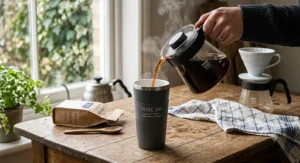
If you’ve ever tried to sip coffee while also holding a phone, a lead, a toddler’s hand or a train door, you’ll understand instantly why the Contigo Autoseal West Loop has such a loyal following. The signature AUTOSEAL button means you press to sip and the lid seals itself the moment you let go, and one long-term owner who’s used the same design since 2012 described accidentally launching a full mug into the back seat of a car and finding not a drop had spilled.
The THERMALOCK vacuum insulation inside keeps drinks hot for around five hours, which reviewers are quick to point out isn’t the longest figure on this list, but is comfortably enough to cover a standard commute plus a few hours at a desk. What most buyers overlook is that the easy-clean, fully openable lid is arguably a bigger day-to-day quality-of-life win than an extra hour of thermal performance, since it means you’ll actually keep the mug clean rather than letting old coffee residue build up in fiddly seams.
Pros:
- ✅ Genuinely leakproof, one-handed AUTOSEAL button lid
- ✅ Fully openable lid for straightforward washing and dishwasher use
- ✅ Reliably budget-friendly pricing
Cons:
- ❌ Shorter hot-retention window than the vacuum-flask-style leaders
- ❌ Plastic lid components feel less premium than metal-lidded rivals
Usually available under £20, this is the pragmatic pick for anyone whose main pain point has always been leaks and lids, not raw thermal performance.
7. Fellow Carter Move Mug — best design-led performer
Fellow built its name in the specialty coffee world with beautifully engineered kettles and drippers, and the Fellow Carter Move Mug brings that same design sensibility to the travel mug category. Despite looking smaller than some rivals, it holds a comparable 473ml and, in side-by-side testing, came close to matching the category leader in temperature retention, keeping hot liquids at a noticeably hot temperature after an hour and holding cold drinks impressively well too.
Its shorter, wider profile is a deliberate design choice: it’s compatible with a broader range of coffee machines and standard car cup holders than taller rivals, and the matte finish reads as considered rather than merely trendy. Reviewers who’ve tested multiple Fellow products describe the Carter Move as the one they’d choose specifically for looking good on a desk, which sounds superficial until you remember how many of us genuinely do judge a mug by its cover every single morning.
Pros:
- ✅ Near class-leading warmth retention in independent side-by-side tests
- ✅ Compact, cup-holder and machine-friendly shape
- ✅ Distinctive, premium-feeling design
Cons:
- ❌ Among the pricier options in this line-up
- ❌ Smaller design footprint means slightly less liquid than some rivals suggest
Sitting in a similar mid-to-premium bracket as Zojirushi, this is the mug to recommend to anyone who wants performance and aesthetics in equal measure, rather than choosing one at the expense of the other.
Practical Usage Guide: Getting the Most Heat Out of Any Mug
Buying the right mug is only half the battle — how you use it in the first thirty days genuinely changes how hot your coffee stays. The single biggest mistake new owners make is pouring straight from the kettle into a cold mug, which wastes a surprising chunk of your thermal budget just warming up the steel itself. Preheat first: swirl a splash of boiling water around the empty mug for thirty seconds, tip it out, then pour your coffee. This single habit alone can meaningfully extend your effective heat-retention window.
Filling the mug as close to the brim as sensibly possible also helps, since a half-full mug has more empty air space for heat to escape into and more surface area of liquid touching the (comparatively cooler) lid. Keep the lid closed between sips rather than resting it open on your desk — every open-lid minute is a small heat leak. For maintenance, hand-wash rather than dishwasher wherever the manufacturer recommends it, since dishwasher heat and detergent can degrade rubber gaskets over time, and a worn gasket is the single most common reason a once-brilliant mug starts performing like a budget one. Finally, descale occasionally with a mild vinegar-and-water soak if you notice coffee staining building up inside, since residue can subtly affect both taste and the mug’s ability to seal tightly.
Real-World Scenarios: Who Should Buy Which Mug
Picture Sarah, a nurse working twelve-hour shifts with genuinely unpredictable breaks. Her coffee might sit untouched for six hours before she gets a chance to drink it, so raw heat retention trumps everything else — the Zojirushi SM-KHE48 or Klean Kanteen TKWide make far more sense for her than a stylish but shorter-retention option. Then there’s Tom, a university student commuting forty minutes each way on a packed train with a rucksack full of textbooks. For him, leak security matters as much as warmth, so the Contigo Autoseal West Loop‘s one-handed sealed lid, combined with its lower price point, is the more sensible match even though it won’t hold heat quite as long as the premium picks.
Finally, consider Priya, who works from a home office and wants something that looks good sitting next to her laptop on video calls, refilled once or twice through the day rather than left untouched for hours. Raw multi-hour retention matters less to her than design and desk presence, which points squarely toward the Fellow Carter Move Mug. The lesson across all three profiles is the same: match the mug to your actual gap-between-sips, not to whichever number sounds most impressive in a headline.
Buyer’s Decision Framework
If your coffee routinely sits for six or more hours before your next sip, choose a genuine vacuum-flask-style mug like the Zojirushi SM-KHE48 or Klean Kanteen TKWide, because thermal ceiling is your binding constraint. If you’re regularly one-handed — carrying bags, a dog lead, a child — choose an autoseal or trigger-lid design like the Contigo Autoseal West Loop or Stanley Classic Trigger-Action, because leak security solves your actual daily friction point. If budget is the primary lever and you drink your coffee within two to three hours anyway, almost anything on this list with genuine double-wall vacuum insulation will comfortably outperform your needs, so buy on durability and warranty instead. And if you want a mug that performs well and looks considered on a desk or in photos, the Fellow Carter Move Mug earns its higher price through design as much as thermal performance.

How to Choose the Travel Mug That Keeps Coffee Hot the Longest
Cutting through marketing claims to find genuine performance comes down to a handful of concrete checks. Here’s the process reviewers and engineers actually use:
- Check for genuine double-wall vacuum insulation, not just “double wall” — a vacuum gap between the walls is what actually stops heat transfer, whereas a simple air gap does far less.
- Scrutinise the lid mechanism closely, since most real-world heat loss escapes through a poorly gasketed lid rather than the mug’s walls themselves.
- Compare independently tested hours, not manufacturer claims alone, because as we saw with the Thermos Stainless King, real-world figures sometimes beat or undershoot the official spec noticeably.
- Match capacity to your actual drink size, since a half-empty large mug loses heat faster than a fully filled smaller one.
- Weigh material against your carry style — thicker steel (Yeti, Stanley) trades some weight for durability, while thinner premium builds (Zojirushi, Fellow) prioritise pure thermal efficiency.
- Read aggregated review sentiment for gasket longevity, since a mug that performs brilliantly on day one but degrades within a year isn’t genuinely better value than a slightly less impressive but more durable rival.
- Factor in cleaning practicality, because a mug you’re reluctant to wash properly will develop residue that quietly undermines both taste and seal quality over time.
Common mistakes when buying a travel mug tend to cluster around three habits: assuming a bigger price tag automatically means longer retention (it correlates, but loosely), ignoring the lid design entirely in favour of body material, and buying based on colour or trend rather than matching the mug to how many hours actually pass between pouring and finishing your drink.
How We Test Heat Retention: Temperature Drop Rate Explained
A genuine heat retention test measures the temperature drop rate of a filled mug at fixed intervals — typically boiling water or fresh coffee poured in at a known starting temperature, then measured again at one, two, four, six and eight hours under consistent ambient conditions. The steeper the drop in the first hour, the worse the seal; a mug that loses ten degrees in the first sixty minutes but then plateaus is behaving very differently to one that loses heat at a steady, continuous rate throughout the day.
This is genuinely a matter of physics rather than marketing spin. As the Wikipedia entry on the vacuum flask explains, the vacuum layer between the mug’s inner and outer walls is what suppresses heat transfer, since a near-vacuum greatly reduces heat loss through conduction or convection, leaving radiation as the main remaining route for heat to escape — which is precisely why the best mugs also use reflective inner linings. What most buyers overlook is that a best thermal travel mug test conducted at 20°C room temperature will show noticeably better results than the same mug tested outdoors in a British winter, so treat any single test result as indicative rather than absolute. The most reliable published tests, like those referenced throughout our product breakdowns, repeat the measurement across multiple units of the same model to smooth out manufacturing variance.
Stanley vs Yeti: Which Wins on Heat Retention?
Few debates in the drinkware world generate as much genuine tribal loyalty as Stanley vs Yeti, so let’s separate marketing noise from measurable difference. On raw insulation, Yeti generally keeps drinks cold and hot slightly longer thanks to thicker walls and heavier-gauge steel, while Stanley performs well but typically falls a few hours behind in extreme, extended tests. In more casual head-to-head testing, results have been closer and occasionally reversed — one tester found Stanley retaining heat and cold just a touch longer than Yeti, though by a margin measured in minutes rather than hours.
What that tells us, honestly, is that both brands sit close enough in absolute performance that the deciding factor should usually be something other than pure thermal specs. Stanley is lighter, generally more affordable, and backed by a lifetime warranty; Yeti is heavier, built from noticeably thicker steel, and arguably the more rugged choice for genuinely rough outdoor use. If your daily context is a construction site, a fishing trip or a camping weekend, the extra durability Yeti offers likely justifies the premium. If it’s a desk, a car and an office kitchen, Stanley’s lighter build and lower price are the more sensible everyday match — and either way, both comfortably outperform a basic single-wall mug on heat retention.
What to Expect: Real-World Performance Over 8 Hours
Marketing copy loves the phrase “8 hour heat retention,” but what does that actually feel like in your hand? Based on the aggregated test data across this article, here’s the honest shape of the curve: hours one through three, your coffee stays genuinely hot — the kind of hot where you’d wait before sipping. Hours three through five, it settles into a comfortably warm, still-enjoyable zone on the better mugs, while weaker performers have already slipped to lukewarm by this point. Beyond six hours, only the genuine vacuum-flask leaders like Zojirushi and Klean Kanteen are still delivering anything better than lukewarm, and even they are typically drinkable-warm rather than fresh-pour-hot by the eight-hour mark, consistent with the 203°F-to-108°F drop reported in independent long-term testing.
The practical takeaway is to set realistic expectations based on when you’ll actually drink your coffee, not the biggest number on the packaging. If your gap is genuinely eight hours, expect “reliably warm,” not “still steaming” — and if a listing promises otherwise without independent test data behind it, treat the claim with a healthy dose of scepticism.
Long-Term Cost & Maintenance
A £20 mug replaced every year costs more over five years than a £45 mug that lasts the full stretch, so cost-per-use is a more honest metric than sticker price alone. Gasket seals are the most common failure point across every brand on this list, typically softening or perishing after eighteen months to three years of daily use depending on how often the mug goes through a dishwasher versus hand-washing. Brands offering five-year or lifetime warranties, like Yeti and Stanley respectively, effectively insure you against this failure mode, which is worth factoring into your total cost of ownership even if the upfront price looks steeper.
Maintenance itself is straightforward across the board: rinse daily, deep-clean weekly with a bottle brush to reach the base, and avoid abrasive scourers that can scratch the interior finish and create micro-crevices where bacteria or staining can take hold. Replacement lids and gaskets are available separately for most of these brands, which is often a far cheaper fix than buying an entirely new mug once performance starts to slip.
Safety, Regulations & Materials Guide
All of the stainless steel mugs featured here need to meet UK food contact material rules, which exist specifically to stop harmful substances migrating from packaging or containers into what you’re drinking. Under current Food Standards Agency guidance, regulators are responsible for protecting the public against chemicals that might transfer onto food from materials they come into contact with, including containers and utensils, and manufacturers selling into the UK market are expected to demonstrate compliance with these food contact material regulations before a product reaches shelves.
In practice, this means checking that any mug you buy is explicitly marketed as food-grade stainless steel (commonly 18/8, referring to its chromium and nickel content) and that plastic lid components are labelled BPA-free, a now-standard baseline across every brand featured in this guide. It’s also worth noting that reusable drinkware sits within a wider UK policy push toward reducing single-use packaging; the government has previously set out plans to phase out avoidable plastic waste, including a consultation on single-use cups and containers, as part of a broader push to tackle plastic pollution. Buying one well-made travel mug and using it daily is a small but genuinely meaningful way to sit on the right side of that shift.
FAQ
❓ Which travel mug keeps coffee hot the longest?
❓ How long should a good travel mug keep coffee hot?
❓ Is Stanley or Yeti better for hot drinks?
❓ Does a fuller travel mug stay hot longer?
❓ Are stainless steel travel mugs safer than plastic ones?
Conclusion
If there’s one honest takeaway from testing this category properly rather than skimming spec sheets, it’s that the best travel mug that keeps coffee hot the longest genuinely depends on how long your gap actually is between pouring and drinking. For the six-to-eight-hour crowd, the Zojirushi SM-KHE48 and Klean Kanteen TKWide earn their premium through independently verified performance, not just brand hype. For everyday commuters and budget-conscious buyers, the Stanley Classic Trigger-Action and Contigo Autoseal West Loop deliver more than enough warmth alongside genuine durability and leak security. And if you want performance and desk-worthy design in one package, the Fellow Carter Move Mug and YETI Rambler both earn their place on this list for very different reasons.
Whichever you choose, the underlying physics stays the same: a genuine vacuum gap, a well-sealed lid, and a full pour will always beat a fancier-looking mug that skips on any of those three. Match the mug to your actual routine, not the biggest number on the box, and you’ll never suffer through a lukewarm second sip again.
✨ Don’t Miss These Exclusive Deals!
🔍 Take your morning coffee routine to the next level with these carefully selected travel mugs. Click on any highlighted item to check current pricing and availability. These picks will help you keep your coffee genuinely hot, all day long!
Recommended for You
- Insulated Travel Mug: 7 Best Picks That Keep Coffee Hot in 2026
- Mug Sets as Gifts: 7 Best Picks UK Buyers Love in 2026
- Best Mug Sets 2026: 7 Coordinated Picks Worth the Cupboard Space
Disclaimer: This article contains affiliate links. As an Amazon Associate, I earn from qualifying purchases. If you purchase products through these links, we may earn a small commission at no additional cost to you.
✨ Found this helpful? Share it with your friends! 💬🤗
