In This Article
There’s a specific kind of guilt that hits you at the till in Pret. You know the drill — you’ve got a reusable cup sitting in a drawer at home, gathering dust and yesterday’s coffee ring, while you hand over a paper cup that’s destined for landfill within the hour. The glass reusable cup vs plastic reusable cup debate sounds like the kind of thing only a sustainability nerd would lose sleep over, but it actually comes down to three very practical questions: which one tastes cleaner, which one survives your handbag, and which one you’ll actually bother using every single day.
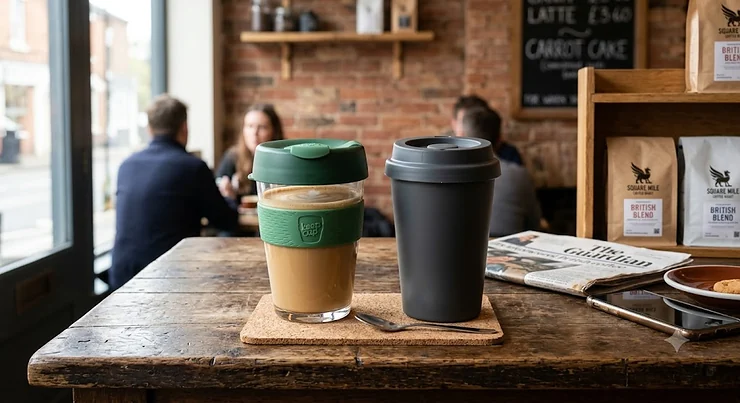
Here’s the short version. A glass reusable cup is typically made from tempered soda-lime or borosilicate glass — completely inert, so it can’t transfer flavour or shed particles into your drink, but it’s heavier and it will shatter if you drop it on tile. A plastic reusable cup is usually polypropylene or Tritan copolyester — virtually unbreakable and far lighter, but hot liquid interacting with plastic is precisely the scenario that maximises particle shedding, and cheaper plastics can pick up smells over time. Britain gets through roughly 2.5 billion disposable coffee cups every year, and both materials solve that waste problem — they just solve it in different ways, with different trade-offs.
This guide walks through seven real cups you can buy on amazon.co.uk right now, spanning genuine glass and genuine plastic construction across budget, mid-range and premium price points, plus the safety research, the flavour science, and the environmental maths that actually separates the two materials. No invented reviews, no fabricated ratings — just spec sheets, sourced research and honest analysis, so you can pick the cup that will actually survive the school run, the office fridge and the 8am scramble for the train.
Quick Comparison Table: Glass Reusable Cup vs Plastic Reusable Cup
| Factor | Glass Reusable Cup | Plastic Reusable Cup |
|---|---|---|
| Flavour transfer | None — glass is chemically inert | Possible over time, especially with cheaper polypropylene |
| Weight | Heavier, noticeable in a bag | Lightweight, barely noticeable |
| Breakage risk | High if dropped on a hard surface | Very low — most survive a fall |
| Microplastic/particle shedding | None from the vessel itself | Possible with hot liquids, varies hugely by plastic grade |
| Heat retention | Poor — cools in 30-45 minutes without insulation | Similarly poor unless double-walled |
| Best for | Home, office desk, café-style sipping | Commuting, hiking, anywhere breakage is a real risk |
Looking at the table above, neither material wins outright — it depends entirely on what “reusable” means in your life. If your cup lives on a desk or a kitchen counter, glass genuinely has no downside worth worrying about. If your cup lives in a rucksack that gets thrown around a train platform, plastic’s shatterproof nature starts to matter more than any theoretical taste advantage. The next seven products below cover both camps, from featherweight silicone-and-plastic hybrids to artisan-blown borosilicate glass.
💬 Already know which material you’re leaning towards? Jump straight to the picks below and find your size.
Top 7 Glass and Plastic Reusable Cups: Expert Analysis
1. KeepCup Brew Cork — purest taste with zero flavour transfer
The KeepCup Brew Cork is the cup that most “glass vs plastic” debates start with, and for good reason — it’s essentially the control group. The body is toughened soda-lime glass wrapped in a genuine cork band, available across the standard 8oz/227ml, 12oz/340ml and 16oz/454ml café sizes, with a splashproof press-fit lid that’s shared across KeepCup’s whole range. Because glass carries no flavour of its own, coffee, tea and even fizzy water taste exactly as they should sip after sip, with none of the faint plasticky note some drinkers report from cheaper vessels.
Based on the spec comparison with KeepCup’s own plastic Original, the Brew Cork trades about 60g of extra weight for genuinely inert taste — a fair swap if the cup mostly travels between kitchen and desk rather than bouncing around a bike pannier. Reviewers on amazon.co.uk consistently praise the cork band’s grip and insulation, though a recurring complaint notes the band could sit slightly taller for a fuller hand-hold when the coffee inside is properly hot.
Pros:
- ✅ Zero flavour transfer thanks to inert glass body
- ✅ Genuine cork band gives real grip and heat buffering
- ✅ Interchangeable lid and band system shared across sizes
Cons:
- ❌ Shatters if dropped on a hard floor, unlike plastic siblings
- ❌ Cork band sits low, so very hot drinks can still warm your fingers
Price sits in the £20-£25 range at the time of research, and check current price before buying since KeepCup regularly rotates colourways. For anyone who values taste over toughness, this is the benchmark glass pick.
2. JOCO Cup 16oz — artisan borosilicate built to handle thermal shock
Where the KeepCup uses soda-lime glass, the JOCO Cup is blown from borosilicate — the same toughened glass family used in lab equipment and oven-safe dishes, chosen specifically because it resists cracking when it goes from fridge-cold to kettle-hot in seconds. Each 16oz/473ml cup is artisan-blown rather than machine-pressed, wrapped in a thermal silicone sleeve, and finished with a wide-mouth drinking rim that makes it genuinely easy to clean by hand or run through the top rack of a dishwasher.
What most buyers overlook about borosilicate is that it isn’t just about surviving a knock — its resistance to thermal shock means it won’t develop the fine internal stress cracks that eventually cloud and weaken ordinary soda-lime glass after years of hot-cold cycling. That’s a meaningful durability edge for anyone who fills the cup straight from a kettle rather than letting coffee cool slightly first. One recurring theme in UK customer feedback is that the silicone sleeve, while a nice grip aid, doesn’t fully block heat transfer on very hot pours — so treat it as a comfort feature rather than an oven glove.
Pros:
- ✅ Borosilicate glass resists thermal-shock cracking long-term
- ✅ Wide-mouth design genuinely easy to hand-wash
- ✅ Artisan-blown finish feels distinctly premium versus mass-market glass
Cons:
- ❌ Silicone sleeve doesn’t fully insulate against very hot liquid
- ❌ Sits at the pricier end of the glass category, around £24-£30
If you’re the sort of person who fills a cup with tea that’s practically still boiling, the JOCO Cup‘s borosilicate build is the more forgiving choice long-term than standard soda-lime glass.
3. Sivaphe Reusable Glass Coffee Cup — the budget entry point into glass
Not everyone needs a design-led glass cup with a premium price tag, and that’s where the Sivaphe Reusable Glass Coffee Cup earns its place on this list. It’s a straightforward 16oz glass tumbler wrapped in a silicone thermal sleeve, finished with a spill-resistant lid — essentially the same construction formula as pricier rivals, minus the artisan branding and the matching price uplift.
Here’s what the spec sheet won’t tell you outright: budget glass cups like this one use the same fundamental soda-lime glass as premium options, so the taste-purity argument holds regardless of price. What you’re paying extra for on the KeepCup or JOCO is band material, lid engineering and brand warranty support, not the glass itself. For someone testing whether they’ll actually stick with a glass cup before committing to a pricier one, this is a sensible way in — reviewers on similar budget glass tumblers report the silicone sleeve loosening slightly after repeated dishwasher cycles, which is worth handwashing around if you want it to last.
Pros:
- ✅ Genuine glass taste purity at a fraction of premium pricing
- ✅ Silicone sleeve adds grip and basic heat buffering
- ✅ Wide availability and easy replacement if lost or chipped
Cons:
- ❌ Sleeve fit can loosen with heavy dishwasher use over time
- ❌ Lacks the brand-backed warranty support of KeepCup or JOCO
Expect a price in the £15-£20 range, making it one of the more accessible ways to trial the glass reusable cup vs plastic reusable cup question without committing serious cash upfront.
4. KeepCup Original (Plastic) — the direct like-for-like plastic comparison
This is arguably the most useful product on the whole list for settling the debate, because it’s the same brand, the same lid system, and almost the same shape as the glass Brew Cork above — just moulded from polypropylene (#5 recyclable plastic) instead of glass. The KeepCup Original comes in the same 8oz, 12oz and 16oz sizes, is BPA and BPS-free, and weighs a genuine fraction of its glass sibling, which matters more than it sounds once you’re carrying it alongside a laptop and a packed lunch.
Reviewers consistently flag two things worth knowing before you buy. On the positive side, several long-term owners report zero concern about BPA leaching and genuine day-to-day durability — one reviewer on their third cup after years of use, replaced only due to loss rather than failure. On the negative side, a recurring complaint is that the plastic body can absorb the smell of washing-up liquid or strong-smelling drinks if it isn’t rinsed promptly, something glass simply doesn’t do. That’s the practical trade-off in a nutshell: unbreakable convenience against a small risk of picked-up odours over years of use.
Pros:
- ✅ Virtually unbreakable compared with the glass equivalent
- ✅ Noticeably lighter for daily commuting or cycling
- ✅ Shares lids and bands with KeepCup’s glass range
Cons:
- ❌ Can absorb detergent or drink odours if not rinsed quickly
- ❌ Plastic surface can dull or scratch after years of dishwasher cycles
At around £10-£14, it’s also the cheapest cup on this list, which makes it the natural budget-plastic benchmark against the budget-glass Sivaphe above.
5. Frank Green Original Reusable Cup — Tritan built to resist stains and odour
Where the KeepCup Original uses standard polypropylene, the Frank Green Original Reusable Cup steps up to Tritan copolyester — a plastic specifically engineered to resist staining and odour retention, which is the exact weakness reviewers flag most often with cheaper polypropylene cups. The 12oz/340ml inner cup sits inside a non-slip exterior shell designed to fit standard UK car cup holders, and the whole unit is BPA-free, FDA and EU-approved for food contact.
On paper this means Tritan should hold up better over a two- or three-year ownership window than basic PP, because its molecular structure resists the staining that turmeric lattes and strong builder’s tea are notorious for. Frank Green’s own material claims are consistent with independent lab data on Tritan generally, though it’s worth noting that even stain-resistant plastics aren’t recommended for near-boiling liquid on a daily basis — the resistance is about staining and odour, not about eliminating particle shedding entirely. Consumer testing group Which? has previously rated Frank Green among the brands it put through leakproof and durability testing alongside KeepCup and Bodum, which is a useful independent data point beyond the brand’s own marketing.
Pros:
- ✅ Tritan resists staining and odour better than standard polypropylene
- ✅ Non-slip shell fits standard UK cup holders securely
- ✅ Independently tested by consumer groups alongside major rivals
Cons:
- ❌ Among the pricier plastic options, typically £24-£30
- ❌ Some of the appeal is branding and colourways rather than function
If odour retention is the plastic flaw that’s put you off before, this is the cup engineered specifically to solve it.
6. Stojo Collapsible Cup — the only cup on this list that folds flat
Glass simply cannot do what the Stojo Collapsible Cup does: fold down from a full 12oz/355ml cup to a disc roughly 4.5cm tall and 9cm wide, small enough to disappear into a coat pocket or a laptop sleeve. It’s built from LFGB-certified food-grade silicone with a #5 recyclable plastic collar, tab and lid, and every part is designed to separate for a proper deep clean rather than trapping grime in fixed seams.
Here’s what most buyers overlook about collapsible cups: the very flexibility that makes them packable also means the walls offer almost no thermal barrier, so the cup itself can get genuinely hot to the touch with a fresh pour — several reviewers specifically mention this despite the design intent. Reviewer sentiment on temperature retention is genuinely mixed; some report it keeps drinks reasonably warm for a commute, others say it cools quickly, which likely comes down to ambient temperature and how full the cup is poured. What’s consistently praised is the leakproof seal, which reviewers describe as reliably tight even when the cup is squashed into a bag.
Pros:
- ✅ Collapses to pocket size — nothing glass can match
- ✅ Fully dismantles for a genuinely deep clean
- ✅ Leakproof seal holds up well under reviewer testing
Cons:
- ❌ Cup walls get noticeably hot to the touch with fresh hot drinks
- ❌ Heat retention is inconsistent according to reviewer reports
Priced around £16-£20, it’s the cup to buy if “will I actually carry this today” is your biggest barrier to using a reusable cup at all.
7. Circular&Co Reusable Coffee Cup — built from six recycled paper cups
The Circular&Co Reusable Coffee Cup takes a genuinely different approach to the plastic question: rather than virgin polypropylene, the 12oz/340ml outer shell is made from an average of six single-use paper cups diverted from waste, with a hard-wearing, food-safe recycled polypropylene inner layer and an insulated cavity that keeps drinks warm for roughly 60-90 minutes. The one-handed swift-click lid and 360-degree drinking rim were both praised in independent testing.
What most buyers overlook is that even a genuinely circular-economy cup like this one still requires some virgin plastic for the food-contact inner layer, because current UK and EU food-safety legislation doesn’t yet permit fully recycled plastic in direct food contact — the brand is open about this and is actively working with regulators to change it. That’s honest positioning rather than a flaw to hide. Consumer group Which? has previously named the Circular&Co cup among its recommended picks after testing it against rival travel mugs for durability and everyday use, which lends real weight to the “still our favourite” claim beyond marketing copy.
Pros:
- ✅ Outer shell diverts genuine single-use cup waste from landfill
- ✅ Insulated layers keep drinks warm for 60-90 minutes
- ✅ Independently recommended by a UK consumer testing body
Cons:
- ❌ Food-safe inner layer still requires some virgin plastic by law
- ❌ Not fully recyclable as a single unit at end of life
Expect to pay in the £14-£18 range — solid value for a cup that’s doing more with its waste footprint than most plastic alternatives on this list.
Top 7 Products: Specs, Price Range and Best For
| Product | Material | Capacity | Price Range | Best For |
|---|---|---|---|---|
| KeepCup Brew Cork | Soda-lime glass + cork | 8-16oz | £20-£25 | Purest taste, desk or home use |
| JOCO Cup 16oz | Borosilicate glass | 16oz | £24-£30 | Hot-to-cold thermal shock resistance |
| Sivaphe Reusable Glass Coffee Cup | Soda-lime glass | 16oz | £15-£20 | Budget entry into glass |
| KeepCup Original (Plastic) | Polypropylene #5 | 8-16oz | £10-£14 | Cheapest, unbreakable everyday carry |
| Frank Green Original Reusable Cup | Tritan copolyester | 12oz | £24-£30 | Stain and odour resistance long-term |
| Stojo Collapsible Cup | Food-grade silicone + plastic | 12oz | £16-£20 | Packable travel and commuting |
| Circular&Co Reusable Coffee Cup | Recycled paper + polypropylene | 12oz | £14-£18 | Circular-economy credentials |
Scanning this table, the price gap between budget and premium glass is actually narrower than the gap on the plastic side — Tritan construction on the Frank Green costs nearly triple the basic KeepCup Original, whereas glass options cluster more tightly together. If your budget caps out under £15, the KeepCup Original and Sivaphe sit at almost identical price points despite being different materials entirely, which makes that particular pair the cleanest real-world test of the glass-vs-plastic question for cost-conscious buyers.
✨ Don’t Miss These Exclusive Deals!
🔍 Take your morning coffee routine to the next level with a cup that actually matches how you live — whether that’s a desk-bound glass tumbler or a bag-friendly plastic collapsible. Click through on any highlighted pick above to check current pricing and availability before it changes. ☕♻️
Practical Usage Guide: Getting the Most From Your First 30 Days
However you land on the glass reusable cup vs plastic reusable cup question, the first month of ownership decides whether a cup becomes a daily habit or ends up back in the “reusable cups I forgot about” drawer. Start by handwashing any silicone sleeve or cork band separately for the first few washes — dishwasher heat can loosen adhesive on cheaper bands faster than the manufacturer’s care label suggests, something several budget glass reviewers flagged directly.
For plastic cups, rinse immediately after every use rather than leaving the cup to sit, since odour absorption happens fastest in the first hour after a strong-smelling drink like a chai latte or a herbal tea. A quick rinse with a bicarbonate of soda solution once a week clears any lingering smell before it becomes permanent — a trick coffee-cup reviewers recommend specifically for silicone and polypropylene bodies. For glass cups, the equivalent maintenance step is simpler: check the lid seal monthly, since that’s the component most likely to fail before the glass itself ever does.
The most common first-month mistake, reported consistently across both materials, is treating the cup like a disposable one — leaving it unwashed in a bag overnight “just this once.” Do that twice with a plastic cup and you’ve likely set an odour that no amount of bicarbonate will fully shift. Build the habit of rinsing at the point of finishing your drink, not when you next remember, and either material will comfortably outlast its first year.
Real-World Scenarios: Which Cup Actually Fits Your Life
Specs only tell half the story, so here’s how the glass-versus-plastic decision plays out for three genuinely different daily routines.
If you’re a university student commuting by bus with a backpack that also carries textbooks and a laptop charger, the Stojo Collapsible Cup or KeepCup Original make far more sense than any glass option — both survive being dropped on a bus floor, and the Stojo’s fold-flat design means it takes up zero space when it’s empty between lectures. Budget-conscious students in particular benefit from the KeepCup Original’s sub-£15 price point, since replacing a lost or damaged cup won’t sting.
If you work from a home office and your cup travels no further than the kitchen and back, glass stops being a risk and becomes a genuine upgrade. The JOCO Cup or KeepCup Brew Cork deliver noticeably cleaner-tasting coffee and tea with zero commuting risk, and the weight that’s a downside on a bus is irrelevant sitting on a desk all day.
If you’re a parent juggling school runs, the car cup holder, and a toddler who occasionally grabs whatever’s within reach, durability trumps everything else. The Frank Green Original with its non-slip shell and stain-resistant Tritan body, or the Circular&Co Reusable Coffee Cup with its insulated, drop-tolerant construction, both handle that chaos far better than glass ever could.

What Is a Glass Reusable Cup vs Plastic Reusable Cup?
A glass reusable cup is a drinking vessel made from tempered soda-lime or borosilicate glass, prized for being chemically inert and free of flavour transfer, but vulnerable to breakage on impact. A plastic reusable cup is typically moulded from polypropylene, Tritan or a food-grade silicone blend — lightweight and shatterproof, but more prone to odour retention and, when exposed to hot liquid, particle shedding depending on the specific plastic grade used.
Both categories exist to solve the same core problem:the roughly 2.5 billion disposable coffee cups the UK gets through every year, most of which are plastic-lined paper that’s genuinely difficult to recycle at scale. The material you choose changes how that daily habit feels — heavier and purer-tasting with glass, lighter and tougher with plastic — rather than whether it works at all.
Is Glass Better Than Plastic for a Coffee Cup?
For flavour purity and long-term chemical inertness, yes — glass is objectively the better material, because it cannot leach compounds or retain odours regardless of how many times it’s washed or what’s poured into it. For durability in a bag, on a commute, or around small children, the honest answer flips: plastic is better, because a dropped glass cup is a dropped glass cup, full stop, while most plastic cups shrug off exactly that kind of impact.
Based on the spec comparison across all seven products above, there isn’t a single winner — there’s a winner per use case. Reviewers consistently note that glass cup owners who’ve broken one previous cup often deliberately buy plastic as a replacement, which is a fairly telling real-world verdict on where the trade-off actually bites hardest.
Glass Coffee Cup Pros and Cons
Weighing up a glass coffee cup specifically, independent of any single product, the pattern across the research and reviewer sentiment gathered for this guide is consistent enough to summarise honestly.
Pros:
- ✅ Completely inert, so it never transfers flavour between drinks
- ✅ Genuinely dishwasher and microwave safe on most borosilicate models
- ✅ Ages well — no staining, clouding or plastic-odour build-up over years
Cons:
- ❌ Breaks on impact with hard flooring or tile
- ❌ Heavier to carry than any plastic or silicone equivalent
That second con matters more than it sounds — coffeesetupuk.co.uk’s own testing found glass and silicone cups cool to room temperature within roughly 30-45 minutes without a vacuum layer, so a glass cup is genuinely a “drink it fairly soon” vessel rather than an all-day flask.
Reusable Glass Cup Safety
Safety concerns around reusable glass cups fall into two genuinely separate categories: breakage risk and chemical safety, and they deserve very different levels of worry. Chemically, tempered soda-lime and borosilicate glass are among the safest food-contact materials available — inert, non-porous, and incapable of leaching plasticisers or microplastics because there’s simply no plastic present in the vessel wall.
Breakage is the real safety consideration, and it’s worth being specific rather than vague about it. A dropped glass cup on a hard kitchen floor can shatter into sharp fragments, which is a genuine hazard around bare feet, pets or young children — this is precisely why several products on this list wrap the glass in a cork or silicone sleeve, which cushions minor knocks without eliminating the risk of a floor-height drop. If your household includes toddlers who like to grab cups off low tables, the plastic and Tritan options further up this guide are the more sensible safety choice, not the glass ones — no amount of “premium borosilicate” changes that basic physics.
Microplastics Leaching: What the Research Actually Shows
This is the section where the glass-versus-plastic debate gets genuinely evidence-based rather than opinion-based, so it’s worth being precise about what’s actually been measured. Peer-reviewed research using ICP-MS analysis to test potentially toxic elements leached from disposable paper and plastic cups in hot water found significant variability between cup types, with plastic cups demonstrating greater leaching potential than paper alternatives and lead specifically posed an elevated non-carcinogenic risk in plastic cups, with children showing higher relative exposure than adults due to lower body weight You can read the full peer-reviewed health risk assessment on plastic and paper cup leaching for the complete methodology.
It’s important to be honest about scope here: most of the published research measuring microplastic and chemical release focuses specifically on single-use paper cups with plastic linings and disposable plastic cups exposed to near-boiling water repeatedly, not on reusable food-grade plastics like Tritan or polypropylene used as intended. Reusable cup manufacturers generally use higher-grade, BPA-free plastics specifically because they’re designed for repeated hot-liquid contact, which is a meaningfully different engineering brief than a single-use cup never meant to be reused at all. That said, the underlying mechanism — heat accelerating particle and chemical release from plastic — doesn’t disappear just because the plastic is thicker or reusable; it’s simply reduced. Glass and stainless steel remain the only materials in this comparison with zero plastic-leaching pathway by definition, because there’s no plastic in the liquid-contact surface at all.
Flavour Integrity: Why Material Changes How Coffee Tastes
Ask any specialty coffee roaster why they serve tastings in glass rather than plastic, and you’ll get the same answer every time: taste is chemistry, and porous or reactive surfaces interfere with it. Glass has essentially zero surface reactivity, which is why coffee, wine and tea tasting has used glass vessels for centuries — nothing in the cup competes with what’s actually in the drink.
Plastic’s flavour-integrity story is more nuanced than “plastic tastes bad.” High-grade Tritan and food-grade silicone are formulated specifically to resist flavour absorption and off-gassing, which is exactly the stain-and-odour-resistance claim behind products like the Frank Green Original above. Cheaper polypropylene, by contrast, is more porous at a microscopic level and more prone to absorbing strong flavours — coffee oils, chai spices, herbal tea tannins — that can subtly bleed into the next drink poured in, especially if the cup isn’t rinsed promptly. If flavour purity is your single biggest priority, glass removes the variable entirely; if you’ve chosen plastic for durability, spending slightly more on Tritan over basic polypropylene meaningfully narrows that flavour gap.
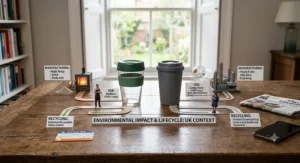
Environmental Impact: Glass vs Plastic Over a Lifetime
Environmental impact isn’t just about the material — it’s about how many times you actually use the cup before it’s replaced, which is where a lot of well-meaning reusable cup purchases quietly fail. A reusable cup needs to be used a meaningful number of times to offset the carbon footprint of manufacturing it in the first place, and that break-even point differs meaningfully by material: steel needs the most uses to break even, glass needs noticeably fewer, and silicone sits somewhere between the two.
The policy backdrop matters here too. Keep Scotland Beautiful has estimated that almost 500 million single-use disposable cups are given out in Scotland every year alone, and only around a quarter of a percent of those cups actually get recycled, largely because the plastic lining inside paper cups makes separation difficult at standard recycling facilities. That single statistic is the entire argument for reusables of either material — a glass or plastic reusable cup used daily for even a single year keeps hundreds of disposable cups out of that broken recycling stream. For the wider policy context on how the UK has approached this problem, the government’s own environment blog has addressed the debate around a UK-wide disposable cup charge directly.
Where the two reusable materials genuinely differ is end-of-life. Glass is infinitely recyclable through standard kerbside collection in the UK without any loss of quality, provided it’s actually disposed of via glass recycling rather than general waste. Plastic recyclability depends heavily on the specific polymer and local facility capability — polypropylene is broadly recyclable, but composite cups mixing plastic with silicone bands or cork are often not separable at standard recycling plants, meaning they’re more likely to end up in general waste at the end of their life regardless of the “recyclable” label on the packaging.
How to Choose Between a Glass and Plastic Reusable Cup
Cutting through the marketing, here’s the honest decision framework, in the order that actually matters for most buyers:
- Assess your drop risk first. If the cup travels in a bag, on a bike, or anywhere near young children, that alone should push you towards plastic or Tritan regardless of every other factor.
- Decide how much flavour purity actually matters to you. If you’re particular about tasting exactly what’s in your cup and nothing else, glass wins this factor outright.
- Check the lid mechanism, not just the body material. A leaking lid ruins either material equally, so read reviews on the specific lid before you buy.
- Match capacity to your actual drink size. 8oz suits an espresso-based drink; 12-16oz suits a filter coffee or tea; buying too large just means more cold drink left over.
- Factor in your dishwasher habits honestly. Cork and silicone bands generally last longer handwashed; if you’ll never handwash, favour cups with simpler, fully dishwasher-rated components.
- Consider replacement cost. If you tend to lose or damage cups, a £12 plastic KeepCup is a far more forgiving mistake than a £28 glass equivalent.
- Check independent testing where it exists. Which? has tested several of the brands featured in this guide for leakproof performance and everyday durability, which is a useful sanity check beyond manufacturer claims.
Common Mistakes When Buying a Reusable Cup
The single most common mistake buyers make is choosing a cup based on how it looks on a shelf rather than how it fits their actual daily route — a beautiful glass cup that gets left at home because it’s “too precious” to risk on the commute delivers zero environmental benefit compared with an unglamorous plastic one that’s genuinely carried every day.
A second frequent mistake is ignoring lid replaceability. Lids wear out faster than cup bodies on almost every product in this category, and buying from a brand that sells replacement lids separately — as KeepCup, Frank Green and Circular&Co all do — extends the cup’s usable life by years rather than forcing a full replacement the moment a seal fails. A third, more subtle mistake is buying a cup sized for what you’d order in a café rather than what you actually drink at home; an oversized cup that’s never filled to the brim doesn’t insulate as effectively, since more air space means faster heat loss regardless of material.
Long-Term Cost and Maintenance
| Consideration | Glass Cups | Plastic Cups |
|---|---|---|
| Typical lifespan with care | 3-5+ years | 2-4 years |
| Main failure point | Body (breakage) | Lid seal or surface odour |
| Replacement parts available | Usually lids and bands only | Usually lids and full-body replacements |
| Ongoing cost | Low, unless dropped | Low, occasional lid replacement |
The maths on long-term value comes down to how carefully the cup is treated rather than the material itself. A KeepCup Brew Cork handled gently on a desk for years can easily outlast a KeepCup Original carried daily in a bag that eventually loses its lid seal — but the same glass cup dropped once on a hard floor becomes a total write-off in a way no plastic cup on this list realistically would. Factor in your own realistic habits, not your aspirational ones, when weighing that lifespan column.
Most UK coffee chains now offer a discount of roughly 25p to 50p for bringing your own cup of either material, and at three coffees a week that adds up to somewhere in the £39-£78 annual range — which comfortably covers the cost of any single cup on this list within the first few months of ownership, glass or plastic alike.

Frequently Asked Questions
❓ Is a glass reusable cup better than a plastic one for hot drinks?
❓ Do plastic reusable cups leach microplastics like disposable ones?
❓ How long do glass reusable cups actually last?
❓ Can I put a glass reusable cup in the microwave?
❓ Which is more eco-friendly, glass or plastic reusable cups?
Conclusion
The glass reusable cup vs plastic reusable cup question was never really about which material is objectively superior — it’s about matching material to routine. Glass gives you flavour purity that plastic simply can’t fully replicate, chemical inertness that removes any leaching question entirely, and a satisfying weight that feels deliberate rather than disposable. Plastic gives you the practical resilience that a glass cup can never offer: a drop on the pavement that ends in a shrug instead of a dustpan.
Across the seven products covered here, the honest recommendation splits cleanly by lifestyle rather than by hype. Deskbound and detail-oriented about taste, the KeepCup Brew Cork or JOCO Cup are worth the extra care they demand. Commuting, parenting, or generally living a life where things get dropped, the KeepCup Original, Frank Green Original Reusable Cup, Stojo Collapsible Cup or Circular&Co Reusable Coffee Cup will still be in one piece long after a glass equivalent wouldn’t be. Whichever camp you land in, the actual environmental win only happens the day you start using it — so pick the one you’ll genuinely carry.
✨ Ready to make the switch? Grab your pick above and start saving on every coffee run from tomorrow morning. 💬🤗
Recommended for You
- Glass Reusable Coffee Cup: 7 Best Picks for 2026 (UK Guide)
- KeepCup Glass vs Brew: Which Is Better in 2026?
- KeepCup vs Competitors: 7 Reusable Cups Tested for 2026
Disclaimer: This article contains affiliate links. As an Amazon Associate, I earn from qualifying purchases. If you purchase products through these links, we may earn a small commission at no additional cost to you.
✨ Found this helpful? Share it with your friends! 💬🤗
