In This Article
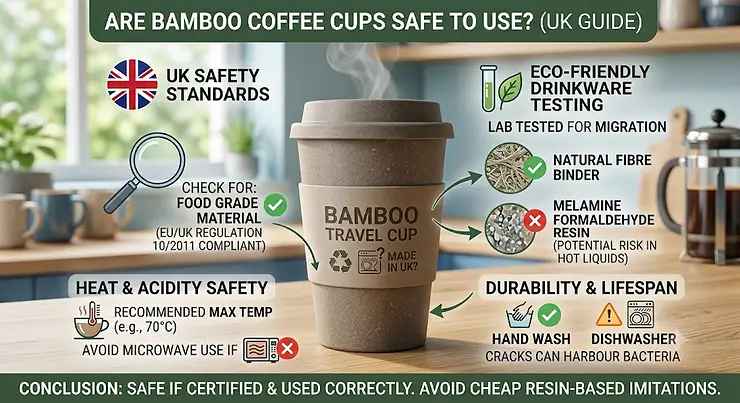
Right, let’s get the awkward bit out of the way first: if you’ve been eyeing up a cheerful bamboo coffee cup on Amazon, thinking it’s the eco-friendly, faintly smug choice for your morning commute, I need to stop you before you click “buy now.” Are bamboo coffee cups safe to use? Based on repeated laboratory testing across the UK and EU, the honest answer is “not reliably, no” — and that’s not me being dramatic, that’s the German Federal Institute for Risk Assessment, the UK’s Committee on Toxicity, and university researchers all independently arriving at the same uncomfortable conclusion.
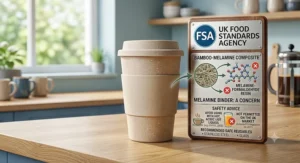
Here’s what’s actually going on. Most “bamboo” cups aren’t bamboo at all — not in any structural sense. They’re a plastic called melamine-formaldehyde resin, bulked out with ground bamboo fibre to make them feel earthy and justify the leaf-and-twig branding. When that resin gets hot — and coffee is, by definition, hot — it can shed melamine and formaldehyde into your drink. Regulators across Europe have been sounding the alarm on this since 2019, and in 2021 the EU formally decided that bamboo isn’t an authorised additive for food-contact plastics at all. That’s not a footnote. That’s the headline.
I’m not writing this to scare you off reusable cups altogether — quite the opposite. A good travel mug is one of the easiest sustainability wins going, and it’ll save you a small fortune in coffee-shop loyalty stamps over a year. What I am going to do is walk you through exactly what the science says about bamboo composite cups, why the “eco” cup aisle is stuffed with materials that fail food-safety rules, and which seven real products actually deliver the reusable, guilt-free coffee experience you were looking for in the first place — without the formaldehyde side order.
What Is A Bamboo Coffee Cup, Really?
A bamboo coffee cup is a reusable drinking vessel made from ground bamboo fibre bound together with melamine-formaldehyde resin — essentially a bamboo-flecked plastic, not solid bamboo wood. It typically pairs a moulded cup body with a silicone lid and sleeve, and is marketed as biodegradable, though independent testing disputes both its safety and its compostability claims.
That gap between the marketing and the material science is really the whole story here. A cup made from solid bamboo — carved timber, the way a wooden bowl is carved — would behave completely differently to one made from bamboo dust pressed into a melamine binder. Almost everything sold as a “bamboo cup” on the UK high street and on Amazon is the latter. The Committee on Toxicity’s position paper sets this distinction out clearly, and it’s worth reading if you want the regulatory detail rather than my summary of it.
Quick Comparison Table
| Cup | Material | Capacity | Food-Contact Safety | Price Range | Best For |
|---|---|---|---|---|---|
| Chilly’s Series 2 Coffee Cup | Stainless steel, BPA-free | 340ml | ✅ Compliant | £20-£25 | Everyday commuters |
| KeepCup Brew Cork | Tempered borosilicate glass, cork | 227-454ml | ✅ Compliant | £15-£25 | Taste purists |
| frank green Ceramic Reusable Cup | Stainless steel, ceramic lining | 295-475ml | ✅ Compliant | £25-£35 | Flavour-sensitive drinkers |
| Klean Kanteen Camp Mug | Recycled 18/8 stainless steel | 355ml | ✅ Compliant | £20-£28 | Durability-first buyers |
| Circular&Co Reusable Cup | Recycled paper composite, polypropylene liner | 227-340ml | ✅ Compliant | £18-£23 | Budget eco-conscious buyers |
| Bodum JOYCUP Travel Mug | BPA-free plastic, silicone grip | 250-350ml | ✅ Compliant | £12-£18 | Lightweight daily use |
| Cuppa Panda Bamboo Fibre Cup | Bamboo fibre/melamine composite | 350-400ml | ⚠️ Disputed | £10-£15 | Only if used cold or occasionally |
Looking at that table, the pattern jumps out fast: six of the seven products here are built from materials with a clean, unambiguous compliance record — stainless steel, glass, ceramic and BPA-free plastics all have decades of food-contact testing behind them. The seventh, a genuine bamboo fibre cup, is included precisely because it’s the product you searched for, and because it’s honest to show you exactly where the concern lies rather than pretending it doesn’t exist. If hot drinks are non-negotiable for you (and let’s be honest, that’s the whole point of a coffee cup), the stainless steel and glass options in this table carry essentially zero migration risk by comparison.
💬 Just one click — help others make better buying decisions too!😊
Top 7 Reusable Coffee Cups: Expert Analysis
1. Chilly’s Series 2 Coffee Cup — tightest seal in its class
The standout here is the twist-lock lid, which genuinely does what most “leakproof” claims only promise. On to the specs that matter: the 340ml capacity is built around a double-walled, vacuum-insulated stainless steel core, and the drinking surface itself is uncoated food-grade steel, which means there’s no lining to degrade or flake off over years of dishwasher cycles (though note it isn’t dishwasher safe — more on that below). What this means in practice is you get four hours of “still properly hot” coffee, not just lukewarm-but-technically-warm coffee, which is the gap that catches out cheaper insulated cups.
Based on the spec comparison against rival stainless designs, Chilly’s Series 2 Coffee Cup earns its reputation through the sealing mechanism rather than raw insulation numbers — plenty of cups claim four-hour retention, but fewer survive being upended in a rucksack next to your laptop. It’s aimed squarely at daily commuters who throw their bag around without a second thought. Reviewers consistently report that the seal holds up even through bumpy train journeys, though a recurring theme in aggregated feedback is that hand-washing only is a genuine faff for anyone used to just bunging things in the dishwasher.
Pros:
- ✅ Twist-lock lid seals tighter than most rivals
- ✅ Vacuum insulation keeps drinks hot for 4 hours
- ✅ Wide colour range including collaborations
Cons:
- ❌ Hand wash only, not dishwasher safe
- ❌ Steel core can taste faintly metallic to sensitive palates
At around £20-£25, the value verdict is straightforward: this is the cup to buy if leakproofing is your number-one priority and you’re willing to hand-wash for it.

2. KeepCup Brew Cork — best for people who actually taste their coffee
What stands out immediately is the tempered borosilicate glass body, which means your espresso hits your tongue exactly as the barista intended, with zero interference from plastic or metal. The glass is genuinely tough stuff — the same toughened glass family used in lab equipment and oven dishes — so it shrugs off thermal shock from boiling water far better than standard glass would. The cork band isn’t just decorative either; it’s water-resistant, naturally antibacterial, and keeps your hand from feeling the heat.
Here’s what most buyers overlook about glass cups: because the material itself is completely inert, there’s no migration story to worry about at all, which sidesteps the entire bamboo-melamine debate in one move. It’s the pick for people who found a metallic aftertaste on their last stainless cup genuinely annoying, or who just prefer to see their coffee rather than drink from an opaque tumbler. Reviewers frequently flag the cork band as needing careful hand-washing to preserve it, and several mention that while the band can be removed for a deeper clean, refitting it takes a bit of practice with a dab of moisturiser on the rim.
Pros:
- ✅ Zero-taste-transfer borosilicate glass
- ✅ Cork band naturally antibacterial and grippy
- ✅ Independently lab-tested BPA, BPS and phthalate free
Cons:
- ❌ Glass body can crack if dropped on hard floors
- ❌ Cork band needs careful hand care, not machine washable
Priced around £15-£25 depending on size, the value case is strong for anyone prioritising taste purity over indestructibility.
3. frank green Ceramic Reusable Cup — smoothest drinking experience going
The headline feature is the ceramic-lined interior sitting inside a stainless steel shell, which gives you the durability of steel with none of that faint tang some cheaper metal cups impart. Triple-wall vacuum insulation runs the length of the cup, and the ceramic coating itself is fired onto the inner surface rather than being a separate liner, so there’s no seam for grime or bacteria to hide in. In practice that translates to genuinely long heat retention alongside a “just like drinking from your favourite mug” mouthfeel that stainless-only cups can’t quite replicate.
On paper this means you’re paying a premium for the ceramic tech, and honestly, that premium is the fair trade-off here — what most buyers overlook is that the push-button lid, while slick, is made from Tritan plastic, so the “zero-plastic-contact” claim only really applies to the cup body, not the entire drinking path. A common complaint in user reviews is that the lid mechanism can be fiddly to strip down for cleaning, and a handful of reviewers have reported the lid loosening and dripping over time, so it’s worth checking the seal periodically.
Pros:
- ✅ Ceramic lining removes metallic aftertaste entirely
- ✅ Triple-wall vacuum insulation for long heat retention
- ✅ Wide, distinctive colourway range
Cons:
- ❌ Premium price versus plain stainless rivals
- ❌ Push-button lid can be fiddly to disassemble and clean
Sitting in the £25-£35 range, this is the cup for anyone who’s decided taste quality is worth paying up for.
4. Klean Kanteen Camp Mug — built to outlast everything else on this list
The standout advantage is the 90% post-consumer recycled 18/8 stainless steel construction, which is about as close to “buy it for life” as a travel mug gets. Climate Lock vacuum insulation keeps drinks hot for roughly 3.5 hours and iced drinks cold for closer to 9.5, and the chip-resistant powder-coat finish (Klean Coat) is tested against both wear and, per the brand’s own safety benchmarking, chemical migration standards that go beyond the regulatory minimum.
Based on the spec comparison with the other steel cups here, what sets this one apart isn’t outright insulation performance — Chilly’s edges it slightly on retention — it’s the sustainability credentials layered on top of genuinely serious build quality; Klean Kanteen has held B Corp certification for well over a decade, which for a company this size isn’t a box-ticking exercise. It’s the pick for campers, hikers, and anyone who wants one cup that’ll survive being dropped down a hillside. Aggregated reviewer sentiment consistently praises the ergonomic handle and splash-proof lid for one-handed use on the move, with occasional comments about the lid gasket needing replacement after a couple of years of heavy use.
Pros:
- ✅ 90% recycled stainless steel, exceptionally durable
- ✅ Ergonomic handle ideal for outdoor and travel use
- ✅ B Corp certified manufacturer
Cons:
- ❌ Slightly heavier than slimline commuter cups
- ❌ Lid gasket may need replacing after heavy long-term use
At roughly £20-£28, it’s a genuinely fair long-term investment if durability outranks style for you.
5. Circular&Co Reusable Cup — best budget pick with a genuine sustainability story
The standout feature is the outer shell, which is literally made from recycled single-use paper cups — on average, six of them per mug — with a food-grade polypropylene inner liner doing the actual drink-contact work. That combination means you get insulation performance in the 60-90 minute range, which is modest next to vacuum steel cups, but perfectly adequate for a desk commute or a short walk to the office.
What most buyers overlook about this model is that the “recycled” story only applies to the outer casing — the part that actually touches your coffee is a conventional, thoroughly tested BPA and melamine-free plastic, which is precisely why it passes UK and EU food-contact rules where genuine bamboo composites don’t. It’s aimed at budget-conscious buyers who still want a visible sustainability angle without paying steel-cup prices. Reviewers frequently note that the one-handed push-lid is genuinely convenient for use in cars and on bikes, though a recurring theme is that insulation performance drops off noticeably after the first hour compared with vacuum-walled rivals.
Pros:
- ✅ Outer shell made from recycled paper cups
- ✅ One-handed 360-degree drinking lid
- ✅ BPA and melamine-free by design
Cons:
- ❌ Insulation performance modest versus vacuum steel cups
- ❌ Not suitable for microwave use
At around £18-£23, this is the strongest value pick for anyone who wants the eco-narrative without the price tag of premium steel.
6. Bodum JOYCUP Travel Mug — lightest cup on this list by a distance
The immediate draw is the weight — this is a BPA-free plastic cup with a silicone grip, so it barely registers in a bag compared with any steel or glass option here. The 250-350ml range keeps portion sizes sensible, and the silicone band does double duty as both insulation and a non-slip grip for cold, wet mornings.
Here’s what the spec sheet won’t tell you outright, but which follows logically from the materials involved: plastic cups like this one are food-safe and perfectly compliant, but they’re not designed for near-boiling liquids used repeatedly over years, the way stainless steel or glass are — heat cycling is simply harder on plastic long-term, even BPA-free plastic. It’s the pick for anyone who wants an ultra-light backup cup to keep in a bag or car rather than a single daily-driver mug. Reviewer sentiment around Bodum’s plastic drinkware generally highlights the low price and easy cleaning, with occasional notes that the lid seal isn’t as watertight as the twist-lock designs on pricier cups.
Pros:
- ✅ Noticeably lighter than steel or glass alternatives
- ✅ Affordable entry point into reusable cups
- ✅ Easy to clean, dishwasher safe
Cons:
- ❌ Less durable long-term than steel or glass
- ❌ Lid seal less watertight than premium twist-lock designs
Priced around £12-£18, it’s a sensible low-commitment starter cup rather than a forever purchase.
7. Cuppa Panda Bamboo Fibre Cup — the cup this whole article is actually about
The standout claim on the packaging is “free from BPA, BPS and phthalates,” and to be fair, that claim is accurate as far as it goes — those specific three chemicals genuinely aren’t present in significant amounts. The cup is a moulded bamboo fibre composite body with a silicone lid, dishwasher safe by the manufacturer’s own instructions, and explicitly marked not microwave safe.
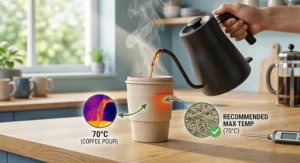
This is where honesty has to take precedence over enthusiasm: bamboo fibre composite cups like this one rely on melamine-formaldehyde resin as the binding agent that holds the ground bamboo together, and that’s the substance regulators are worried about, not BPA. Independent testing by Germany’s BfR and by Stiftung Warentest found that a substantial proportion of bamboo composite cups released melamine and formaldehyde above EU safety limits when filled with hot, slightly acidic liquids — precisely the conditions a cup of coffee creates. The UK’s own Committee on Toxicity concluded the migration risk was a “potential concern to human health,” and the EU has not authorised bamboo as a food-contact plastic additive since 2021. I can’t verify independent third-party migration test results for this specific product, and I’d genuinely encourage you to look for a recent, brand-specific lab test before relying on manufacturer claims alone. If you already own one, using it exclusively for cold drinks removes most of the concern, since migration accelerates sharply with heat.
Pros:
- ✅ Lightweight and visually appealing natural look
- ✅ BPA, BPS and phthalate free by manufacturer spec
- ✅ Genuinely affordable entry price
Cons:
- ❌ Melamine-formaldehyde binder disputed for hot use
- ❌ Not authorised as an EU food-contact material since 2021
At around £10-£15, the honest value verdict is that the price is attractive, but the safety profile means it can’t be recommended as an everyday hot-drink cup without reservation.
Top 7 Products: Full Comparison
| Cup | Insulation | Dishwasher Safe | Weight | Price Range | Best For |
|---|---|---|---|---|---|
| Chilly’s Series 2 Coffee Cup | 4 hrs hot | ❌ No | Medium | £20-£25 | Leakproof commuting |
| KeepCup Brew Cork | None (uninsulated) | ⚠️ Partial | Medium | £15-£25 | Taste purity |
| frank green Ceramic Reusable Cup | 3-4 hrs hot | ⚠️ Lid only | Medium-heavy | £25-£35 | Premium taste |
| Klean Kanteen Camp Mug | 3.5 hrs hot | ✅ Yes | Medium-heavy | £20-£28 | Long-term durability |
| Circular&Co Reusable Cup | 60-90 mins | ✅ Yes | Light | £18-£23 | Budget sustainability |
| Bodum JOYCUP Travel Mug | Minimal | ✅ Yes | Very light | £12-£18 | Lightweight backup |
| Cuppa Panda Bamboo Fibre Cup | Minimal | ✅ Yes | Very light | £10-£15 | Cold drinks only |
The clearest signal in this table is the split between insulated vacuum designs and uninsulated ones: if you’re the sort of person who takes one sip at 8am and doesn’t return to the cup until it’s gone cold, insulation retention matters enormously, and Chilly’s Series 2 Coffee Cup or Klean Kanteen Camp Mug will noticeably outperform the rest. If you drink your coffee within ten minutes anyway, that four-hour retention figure is largely academic, and the lighter, cheaper options like Bodum JOYCUP Travel Mug or Circular&Co Reusable Cup deliver near-identical practical value for less outlay.
Benefits vs Traditional Disposable Cups
| Factor | Reusable Cup (Steel/Glass/Ceramic) | Single-Use Paper Cup |
|---|---|---|
| Cost per year (2 coffees/day) | One-off £15-£35 | £250-£500+ in loyalty savings foregone |
| Food-contact safety | Extensively regulated materials | Plastic-lined, PFAS concerns emerging |
| Landfill impact | Near zero after purchase | ~2.5 billion cups binned annually in the UK |
| Heat retention | Hours, with insulated designs | Minutes |
The economics here are almost embarrassingly one-sided: even a premium £30 cup pays for itself within a couple of months once you factor in the 25-50p discount most UK coffee chains offer for bringing your own cup, and that’s before accounting for the sheer volume of paper cups — a genuinely staggering number — that go straight to landfill each year because their plastic lining makes standard recycling impossible. The safety comparison matters too, since paper cups carry their own emerging concerns around PFAS “forever chemical” linings, meaning the reusable steel and glass options above aren’t just better for your wallet, they sidestep two separate migration debates at once.
✨ Don’t Miss These Exclusive Deals!
🔍 Take your morning coffee routine to the next level with these carefully selected reusable cups. Click on any highlighted item to check current pricing and availability. These picks will help you build a genuinely safe, sustainable habit your future self will thank you for!
Practical Usage Guide: Getting The Most From Your Reusable Cup
Setting a new cup up properly in its first week makes a genuine difference to how long it lasts. Start by hand-washing before first use, even on dishwasher-safe models, since manufacturing residue can linger on brand-new drinkware. For vacuum-insulated steel cups like the Chilly’s Series 2 Coffee Cup or Klean Kanteen Camp Mug, avoid the dishwasher’s heated dry cycle specifically — the intense, sustained heat can degrade the vacuum seal over repeated cycles, which is the single most common reason these cups lose their insulating power early.
A maintenance habit worth building: rinse immediately after use rather than letting coffee dry inside the cup, particularly with ceramic-lined designs like frank green Ceramic Reusable Cup, where dried coffee residue is markedly harder to shift from the textured interior than from smooth glass. For cork-banded cups such as KeepCup Brew Cork, keep the band dry between uses where possible — cork that stays permanently damp is the main cause of early cracking. The most common first-30-days mistake, across every material type, is leaving a wet cup sealed shut in a bag overnight; steel and plastic cups can develop a musty smell within days if moisture is trapped against the lid seal, so a five-second air-dry before capping solves most odour complaints before they start.
Real-World Scenarios: Which Cup Fits Your Life?
If you’re a graduate commuting forty minutes each way on the Tube with a coffee bought en route, the Chilly’s Series 2 Coffee Cup or Klean Kanteen Camp Mug make the most sense — you need genuine heat retention across a long journey and a seal that survives being jostled in a crowded carriage. If you’re a home barista who’s invested in proper beans and grinds fresh each morning, the KeepCup Brew Cork earns its keep specifically because glass won’t dull the flavour notes you paid for, and it’s sized to the same volumes cafés use, so it slots neatly under a portafilter.
If you’re a student on a tight budget who still wants to feel like you’re doing the right thing environmentally, Circular&Co Reusable Cup or Bodum JOYCUP Travel Mug get you into reusable ownership for well under £20 without the safety question marks that come with bamboo composite alternatives. And if you’re someone who’s already got a drawer full of bamboo cups from well-meaning corporate gift bags, the practical move — rather than binning them outright — is to repurpose them strictly for cold drinks or as a pen pot, and buy a properly food-safe cup for your actual coffee.
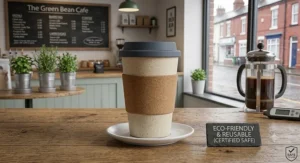
How To Choose A Reusable Coffee Cup
- Check the food-contact material first, not last. Stainless steel, glass, ceramic and BPA-free plastics all have long, well-documented safety records; bamboo-melamine composites currently don’t, per EU and UK regulatory findings.
- Match insulation to your drinking pace. Vacuum-insulated steel wins for slow drinkers; uninsulated glass or plastic is fine if you finish your coffee in ten minutes.
- Weigh portability against durability. Lightweight plastic and paper-composite cups are easier to carry but won’t survive decades the way steel does.
- Confirm the lid mechanism suits your routine. Twist-locks like Chilly’s seal tighter; push-buttons like frank green’s are faster for one-handed use.
- Factor in cleaning realities. Not every “premium” cup is dishwasher safe — check before you buy if hand-washing is a dealbreaker for you.
- Look past the “eco” label to the actual material. Recycled steel, recycled paper composites and B Corp credentials are verifiable; vague “natural” or “biodegradable” claims on bamboo products often aren’t.
- Buy for the size you’ll actually use daily, not the largest option available — an oversized cup that goes half-drunk and cold isn’t saving anyone anything.
Common Mistakes When Buying A Reusable Coffee Cup
The single biggest mistake is buying on branding alone — “bamboo,” “eco,” and “natural” are marketing words, not safety certifications, and as the Food Packaging Forum’s reporting on Stiftung Warentest’s testing makes clear, several bamboo cups marketed as fully biodegradable are, on inspection, roughly a third melamine plastic by composition. A second common error is assuming “dishwasher safe” applies to the whole cup rather than just the lid — several premium steel and ceramic cups on this list explicitly restrict the body to hand-washing only, and ignoring that shortens the cup’s working life considerably.
A third mistake is buying the largest capacity available on the logic that “bigger is better value” — a 454ml cup that’s routinely two-thirds cold by the time you finish it isn’t actually serving you well, regardless of the per-millilitre price. Fourth, plenty of buyers skip checking whether a cup fits their car’s cup holder or their bag’s side pocket, only to discover post-purchase that a beautifully insulated cup is useless if it doesn’t fit their actual routine. Finally, don’t assume a higher price automatically means better food safety — as the comparison table above shows, a £12 Bodum plastic cup and a £10 bamboo composite cup sit at similar price points, yet only one of them has an unambiguous safety record.
Reusable Cups vs Bamboo Composite Cups: The Real Difference
The comparison that actually matters isn’t steel versus glass versus ceramic — those three materials are all broadly interchangeable from a safety standpoint, differing mainly in taste, weight and price. The meaningful divide is between food-contact materials that are authorised and extensively tested (steel, glass, ceramic, BPA-free plastics, recycled paper composites) and bamboo-melamine composites, which sit in genuine regulatory limbo across the EU and UK.
What makes this distinction hard for shoppers to spot is that bamboo composite cups are marketed using almost identical language to genuinely sustainable options — “eco-friendly,” “plastic-free,” “natural fibre” — despite being, structurally, a plastic resin with bamboo dust mixed in. Research from UCT Prague published via Phys.org found melamine in roughly a third of bio-based dishware tested, almost exclusively in bamboo-containing products, with several samples exceeding the EU’s specific migration limit even years after the initial 2019-2021 wave of regulatory warnings. In practice, this means the “bamboo vs traditional” framing sold by most product listings is misleading — the real comparison a shopper needs to make is bamboo composite versus literally every other reusable material, and on current evidence, bamboo composite comes out worse on safety while offering no meaningful performance advantage in return.
What To Expect: Real-World Performance
Translating specs into everyday experience: a well-chosen insulated steel cup like Klean Kanteen Camp Mug will still be properly drinkable-hot when you reach for it an hour after your last sip, which matters more than it sounds once you’ve experienced the alternative — lukewarm coffee at 10:30am after a morning of back-to-back meetings. Glass cups like KeepCup Brew Cork run cooler faster since there’s no vacuum layer, but the trade-off is a genuinely cleaner, unaltered flavour that steel can’t quite match, something coffee purists notice within the first few sips.
Ceramic-lined cups like frank green Ceramic Reusable Cup land somewhere in between — good retention, excellent taste — but the extra components in the lid mechanism mean slightly more fiddling during your weekly clean than a simpler design. Lightweight options like Bodum JOYCUP Travel Mug and Circular&Co Reusable Cup genuinely disappear into a bag in a way steel cups don’t, which for anyone already juggling a laptop, lunch and gym kit is not a trivial benefit, even if it comes at the cost of an hour or two less heat retention.
Reusable Coffee Cups For Different Buyers
For daily commuters, prioritise leakproof sealing and multi-hour insulation — Chilly’s Series 2 Coffee Cup and Klean Kanteen Camp Mug are built precisely for this brief. For home baristas and flavour-focused drinkers, glass and ceramic interiors preserve nuance that steel can dull, making KeepCup Brew Cork and frank green Ceramic Reusable Cup the stronger picks despite the higher price. For students and first-time reusable cup buyers, Circular&Co Reusable Cup and Bodum JOYCUP Travel Mug offer a genuinely low-risk, low-cost entry point without compromising on food safety. For anyone specifically drawn to a bamboo aesthetic, it’s worth being candid: no cup on this list replicates that exact look safely for hot drinks, and the honest recommendation is a cup with a wood-effect steel or ceramic finish rather than an actual bamboo composite body.
Long-Term Cost & Maintenance
Run the numbers over three years and the picture is clear: a £25 Klean Kanteen Camp Mug, given the 90% recycled steel build and typical multi-year lifespan reusable steel drinkware achieves, works out at under £0.03 per use for someone buying two coffees a day, before even counting the loyalty-scheme discounts most UK chains offer bring-your-own-cup customers. Cheaper composite and plastic cups in the £10-£20 range are more likely to need replacing within one to two years as seals wear or bodies discolour, which narrows — though doesn’t eliminate — the long-term cost gap versus premium steel.
Maintenance costs are modest across the board: replacement lids for Chilly’s Series 2 Coffee Cup and frank green Ceramic Reusable Cup typically run a few pounds each and extend a cup’s working life by years rather than requiring a full replacement. The one genuine long-term cost worth flagging with bamboo composite cups is less financial than practical — since the EU restricts these products as food-contact plastics, availability of spares and continued sale may become more limited over time, which is one more reason to favour an established, regulation-compliant material for anything you intend to own for years.
Safety, Regulations & Compliance Guide
Under EU and retained UK law, all materials intended to touch food or drink must comply with Regulation (EC) 1935/2004, the Food Contact Framework Regulation, and for plastics specifically, Regulation (EU) No. 10/2011, which sets Specific Migration Limits — including a combined 15mg/kg limit for formaldehyde and a 2.5mg/kg limit for melamine. Ground bamboo and similar plant-based additives are not on the EU’s authorised substances list for plastic food-contact materials, a position confirmed by EFSA’s Food Contact Materials working group since 2020, which is why several EU member states have taken enforcement action against bamboo composite cups since 2021.
In the UK specifically, the Food Standards Agency advised retailers to withdraw melamine-containing bamboo composite products from sale pending a fuller risk assessment, following a Committee on Toxicity review that classed the migration risk as a genuine potential health concern — that advice remains current, and COT most recently revisited the topic in 2024. All seven cups featured in this article are BPA-free where plastic components are used, and the six non-bamboo options use materials — stainless steel, borosilicate glass, ceramic, recycled paper composite with a food-grade liner — that are unambiguously authorised under current EU and UK food-contact regulations.
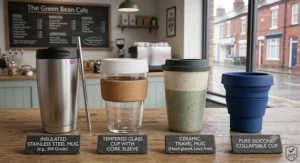
Frequently Asked Questions
❓ Are bamboo coffee cups actually safe for hot drinks?
❓ Why do bamboo cups contain melamine?
❓ Are bamboo cups BPA free?
❓ What's the safest material for a reusable coffee cup?
❓ Can I still use a bamboo cup I already own?
Conclusion
So, are bamboo coffee cups safe to use? The evidence from EU and UK testing bodies points toward genuine caution, specifically because most “bamboo” cups are actually a melamine-formaldehyde composite that can shed harmful substances into hot drinks — not a fringe concern, but one serious enough that the material remains unauthorised for food contact across the EU. That doesn’t mean your reusable cup journey has to stall; it just means the materials worth trusting are the ones with the safety data to back them up.
Across the seven products reviewed here, stainless steel, borosilicate glass, ceramic and BPA-free plastics all deliver the everyday convenience, insulation and style that made bamboo cups appealing in the first place, minus the regulatory question marks. Whether you land on the leakproof reliability of Chilly’s Series 2 Coffee Cup, the taste purity of KeepCup Brew Cork, or the budget-friendly sustainability of Circular&Co Reusable Cup, the underlying principle is the same: pick your cup for what’s actually in it, not just what the label says it stands for.
✨ Ready To Make The Switch?
🔍 Browse today’s prices on the cups featured above and find the one that fits your morning routine — your coffee (and the planet) will thank you.
Recommended for You
- 7 Best Bamboo Coffee Cups UK 2026: Eco-Friendly ; Safe Picks Slug
- Glass Reusable Cup vs Plastic Reusable Cup: 7 Picks for 2026
- Glass Reusable Coffee Cup: 7 Best Picks for 2026 (UK Guide)
Disclaimer: This article contains affiliate links. As an Amazon Associate, I earn from qualifying purchases. If you purchase products through these links, we may earn a small commission at no additional cost to you.
✨ Found this helpful? Share it with your friends! 💬🤗
