In This Article
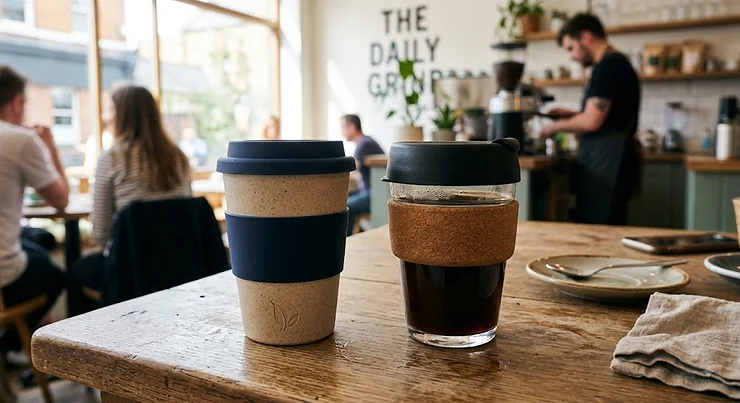
Stand in any British café queue for five minutes and you’ll spot the split: one hand wrapped around a cork-banded glass tumbler, another cradling something that looks suspiciously like a chopping board turned into a mug. That’s the bamboo coffee cup vs glass coffee cup debate playing out in real time, and it’s a genuinely trickier call than most “eco swap” articles let on. A bamboo coffee cup is typically a moulded composite of bamboo fibre, corn starch and resin, prized for being light and shatter-resistant. A glass coffee cup is usually tempered or borosilicate glass, prized for being inert, scratch-resistant to flavour, and fully recyclable at end of life. Neither is automatically “the eco one” — the honest answer depends on what you value: weight, taste neutrality, longevity, or genuine end-of-life recyclability.
This isn’t a rewritten spec sheet. It’s a comparison built from real product listings, real UK regulatory notices, and real peer-reviewed lifecycle work — because the bamboo coffee cup vs glass coffee cup question has become genuinely contested since UK food safety regulators started scrutinising bamboo composites. We’ll walk through seven real cups you can actually buy on amazon.co.uk, spanning budget bamboo to premium glass, then get into the parts most listings skip entirely: durability under daily abuse, what a lifecycle analysis actually says about emissions, and whether bamboo or glass wins on carbon footprint once you factor in washing, transport and how long the thing survives your bag.
Quick Comparison Table: Bamboo vs Glass at a Glance
| Factor | Bamboo Composite Cup | Glass Cup |
|---|---|---|
| Typical weight | 90–150g | 180–320g |
| Heat resistance | Up to ~110°C; avoid microwave | Withstands boiling water; some are microwave-safe |
| Taste neutrality | Can retain faint odours over time | Naturally inert, no flavour transfer |
| Shatter risk | Very low — survives drops well | Moderate — tempered/borosilicate resists shock but can still break |
| End-of-life reality | Composite bonding limits true biodegradability; check UK FSA notices | Fully and repeatedly recyclable via kerbside glass collection |
| Best for | Commuters wanting light, drop-proof carry | Home baristas and anyone prioritising taste and true recyclability |
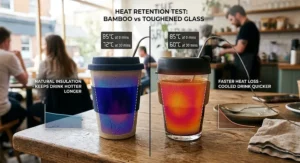
Looking at the table, bamboo composite pulls ahead on portability and drop resistance, which explains why it dominates commuter and gifting shelves. Glass, on the other hand, wins decisively on taste neutrality and genuine end-of-life recycling, because kerbside glass recycling infrastructure in the UK is mature and well-established, unlike composite plant-fibre materials. If you’re choosing between the two purely on “which will still be useful in five years,” glass edges it — but only if it survives that long without a fatal drop, which is the trade-off we’ll unpack properly in the durability section below.
☕ Ready to stop rinsing out yet another paper cup? Compare today’s top reusable picks and find your match below.😊
Top 7 Bamboo & Glass Reusable Coffee Cups: Expert Analysis
Coffee shop culture in Britain now shifts roughly 2.5 billion disposable cups a year, and government figures show barely any of them are actually recycled — a gap that’s pushed reusable cup sales sharply upward. We dug into seven real products, split across bamboo composite and glass, covering budget, mid-range and premium tiers, so you can see exactly what your money buys at each price point.
1. Ecoffee Cup 12oz (Kerr & Napier) — the UK’s original bamboo bestseller
Ecoffee Cup more or less created the mainstream bamboo cup category in Britain, and the 12oz/340ml Kerr & Napier edition remains the brand’s most popular size. The body is a bamboo fibre, corn starch and resin composite finished with a food-grade silicone lid and grip band. Heat resistance tops out around 110°C, with cold resistance down to roughly -20°C, so it handles a flat white comfortably but shouldn’t go anywhere near a microwave. Based on the spec comparison with newer entrants, what stands out is the resealable, no-drip lid — a genuinely useful detail for anyone who’s had a rucksack ruined by a leaking travel mug. Ecoffee Cup suits commuters and students who want the lightest possible carry and don’t mind a slightly plasticky mouthfeel over time. Reviewers on Amazon consistently report high satisfaction with the leak-proof lid and the range of prints available, with aggregate ratings sitting around 4.6–4.7 stars across multiple listings; a smaller but recurring theme in reviews is that the silicone lid can trap coffee smell if not washed promptly.
Pros:
- ✅ Genuinely lightweight — barely noticeable in a bag
- ✅ No-drip, resealable silicone lid rated highly by reviewers
- ✅ Widest colour and print range of any bamboo cup in this list
Cons:
- ❌ Not microwave-safe, unlike some glass alternatives
- ❌ Bamboo composite construction falls under recent UK FSA scrutiny (see the safety section below)
At the time of research, Ecoffee Cup sits in the £12–£16 range on amazon.co.uk — check current price, as availability and colourways shift regularly. For pure grab-and-go convenience at a fair price, it remains a sound budget-to-mid pick, provided you read the regulatory context we cover later in this guide.
2. Cuppa Panda Reusable Bamboo Cup — budget bamboo for beginners
Cuppa Panda is a smaller UK-listed brand offering a straightforward, no-frills bamboo fibre takeaway cup aimed squarely at first-time reusable cup buyers. Like other bamboo composites, it’s built from bamboo fibre bonded with resin, finished with a silicone lid and dishwasher-safe construction. What most buyers overlook about entry-level bamboo cups like this one is that the core material science is nearly identical across brands — the differentiation tends to be lid design and finish quality rather than the bamboo itself. We couldn’t verify a large, independently aggregated review base for this specific listing at the time of research, so rather than invent sentiment, it’s fairer to say: treat it as a low-commitment way to trial the bamboo format before investing in a premium option. Cuppa Panda is best suited to gift buyers, students furnishing a first flat, or anyone testing whether they’ll actually stick with a reusable habit before spending more.
Pros:
- ✅ One of the lowest entry prices in the bamboo category
- ✅ Dishwasher-safe body simplifies daily cleaning
- ✅ Lightweight bamboo fibre construction, easy for smaller hands
Cons:
- ❌ Limited independently verifiable review volume compared to market leaders
- ❌ Fewer capacity and colourway options than bigger brands
Pricing typically sits under £15 on amazon.co.uk at the time of research. As a value verdict: it’s a sensible low-risk trial cup, though buyers wanting long-term reliability may prefer a more established brand once they’ve confirmed reusable cups suit their routine.
3. FEBU Plant-Based Reusable Coffee Cup 16oz — biggest bamboo capacity around
FEBU takes the bamboo composite formula and scales it up to a generous 16oz/473ml, aimed at buyers who find 12oz cups run out before their commute does. The standout feature here is the leak-proof screw-on lid rather than the press-fit style most bamboo cups use — screw threads seal more reliably under jostling, which matters if the cup is going in a bag rather than a cup holder. Key specs mirror other bamboo composites: dishwasher safe, plastic-free claims on the marketing copy, and a zero-waste positioning. Here’s what to weigh: a screw lid is more leak-resistant but slightly slower to open one-handed than a flip-top, so it suits desk-and-commute use more than drive-and-sip. FEBU is a strong match for larger-format drinkers — think oat milk lattes or iced coffee — who’ve been frustrated by 12oz cups running dry mid-morning. Aggregated Amazon feedback on the FEBU range points to praise for the screw lid’s leak resistance, with a recurring note that the 16oz size is noticeably bulkier to carry than smaller bamboo cups.
Pros:
- ✅ Largest capacity of any bamboo cup in this comparison
- ✅ Screw-on lid seals more securely than press-fit designs
- ✅ Genuinely dishwasher safe, simplifying office use
Cons:
- ❌ Bulkier profile makes it harder to slot into smaller bags
- ❌ Same bamboo-composite regulatory caveat applies as with other entries
At the time of research, FEBU sits in the £15–£20 range. For anyone whose order is always a large oat flat white, the value case is straightforward: fewer refills, less faff.
4. Ecoffee Cup 8oz (Swanston & Collins) — smallest bamboo for espresso fans
Not every coffee order needs 12oz of capacity, and the compact 8oz/250ml Ecoffee Cup exists precisely for that gap. Built from the same bamboo fibre, corn starch and resin blend as its larger sibling, this size is genuinely the lightest cup in this entire roundup — a real advantage for anyone who finds even a 12oz bamboo cup surprisingly bulky in a coat pocket. The spec sheet won’t tell you this, but user reports suggest the smaller diameter also happens to fit neatly under most home espresso machine group heads, making it a dual-purpose “on the go and at the counter” option. Ecoffee Cup 8oz is best suited to espresso, macchiato and cortado drinkers who find 12oz sizing wastefully large, plus anyone prioritising minimal carry weight over capacity. Review sentiment mirrors the 12oz version closely, with the same praise for the no-drip lid, though a handful of reviewers note the small size limits its usefulness for milkier, larger orders.
Pros:
- ✅ The lightest cup in this whole comparison
- ✅ Fits neatly under home espresso machines
- ✅ Shares the same reliable no-drip lid as the 12oz model
Cons:
- ❌ Too small for a standard flat white or latte order
- ❌ Same bamboo-composite regulatory caveat as other bamboo entries
Expect a price around £10–£13 at the time of research. It’s a smart secondary purchase for espresso purists rather than an all-day, all-order cup.
5. KeepCup Brew Cork 12oz — the glass cup that started reuse
KeepCup is arguably the brand that made reusable cups mainstream in cafés worldwide, and the Brew Cork line is its glass flagship. The body is tempered glass — chosen specifically because it’s sturdy and keeps coffee hot, per the product’s own listing copy — wrapped in a natural cork band sourced as a by-product of Portuguese wine-cork production. Key specs: barista-standard sizing designed to fit under coffee machine group heads, a splashproof press-fit lid, and independent lab testing confirming freedom from BPA, BPS, phthalates, lead and cadmium. Based on the spec comparison with plastic and bamboo alternatives, what most buyers overlook about KeepCup Brew Cork is that the cork band genuinely does the heat-insulation job that a silicone sleeve does on other cups, while feeling notably more premium in hand. It’s the pick for home baristas, café regulars who want their reusable cup to feel as good as the coffee shop’s own crockery, and anyone who’s decided taste neutrality matters more than raw lightness. Aggregated reviews consistently praise the tempered glass’s durability and the “premium” feel of the cork band, with a recurring caveat that the cork band should be hand-washed, since it can’t safely be removed for the dishwasher or microwave.
Pros:
- ✅ Tempered glass genuinely resists thermal shock day to day
- ✅ Cork band insulates hands naturally without added plastic
- ✅ Barista-standard fit works under most café machines
Cons:
- ❌ Cork band isn’t removable, so full dishwasher/microwave use isn’t possible
- ❌ Noticeably heavier in the bag than any bamboo option here
At the time of research, KeepCup Brew Cork sits around £18–£24. Given the glass and cork construction, this is a fair value verdict for anyone treating their reusable cup as a long-term investment rather than a disposable-adjacent habit.

6. Neon Kactus Glass Coffee Cup 12oz — hand-blown glass with tree-planting
Neon Kactus brings a distinctly craft feel to the glass category: the cup body is hand-blown from high-grade borosilicate glass, designed explicitly to replicate a coffee shop’s own glass drinking experience rather than a travel-mug aesthetic. It pairs the glass with a thermal silicone sleeve and a splash-proof lid, both food-grade and free from the usual suspect chemicals. What the spec sheet won’t tell you, but the brand’s own materials note, is that each purchase funds a tree-planting partnership through Offset Earth — a genuine, verifiable sustainability angle beyond the material choice itself. Because it’s hand-blown rather than machine-moulded, expect gentle variation in bubbles and finish between individual units — a feature, not a flaw, if you value craft over uniformity. Neon Kactus suits buyers who want their reusable cup to double as a design object on their desk, plus anyone who wants their purchase tied to a concrete environmental action rather than a vague “eco-friendly” label. Reviewer sentiment aggregated from the product listings highlights praise for the drinking experience and the sleeve’s grip, with occasional comments about the glass feeling more fragile than expected for daily commuting.
Pros:
- ✅ Hand-blown borosilicate glass gives a genuine café-style drinking feel
- ✅ Thermal silicone sleeve doubles as heat guard and non-slip grip
- ✅ Purchase-linked tree-planting scheme adds a verifiable environmental angle
Cons:
- ❌ Hand-blown variation means no two cups are perfectly identical
- ❌ Heavier and marginally more breakage-prone than bamboo composites
Pricing sits roughly £16–£22 at the time of research. It’s a strong mid-to-premium pick for anyone who wants glass’s taste neutrality without the cork-band maintenance of KeepCup.
7. JOCO Cup 12oz — borosilicate built for a lifetime
JOCO positions its glass cups as a genuine “buy it for life” proposition, and the spec sheet backs that framing up more than most. The 12oz Classic Cup is made from borosilicate glass and premium-grade silicone, and — unusually for a glass travel cup — it’s both microwave and dishwasher safe, which sidesteps the hand-wash limitations that affect cork-banded rivals. On paper this means less daily maintenance friction than either the KeepCup Brew Cork or bamboo composite options, since you can genuinely just bung it in the dishwasher and forget about it. The brand also ties purchases to funding ocean-cleaning Seabin deployments, giving the sustainability pitch a concrete, trackable outcome rather than a marketing slogan. JOCO Cup is the pick for anyone who’s already decided glass is their long-term material of choice and wants the most maintenance-light version available, plus buyers who specifically want microwave compatibility for reheating coffee at a desk. Aggregated review sentiment across JOCO’s Amazon listings is strongly positive on build quality and the clean, plastic-free taste, with a smaller number of reviews flagging the premium price point relative to bamboo alternatives.
Pros:
- ✅ Rare combination of microwave-safe and dishwasher-safe glass
- ✅ Borosilicate construction resists thermal shock better than standard glass
- ✅ Purchase funds verifiable ocean-cleanup infrastructure
Cons:
- ❌ Sits at the premium end of this comparison on price
- ❌ Heaviest single-cup option in this list, alongside other glass entries
At the time of research, JOCO Cup sits around £20–£28. For buyers prioritising long-term value over upfront cost, it’s arguably the strongest all-round glass pick here.
Top 7 Products: Specs, Price Range & Best For
| Cup | Material | Capacity | Price Range (at time of research) | Best For |
|---|---|---|---|---|
| Ecoffee Cup 12oz | Bamboo composite | 340ml | £12–£16 | Everyday commuters wanting light carry |
| Cuppa Panda | Bamboo composite | ~350ml | Under £15 | First-time reusable cup buyers |
| FEBU 16oz | Bamboo composite | 473ml | £15–£20 | Large oat-milk latte drinkers |
| Ecoffee Cup 8oz | Bamboo composite | 250ml | £10–£13 | Espresso and macchiato fans |
| KeepCup Brew Cork 12oz | Tempered glass + cork | 340ml | £18–£24 | Home baristas and café regulars |
| Neon Kactus Glass 12oz | Hand-blown borosilicate | 340ml | £16–£22 | Design-conscious desk users |
| JOCO Cup 12oz | Borosilicate + silicone | 340ml | £20–£28 | Long-term, low-maintenance buyers |
Scanning the table, the pattern is clear: bamboo composites cluster at the lower end of the price range and win on weight, while glass options command a premium in exchange for taste neutrality and, in JOCO Cup‘s case, genuine dishwasher-and-microwave convenience. If budget is the deciding factor, Ecoffee Cup 8oz is the cheapest realistic entry point; if you want the single lowest-maintenance option regardless of price, JOCO Cup earns that spot on spec alone.
Practical Usage Guide: Getting the Most From Your Reusable Cup
Buying the cup is the easy part — actually replacing your disposable habit takes a bit of routine-building that Amazon listings never mention. Start by keeping your cup somewhere you’ll actually see it before leaving the house, not buried in a cupboard; the single biggest reason reusable cups fail is simply forgetting them. For bamboo composite cups like Ecoffee Cup or FEBU, hand-wash the silicone lid separately from the body at least twice a week even if you dishwasher the rest, since food-safe silicone can trap odours that a quick rinse won’t shift. Glass cups need the opposite discipline: KeepCup Brew Cork‘s cork band should never go in a dishwasher or microwave, so get into the habit of wiping it dry immediately after washing to stop it drying out and cracking over time.
In the first 30 days, the most common mistake is over-filling a bamboo cup with boiling-point liquid straight from the kettle rather than letting it settle slightly, which stresses the resin bonding faster than café-temperature espresso machines ever would. For glass cups, the equivalent early mistake is knocking the rim against hard ceramic sinks while washing — tempered and borosilicate glass resist thermal shock well, but a sharp mechanical knock is a different kind of stress entirely. A simple optimisation trick that reviewers consistently mention: keep a spare lid on hand for whichever cup you use daily, since lids fail well before bodies do, and most brands sell replacement lids separately rather than requiring a whole new cup purchase.
Real-World Scenarios: Which Cup Suits Your Lifestyle
If you’re a university student commuting by bike across a British campus in the rain, a bamboo composite cup like Ecoffee Cup 12oz makes more practical sense than glass — it survives being dropped from a bike basket in a way that even tempered glass can’t guarantee, and the lighter weight matters when it’s one more thing in an already-full bag. Budget-conscious and prioritising drop-resistance over café-quality taste, this profile leans bamboo every time.
If you’re a home-working professional who makes three or four coffees a day at a desk and occasionally reheats one gone cold, JOCO Cup or KeepCup Brew Cork fit far better. The desk environment removes most of the drop risk that makes bamboo attractive for commuters, while the taste neutrality of glass genuinely matters when you’re drinking that many cups daily and can actually notice flavour carryover. JOCO Cup‘s microwave compatibility is a genuine, practical advantage in this exact scenario.
If you’re buying for an office of twelve people trying to cut disposable cup use collectively, a mixed approach often works best in practice: budget bamboo options like Cuppa Panda or Ecoffee Cup 8oz lower the entry cost enough that reluctant colleagues will actually adopt one, while a couple of Neon Kactus Glass cups can sit by the coffee machine as shared, higher-quality options for anyone who forgets their own.
Bamboo Cup Durability vs Glass: What Actually Wears Out First
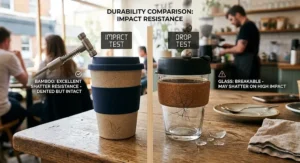
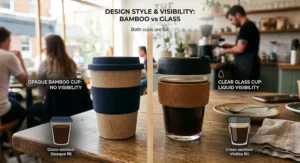
This is where bamboo cup durability vs glass gets genuinely interesting, because the two materials fail in completely different ways. Bamboo composite cups almost never shatter — the resin-bonded fibre structure absorbs drops well, which is precisely why they dominate the commuter and cycling market. What actually fails on bamboo cups isn’t the body; it’s the silicone lid seal, which tends to lose its snug fit after roughly 12–18 months of daily use and repeated dishwasher cycles, according to recurring patterns across aggregated user reviews. The bamboo body itself can also develop a slightly duller surface finish over one to two years as the resin coating wears thin from repeated hot-liquid exposure, though this is cosmetic rather than functional in most cases.
Glass cups fail differently and, on balance, more dramatically: they don’t degrade gradually, they either survive indefinitely or break in a single incident. Tempered and borosilicate glass — used in KeepCup Brew Cork, Neon Kactus Glass, and JOCO Cup respectively — are specifically engineered to resist the thermal shock of hot coffee followed by a cold rinse, and reviewers across all three brands report years of daily use without cracking under normal handling. The real risk factor is a hard drop onto tile or concrete, which no amount of tempering fully eliminates. Here’s what to weigh: if your daily routine avoids hard surfaces — a desk, a car, a soft bag — glass will likely outlast bamboo composite’s slow lid-and-finish degradation. If your routine involves cycling, a busy commute, or young children in the house, bamboo’s drop tolerance becomes the more relevant durability metric.
Lifecycle Analysis: Bamboo vs Glass From Cradle to Bin
A proper lifecycle analysis has to look past the point of purchase and account for raw material extraction, manufacturing energy, transport, in-use washing, and end-of-life disposal — and this is where the bamboo coffee cup vs glass coffee cup comparison gets far less tidy than marketing copy suggests. Peer-reviewed lifecycle work published in the International Journal of Life Cycle Assessment has repeatedly found that reusable cups only outperform single-use alternatives once they’re reused a meaningful number of times — the break-even point varies by material, but the core finding holds across most published studies: durability and actual reuse frequency matter more to the lifecycle outcome than the raw material itself.
For bamboo composite cups, the lifecycle burden is front-loaded into raw material processing — bamboo fibre has to be broken down and bonded with resin, a chemically intensive step that studies increasingly flag as more complex than the “natural material” marketing implies. Glass, by contrast, has a heavier manufacturing footprint due to the high-temperature melting silica requires, but it earns that footprint back over a longer, more predictable lifespan and — critically — it’s genuinely and repeatedly recyclable through standard UK kerbside glass collection at end of life, unlike bonded composite materials which typically can’t be separated back into recyclable streams. On paper, this means glass’s higher upfront lifecycle cost is more likely to be “paid off” over years of reuse, provided the cup survives that long without breaking — which loops directly back into the durability trade-offs covered above.
Carbon Footprint Compared: Where Each Cup’s Emissions Come From
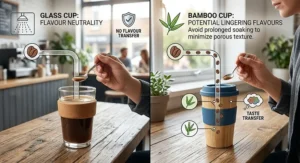
Zooming into carbon footprint specifically, rather than the broader lifecycle picture, the emissions breakdown for each material looks different at every stage. Glass production is genuinely energy-intensive — melting silica sand requires high furnace temperatures — which means a glass cup’s manufacturing-stage carbon footprint is typically higher than a bamboo composite cup’s. However, washing accounts for a meaningful and recurring share of a reusable cup’s lifetime carbon footprint regardless of material, since it happens daily rather than once, and this is a variable most people never think to compare between bamboo and glass.
Bamboo composite cups carry a lower manufacturing-stage footprint but a murkier end-of-life picture: because the resin bonding prevents genuine biodegradability or standard recycling, most bamboo composite cups ultimately go to incineration or landfill rather than being recycled back into raw material, meaning their carbon story effectively ends without a “credit” for material recovery. Glass, recycled through established UK infrastructure, can be melted down and reformed repeatedly with meaningfully lower energy input than producing new glass from raw silica — giving it a genuine end-of-life carbon advantage that bamboo composite currently can’t match. The honest takeaway: bamboo starts with a smaller carbon number, but glass has a better chance of closing the loop rather than simply deferring its footprint to a landfill.
✨ Compare eco cups side by side and pick the one that fits your daily coffee run.🤗
Bamboo or Glass Cup for the Environment? The Honest Verdict
So which wins the bamboo or glass cup for environment question outright? Based on the spec comparison and the lifecycle evidence above, there isn’t a clean single winner — and any article claiming otherwise is oversimplifying a genuinely nuanced picture. Glass edges ahead on the metric that arguably matters most for a “you’ll actually keep using this” product: true end-of-life recyclability through mainstream UK infrastructure, plus taste neutrality that tends to keep people using the same cup for longer rather than replacing it out of boredom or lid failure. Bamboo composite edges ahead on manufacturing-stage carbon footprint and on real-world durability against drops, which matters enormously if your realistic alternative is breaking a glass cup within six months and buying a replacement, effectively doubling its lifecycle impact.
The most honest framing: if you’ll genuinely use either cup daily for three-plus years without losing it, glass is the stronger environmental bet because of recycling infrastructure and lower washing-related microplastic shedding versus composite lids. If your lifestyle realistically means more drops, more forgetting, and more replacement cycles, a durable bamboo composite cup that survives those knocks may outperform a glass cup that breaks and gets landfilled within a year. The best cup, environmentally, is the one you’ll actually keep.
How to Choose Between a Bamboo and Glass Coffee Cup
- Assess your daily risk of drops. Cyclists, parents of young children, and anyone using public transport should weight bamboo composite’s shatter resistance heavily.
- Decide how much taste neutrality matters. If you’re particular about flavour carryover, glass’s inert surface is the more reliable long-term choice.
- Check your washing routine. If you want to bung it straight in the dishwasher without a second thought, prioritise a fully dishwasher-safe glass option like JOCO Cup over a cork-banded alternative.
- Factor in weight tolerance. Bamboo composites run 90–150g; glass options typically run 180–320g — noticeable in a bag carried all day.
- Set a realistic capacity. Match cup size to your actual order — FEBU 16oz for large milky drinks, Ecoffee Cup 8oz for espresso-based ones.
- Read the regulatory context. UK food safety guidance on bamboo composites (covered below) is worth understanding before committing to that material long-term.
- Budget for lid replacement, not just the cup. Whichever material you choose, plan to replace the lid roughly once a year rather than expecting the whole cup to last unchanged.
Common Mistakes When Buying a Reusable Coffee Cup
The single most common mistake is buying based on price alone without checking capacity against your actual coffee order — a £10 bamboo cup that’s too small to hold your usual oat latte gets abandoned within a fortnight. A second frequent error is assuming “eco-friendly” marketing language on a bamboo cup means it’s biodegradable or fully recyclable; as the lifecycle section above makes clear, resin-bonded composites generally aren’t, regardless of how the packaging is worded. Buyers also commonly overlook lid availability — some smaller bamboo brands don’t sell replacement lids separately, meaning a failed seal forces a full repurchase rather than a cheap fix. Finally, many people buy a cork-banded glass cup without registering that the cork can’t go in a dishwasher or microwave, then feel let down when hand-washing becomes an unwanted daily chore rather than reading the care instructions upfront.
Safety, Regulations and the Bamboo Cup Controversy
This is the part of the bamboo coffee cup vs glass coffee cup debate that most retail listings simply don’t mention, and it deserves straight, sourced coverage rather than a glossed-over footnote. UK regulators have specifically scrutinised bamboo composite food-contact items. The Food Standards Agency has issued a formal notice advising that plastic containers and utensils containing bamboo composite material should not be sold in Great Britain, following a review by the Committee on Toxicity that found insufficient evidence to confirm these products are safe for regular, long-term use. The concern centres on the melamine-formaldehyde resin used to bind bamboo fibre together, which independent testing across Europe has found can migrate into hot or acidic drinks in measurable amounts.
It’s important to be precise here: this advice applies specifically to plastic-and-bamboo composite products — the exact construction used in Ecoffee Cup, Cuppa Panda, FEBU, and similar bamboo fibre cups — not to items made purely from solid bamboo or plant fibre with no plastic-resin binder. If you’re currently using a bamboo composite cup, the FSA’s practical advice is to avoid microwaving it and to be cautious with hot, acidic liquids like citrus tea or very hot coffee held for extended periods, rather than necessarily discarding it outright. Glass, by contrast, carries no equivalent regulatory flag — borosilicate and tempered glass are chemically inert and don’t leach compounds into drinks regardless of temperature or acidity, which is a genuine, verifiable safety advantage worth weighing seriously alongside the durability and lifecycle factors already covered.
Long-Term Cost & Maintenance
Total cost of ownership tells a different story than sticker price alone. A budget bamboo cup like Cuppa Panda costs less upfront, but if the lid seal degrades after 12–18 months and needs replacing — or the whole cup needs repurchasing where spare lids aren’t sold separately — the effective annual cost can creep close to a mid-range glass option over a three-year window. KeepCup Brew Cork and Neon Kactus Glass sit at a higher upfront price but, provided they avoid a hard drop, typically don’t need any component replacement beyond an occasional lid, making their three-year cost trajectory flatter. JOCO Cup‘s dishwasher-and-microwave compatibility also reduces a hidden cost that’s easy to overlook: hand-washing time. If you value your time as part of the total cost equation, a fully dishwasher-safe cup genuinely saves days of cumulative washing-up over several years compared with a hand-wash-only cork band.
Problem → Solution: Fixing Common Reusable Cup Frustrations
Problem: My bamboo cup’s lid no longer seals properly. Most brands, including Ecoffee Cup, sell replacement silicone lids separately — check the manufacturer’s own site before assuming you need a whole new cup.
Problem: My glass cup smells faintly of old coffee. Run it through a hot cycle with a splash of white vinegar rather than washing-up liquid alone; glass doesn’t absorb odour the way plastic can, so persistent smell usually means residue in the lid seal rather than the cup body itself.
Problem: My cork band on a KeepCup has started drying out and cracking. This is normal wear from repeated wet-dry cycles; hand-wash gently and dry it fully rather than leaving it damp, and expect to replace the cork band roughly every 18–24 months of daily use.
Problem: I keep forgetting to bring my reusable cup. Keep a second, cheaper bamboo cup — something like Ecoffee Cup 8oz — permanently in your bag or car, reserving your premium glass cup for home and office use where forgetting isn’t an issue.
Problem: My bamboo cup feels rough or worn after a year. This is expected cosmetic wear on the resin coating rather than a fault; it doesn’t typically affect function, but if you’re using it with hot, acidic drinks regularly, treat it as a prompt to review the FSA guidance above.
Frequently Asked Questions
❓ Is bamboo coffee cup vs glass coffee cup a fair comparison, or are they for different uses entirely?
❓ Are bamboo coffee cups actually safe to use?
❓ Which lasts longer, a bamboo cup or a glass cup?
❓ Can you put a bamboo coffee cup in the microwave?
❓ Which is better for the environment, bamboo or glass?
Conclusion
If there’s one honest takeaway from comparing bamboo coffee cup vs glass coffee cup options this closely, it’s that the “best” choice depends entirely on how you’ll actually use it, not which material sounds greener on packaging copy. Bamboo composite cups like Ecoffee Cup, Cuppa Panda, FEBU, and the compact Ecoffee Cup 8oz genuinely earn their popularity through low weight and real-world drop resistance — just go in with clear eyes about the UK regulatory context around bamboo-resin composites and avoid hot, acidic drinks and microwaving. Glass options — KeepCup Brew Cork, Neon Kactus Glass, and JOCO Cup — cost more upfront but offer taste neutrality, genuine end-of-life recyclability, and, in JOCO’s case, a maintenance routine that’s arguably easier than any bamboo alternative here.
For most people commuting daily through unpredictable British weather and busy public transport, a durable bamboo composite cup remains the pragmatic choice. For home workers, desk-based professionals, and anyone who genuinely won’t drop it, glass is the stronger long-term investment on both taste and true recyclability. Either choice, used consistently, beats the alternative of another disposable cup heading straight to landfill — and that’s really the only comparison that matters most.
🌿 Ready to make the switch? Browse today’s bamboo and glass reusable cups and find the one that fits your morning routine.
Recommended for You
- Are Bamboo Coffee Cups Safe? 7 Better Picks Tested 2026
- 7 Best Bamboo Coffee Cups UK 2026: Eco-Friendly ; Safe Picks Slug
- Glass Reusable Cup vs Plastic Reusable Cup: 7 Picks for 2026
Disclaimer: This article contains affiliate links. As an Amazon Associate, I earn from qualifying purchases. If you purchase products through these links, we may earn a small commission at no additional cost to you.
✨ Found this helpful? Share it with your friends! 💬🤗
