In This Article
Somewhere between your third flat white of the week and the guilty glance at the bin overflowing with paper cups, you’ve probably thought: there has to be a better way. There is, and it’s been sitting on a shelf in your local eco shop looking smug about it for years. The best bamboo coffee cup does two things a disposable cup never will — it survives past Tuesday, and it doesn’t need a lecture on the climate crisis to justify its existence. But here’s the twist nobody tells you before you click “buy”: not every cup wearing the word “bamboo” on its label is actually safe, sustainable, or even mostly bamboo. Some are genuinely brilliant. Some are a bamboo-print sticker on a problem waiting to leach into your morning brew.

This guide cuts through the marketing fluff. We’ve dug into real specs, real UK safety guidance, and genuine aggregated review sentiment for seven actual products you can buy today, so you’re not gambling your Tuesday morning coffee — or your kidneys, frankly — on a cheerful-looking cup. Britain gets through roughly 2.5 billion disposable coffee cups a year, and fewer than 1% are actually recycled through standard household collections, so switching to something reusable is one of the easiest wins going. The question is which bamboo cup earns a permanent spot on your desk, and which one belongs firmly on the “skip it” pile.
Quick Comparison Table: Best Bamboo Coffee Cup at a Glance
Before the deep dive, here’s the shortlist. Every product below is covered in full further down the page, with genuine pros, cons, and honest verdicts.
| Product | Material Type | Capacity | Price Range | Best For |
|---|---|---|---|---|
| Ecoffee Cup 14oz | Bamboo/corn fibre composite | 400ml | around £12-£15 | Budget everyday commuters |
| Reusaboo Bamboo Cup | Bamboo fibre, screw lid | 450ml | around £14-£18 | Leak-proof security |
| BROVINO Bamboo Travel Mug | Bamboo shell, steel interior | 473ml | around £18-£24 | Genuine insulation |
| Wazzala Bamboo Travel Mug | Solid handcrafted bamboo | 473ml | around £22-£28 | Gifting and style |
| FEBU Plant-Based Cup | Bamboo and plant starch | 473ml | around £15-£20 | Plastic-free claims |
| DTC Holdings Bamboo Mug | Wood shell, steel cup | 266ml | under £15 | Compact espresso drinks |
| Zuperzozial Cupful of Colour | Bamboo, corn, melamine resin | 150ml x6 | around £20-£28 | Occasional cold drinks (with caveats) |
Looking at the table, the split between “pure or largely bamboo fibre” cups and “bamboo-lined steel” cups matters more than it looks. The Ecoffee Cup and Reusaboo Bamboo Cup win on price and everyday practicality, but if you’re drinking hot coffee daily and want the drink itself never touching a plant-composite surface, the BROVINO Bamboo Travel Mug and Wazzala Bamboo Travel Mug solve that by keeping stainless steel as the actual liquid-contact layer. The Zuperzozial set is the outlier here — gorgeous, affordable per cup, and worth reading the safety section below before it goes anywhere near your coffee.
💬 Bookmark this table now — you’ll want to compare it against the full breakdown below before you decide.
Top 7 Bamboo Coffee Cups: Expert Analysis
Reaching for “bamboo” on a product label tells you almost nothing about how the cup actually performs, what it’s made of underneath the marketing copy, or whether UK food safety regulators would wave it through. Below, each pick gets the full treatment: real specs, honest interpretation, aggregated review sentiment where it’s genuinely available, and a clear-eyed pros and cons list.
1. Ecoffee Cup 14oz Reusable Cup — the budget standard-bearer
The Ecoffee Cup is the reusable cup most Brits have actually held in their hand, and there’s a reason it keeps winning “best budget” awards. Its 400ml body is built from a bamboo and corn-starch fibre composite bound with a plant-based resin, paired with a food-grade silicone lid, stopper, and heat-protective sleeve. At around 220g it’s genuinely light enough to live in a bag without you noticing, and because the material is naturally sterile, it doesn’t carry the faint plasticky aftertaste some hard-plastic travel mugs do. Worth knowing: in response to tightened EU and UK food contact material rules from 2021 onward, Ecoffee Cup has progressively reduced the bamboo content in its formulation in favour of corn-fibre — a detail most listings gloss over but one that’s arguably reassuring given the regulatory picture covered further down this guide. This is the pick for students, commuters, and anyone who wants a reusable habit without the premium price tag. Aggregated review sentiment is largely positive on portability and the grippy silicone band, though some reviewers describe the rim as feeling “a bit papery” against the lips compared with steel or ceramic — a fair trade-off at this price point, in our view.
Pros:
- ✅ Genuinely lightweight for all-day carrying
- ✅ Affordable entry point into reusable cups
- ✅ Wide range of distinctive, colourful designs
Cons:
- ❌ Rim can feel less premium than steel or ceramic
- ❌ Not fully insulated, so drinks cool faster
Prices for the 14oz size typically sit in the low-to-mid teens, and given the brand’s track record and IndyBest recognition, it represents strong value for a first bamboo cup.
2. Reusaboo Bamboo Coffee Cup 450ml — best secure screw lid
If the thing that’s put you off reusable cups before is the horror of a coffee-soaked laptop bag, the Reusaboo Bamboo Coffee Cup is built around solving exactly that. Its 450ml bamboo-fibre body pairs with a sturdy screw-top lid and rubber stopper rather than the simpler push-fit lids found on cheaper rivals, and the whole thing ships in plastic-free, fully recyclable packaging. That screw mechanism means genuinely reduced spill risk on the Tube, on a bike, or shoved into a rucksack side pocket — a meaningfully different real-world experience from cups relying on friction-fit lids alone. Reviewers who’ve made the switch consistently report the security of the seal as the standout feature, with several describing it as noticeably more leak-resistant than their previous cup. On the flip side, that same tight seal can make the cup slightly fiddlier to open one-handed than a simple flip-top, which matters if you’re drinking on the move rather than at a desk. Best for: commuters and travellers who’ve been burned by a leaky lid before and want reassurance built in, plus anyone who’d rather pay a little more upfront than replace a phone that’s taken a coffee bath.
Pros:
- ✅ Screw lid dramatically reduces leak risk
- ✅ Generous 450ml capacity for long drinks
- ✅ Plastic-free, recyclable packaging on arrival
Cons:
- ❌ Screw lid is slower to open one-handed
- ❌ Sits at a slightly higher price than entry cups
At roughly £14-£18, this sits just above the cheapest bamboo cups but earns it through genuinely different lid engineering.
3. BROVINO Stainless Steel Bamboo Travel Mug 16oz — best for insulation and food-contact peace of mind
The BROVINO Bamboo Travel Mug takes a hybrid approach that’s worth paying attention to: a bamboo exterior shell wrapped around a full 304-grade stainless steel interior, rather than a cup made entirely of bamboo composite. In practice, that means your actual coffee never touches the bamboo material at all — the steel liner does the insulating and the drinking-contact work, while the bamboo shell handles grip, looks, and a satisfying weight in the hand. That construction matters more than it might seem, because it sidesteps the exact food-contact concern that’s dogged bamboo-composite cups in recent years (more on that below). Real owner feedback describes the mug as noticeably better at keeping drinks warm than fibre-only bamboo cups, with a sleek look that holds up to daily knocks — several reviewers specifically mention dropping it accidentally with no cracking, just minor surface scuffing on the bamboo shell. The spill-resistant lid has a small sipping opening rather than a full-open rim, which some buyers find limits how quickly they can drink but which meaningfully cuts down on desk spills. Best for: office workers and commuters who want genuine thermal performance alongside the bamboo aesthetic, without the regulatory question marks of pure composite cups.
Pros:
- ✅ Stainless steel interior avoids bamboo food contact
- ✅ Noticeably better heat retention than fibre-only cups
- ✅ Dishwasher safe and stain resistant
Cons:
- ❌ Small sip opening slows fast drinking
- ❌ Heavier in hand than pure bamboo-fibre cups
Typically priced around £18-£24, it’s a mid-range pick that earns its position through material choice rather than branding alone.
4. Wazzala Bamboo Travel Mug with Handle 16oz — best handcrafted build for gifting
Where the BROVINO leans practical, the Wazzala Bamboo Travel Mug leans into bamboo as the star of the show — a solid, handcrafted bamboo exterior shaped through what the maker describes as a lengthy carving process, giving each mug a slightly individual grain and finish that mass-produced plastic cups simply can’t replicate. It comes with a comfortable carrying handle (a genuine point of difference from most slim travel cups designed to slip into a bag), a leak-proof slide lid, and a bonus stainless steel straw with cleaning brush for cold drinks. The handle alone changes the use case: this reads less like a stealthy commuter cup and more like a proper mug substitute for a desk, a camper van, or a kitchen table — somewhere you’d actually want to sit and hold it rather than just grab and go. Because it prioritises genuine handcrafted bamboo, expect more natural variation between individual units than you’d get from injection-moulded composite cups, which buyers looking for a distinctive, less uniform gift item tend to see as a feature rather than a flaw. Best for: gift buyers, home-office workers who want a proper mug feel, and anyone who’ll actually wash by hand rather than assume everything survives a dishwasher cycle.
Pros:
- ✅ Genuine handcrafted solid bamboo construction
- ✅ Carrying handle suits desk and home use
- ✅ Includes reusable steel straw and brush
Cons:
- ❌ Hand-wash recommended over dishwasher use
- ❌ Natural grain means less uniform appearance
Sitting around £22-£28, this is priced as a considered purchase or gift rather than an impulse buy, and the handcrafted angle justifies the premium for the right buyer.
5. FEBU Plant-Based Reusable Coffee Cup 16oz — best for plastic-free and compostable claims
The FEBU Plant-Based Cup markets itself squarely on the plastic-free coffee cup bamboo angle, built from bamboo fibre blended with natural plant starches, with a screw-on lid the brand describes as leak-proof and the whole unit as dishwasher safe. It’s a reasonable pick for buyers whose main motivation is cutting virgin plastic out of their daily routine rather than chasing the best thermal performance. On specs alone, the 16oz capacity matches a typical large takeaway coffee, and the compostable claim is a genuine differentiator versus fibre cups that only advertise being “biodegradable” (a much lower bar, since almost anything technically biodegrades eventually — just not always on a timescale or in conditions that help). What the spec sheet won’t tell you, but a careful buyer should ask before purchasing: compostability claims vary hugely depending on whether a product is certified for home composting, industrial composting only, or neither, so it’s worth checking the manufacturer’s current certification rather than taking “compostable” at face value on the packaging alone. Aggregated feedback on similar bamboo-starch cups in this category tends to flag heat retention as middling — expect a hot drink to cool noticeably within 15-20 minutes rather than staying steaming for hours. Best for: buyers whose top priority is reducing plastic in the supply chain, who are happy to drink a bit faster to enjoy it hot.
Pros:
- ✅ Genuinely plastic-free lid and body construction
- ✅ Compostable positioning beyond basic biodegradable
- ✅ Comfortably fits a full takeaway-size drink
Cons:
- ❌ Limited insulation compared with steel hybrids
- ❌ Compostability requires checking certification specifics
Expect to pay in the region of £15-£20, positioning it between the budget composite cups and the premium steel hybrids.

6. DTC Holdings Bamboo Coffee Mug with Lid 9oz — best compact, non-breakable option
Not everyone wants a 16oz cup — sometimes you just need a proper espresso, cortado, or small pour-over without lugging around something built for a pint of drip coffee. The DTC Holdings Bamboo Coffee Mug answers that with a 9oz (roughly 266ml) capacity, a wooden outer shell, and a stainless steel drinking cup on the inside, marketed explicitly as non-breakable — a genuinely useful claim for anyone who’s ever watched a ceramic mug meet a tiled kitchen floor. The BPA-free stainless interior means, much like the BROVINO above, that your drink is contacting metal rather than composite fibre, which is reassuring from a food-contact standpoint. Because it’s compact and doesn’t try to double as an insulated travel flask, it suits desk use, small kitchens, camper vans, and anyone who simply drinks smaller measures more often rather than one large cup that sits going lukewarm for an hour. Real-world use cases where this shines: van life, boats, offices with limited desk space, and households with kids or clumsy housemates where “unbreakable” genuinely earns its keep rather than being marketing filler. Best for: small-batch drinkers, office desks, and anyone replacing breakable ceramic mugs rather than looking for a takeaway commuter cup.
Pros:
- ✅ Genuinely non-breakable, unlike ceramic mugs
- ✅ Steel interior avoids composite food contact
- ✅ Compact size suits smaller measures
Cons:
- ❌ Too small for a full 16oz takeaway coffee
- ❌ Less suited to long commutes than travel mugs
At under £15 in most cases, it’s one of the more affordable entries here and a smart pick if your usual drink is smaller than a supermarket-sized latte.
7. Zuperzozial Cupful of Colour Set of Six 150ml — best value multipack, with an important caveat
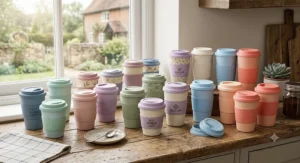
The Zuperzozial Cupful of Colour set is the most visually cheerful pick on this list — six brightly coloured 150ml cups, made from bamboo and corn plant fibres bound together with a melamine resin for added strength, and marketed as dishwasher safe and ideal for picnics, prosecco, tea, or coffee. Here’s the honest part most roundups skip: melamine resin is exactly the additive that UK and EU food safety regulators have flagged in bamboo-composite drinkware, and products combining bamboo fibre with plastic resin binders fall into the category the Food Standards Agency has specifically advised against for food and drink contact (full detail in the safety section below). That doesn’t necessarily mean every unit on sale today is non-compliant, but it does mean a genuinely careful buyer should check the manufacturer’s current formulation and compliance status before using this set for daily hot coffee, rather than assuming “bamboo” automatically means “safe.” Where this set does make sense is as an occasional-use item — cold drinks, garden parties, kids’ squash, or a colourful multipack for guests — situations where exposure is infrequent rather than a twice-daily hot coffee habit. Best for: hosting, gifting a colourful set, and occasional cold-drink use rather than a primary daily coffee cup.
Pros:
- ✅ Excellent value per cup across a set of six
- ✅ Bright, distinctive colours suit gifting and hosting
- ✅ Lightweight and stackable for storage
Cons:
- ❌ Contains melamine resin flagged by UK regulators
- ❌ Less suited to daily hot coffee than other picks here
Typically priced around £20-£28 for the full set of six, which works out affordably per cup — just weigh that against the safety notes above before it becomes your everyday coffee companion.
What Is a Bamboo Coffee Cup, Really? Plant-Based Materials Explained
A bamboo coffee cup is a reusable drinking vessel made either wholly or partly from bamboo — either as solid, carved bamboo wood, or as bamboo fibre blended into a composite with binding agents like corn starch or, less desirably, plastic resins such as melamine. The phrase “plant-based material” gets used loosely across this category, and it’s worth being precise about what it actually covers.
At one end sits genuinely solid bamboo, carved or moulded from the plant itself with minimal processing — think the Wazzala Bamboo Travel Mug above. At the other end sits bamboo fibre used more like a filler, mixed into a resin binder to create a lightweight, mouldable material that behaves a bit like hard plastic — a category that includes many budget “bambooware” products, and which is where UK food safety scrutiny has concentrated. In the middle sits the increasingly common hybrid approach: a bamboo or wood exterior wrapped around a genuine food-grade stainless steel or ceramic interior, so the plant material never actually touches your drink.
Why does this distinction matter more than it used to? Because bamboo’s genuine environmental credentials — it’s one of the fastest-growing plants on Earth, requiring minimal fertiliser, pesticide, or water input to cultivate — got bundled into marketing for products where the bamboo content was actually secondary to a plastic resin doing most of the structural work. Understanding which category a specific cup falls into is the single most useful thing you can do before buying, and it’s the theme running through every product review above.

How to Choose the Best Bamboo Coffee Cup
Picking the right cup comes down to seven practical criteria, roughly in order of importance:
- Check what’s actually touching your drink. Look for whether the drinking surface is bamboo composite, solid bamboo, or a steel/ceramic liner — this affects both taste and the food-contact safety questions covered below.
- Match capacity to your actual drink. A 150ml cup suits an espresso; a 450ml cup suits a takeaway-style latte. Buying oversized just means a cold, half-finished drink by 11am.
- Test the lid mechanism mentally before buying. Screw lids leak less but open slower; flip-top and push lids are faster but less forgiving in a packed bag.
- Decide if insulation actually matters to you. If you drink fast, fibre-only cups are fine. If you nurse a coffee for two hours, a steel-lined hybrid earns its higher price.
- Consider how you’ll clean it. Solid bamboo often needs hand-washing to preserve the finish; composite and steel-lined cups are more commonly dishwasher safe.
- Weigh genuine compostability against basic biodegradability. These are not the same claim, and only one of them tells you anything useful about disposal timescales.
- Factor in your actual usage frequency. Daily commuters justify a higher-spec cup faster than someone who reaches for it twice a week — the maths is covered properly in the cost section further down.
Is a Bamboo Coffee Cup Actually Plastic-Free and Compostable?
Sometimes — and the honest answer depends entirely on which specific product you’re holding. A genuinely plastic-free coffee cup bamboo option, like the FEBU Plant-Based Cup, builds both body and lid from plant-derived materials with no petroleum-based plastic components. Many popular bamboo-fibre cups, however, still pair a bamboo/corn composite body with a silicone lid and stopper — silicone isn’t technically plastic in the traditional sense, but it isn’t plant-based either, and it’s worth knowing that distinction rather than assuming “bamboo cup” automatically means “100% plant matter.”
Compostable is an even more loaded word. True compostability, certified to recognised standards, means a product breaks down into non-toxic material within a defined timeframe under specific conditions — home composting is a notably higher bar than industrial composting, which requires facilities most UK households don’t have access to. A cup marketed simply as “biodegradable” is making a much weaker claim: almost anything biodegrades eventually, including plastic, just potentially over decades or centuries and not always into harmless components. If a compostable claim matters to your buying decision, the responsible move is checking the manufacturer’s current certification details directly, rather than taking a single word on the box as gospel.
Bamboo Coffee Cup vs Stainless Steel Travel Mug
This is the comparison most buyers actually need to make, because “bamboo vs steel” isn’t really about aesthetics — it’s about trade-offs in weight, insulation, and food-contact preference.
| Factor | Bamboo Fibre Cup | Bamboo-Steel Hybrid | Pure Stainless Steel Travel Mug |
|---|---|---|---|
| Weight | Lightest option | Moderate | Heaviest, especially insulated models |
| Heat retention | Weak — cools in 15-30 mins | Good — steel liner insulates | Excellent — often hours |
| Food contact | Drink touches composite | Drink touches steel only | Drink touches steel only |
| Typical price | Lowest | Mid-range | Mid to premium |
| Best for | Casual, occasional use | Daily coffee with some warmth retention | Long commutes, all-day insulation |
The written verdict: a pure bamboo fibre cup like the Ecoffee Cup wins on portability and price but loses on both insulation and, depending on formulation, the food-contact question. A bamboo-steel hybrid such as the BROVINO Bamboo Travel Mug splits the difference nicely, giving you the visual warmth of bamboo with steel doing the actual work. A dedicated stainless steel travel mug without any bamboo at all will out-insulate every bamboo option on this list, so if thermal performance is genuinely your top priority over aesthetics, it’s worth at least considering a steel-only alternative alongside the bamboo picks here.
Safety, Melamine & UK Regulations: What You Need to Know Before You Buy
This is the section most bamboo coffee cup roundups skip entirely, and it’s arguably the most important one here. Since 2021, the picture around bamboo-composite drinkware in the UK and EU has shifted substantially. Following a formal risk assessment, the Food Standards Agency and Food Standards Scotland have advised that food containers and utensils containing bamboo composite material — bamboo fibre bound with a plastic resin such as melamine-formaldehyde — should not be sold or used in Great Britain. Their concern is specific: formaldehyde and melamine can migrate from these composites into food and drink, particularly when the product contacts hot or acidic liquids — which, inconveniently, describes coffee rather precisely.
Crucially, this advice does not apply to items made solely from bamboo or plant-based material with no plastic resin binder, and it doesn’t apply to cups where a steel or ceramic liner keeps the drink away from the bamboo entirely. That’s exactly why several of the products in this guide — the BROVINO Bamboo Travel Mug, the Wazzala Bamboo Travel Mug, and the DTC Holdings Bamboo Coffee Mug — sidestep the concern by construction rather than marketing claim. It’s also why we’ve flagged the Zuperzozial Cupful of Colour set honestly above, since its stated composition includes a melamine resin binder.
Practically, what should you do with this information? Check product descriptions for the words “melamine,” “melamine resin,” or “MFR” alongside bamboo — their presence is the signal to dig deeper before buying for daily hot drink use. If a product simply says “bamboo fibre” without detailing the binder, it’s reasonable to contact the seller and ask directly, since UK retailers are required to be able to answer that question. And if you already own an older bamboo composite cup bought before this guidance tightened, the pragmatic advice from the FSA itself is straightforward: stop using it for food-related purposes and consider it retired.
Common Mistakes When Buying a Bamboo Coffee Cup
Even eco-conscious buyers trip up on a handful of predictable pitfalls, and most are easy to avoid once you know to look for them.
Assuming “bamboo” on the label means 100% bamboo. As covered above, many products are composites where bamboo is a minority ingredient by weight, blended with corn starch, resin, or both. The word on the front of the packaging tells you almost nothing about the actual formulation.
Ignoring the lid entirely. Buyers focus heavily on the cup body and treat the lid as an afterthought, then discover six weeks later that it’s the lid — not the cup — that determines whether their bag survives the commute.
Buying oversized “just in case.” A 450ml cup sounds generous until you’re drinking a lukewarm second half of your coffee because it was never designed to stay warm that long without a steel liner doing the insulating.
Overlooking cleaning requirements. Solid bamboo generally shouldn’t go through repeated dishwasher cycles — the heat and detergent can dry out and crack the wood over time — while some buyers assume all “eco” cups are automatically dishwasher safe.
Skipping the safety check for daily hot-drink use. Given the regulatory picture above, it’s worth a genuinely five-second check of a product’s material description before it becomes your twice-daily coffee vessel rather than an occasional picnic cup.
Real-World Scenarios: Who Should Buy Which Bamboo Cup
The daily commuter on a budget. If you’re grabbing a coffee most weekday mornings and mainly want to cut down on cup waste without overspending, the Ecoffee Cup or Reusaboo Bamboo Cup covers the basics well — light, affordable, and genuinely reduces your disposable count without a big outlay.
The desk-based home worker who wants real warmth. Working from a kitchen table means your coffee often sits for longer stretches between sips. The BROVINO Bamboo Travel Mug, with its steel interior actually holding heat, suits this pattern far better than a fibre-only cup that’s cold by the second chapter of your inbox.
The gift buyer or the person who wants their mug to feel like an object, not a commuter tool. The Wazzala Bamboo Travel Mug‘s handcrafted build and handle make it feel considered rather than grabbed off a shelf — a sensible pick for a birthday, a housewarming, or simply someone who wants their morning ritual to feel a little more deliberate.
The espresso or small-measure drinker. If your actual daily drink is a short black or a single cortado rather than a venti-sized anything, the compact DTC Holdings Bamboo Coffee Mug avoids the “drinking cold dregs from a cup built for double the volume” problem entirely.
Setting Up & Maintaining Your Bamboo Coffee Cup
Getting the most out of a bamboo cup in the first month comes down to a handful of habits worth building early. Rinse and hand-wash any solid bamboo item before first use, then dry it fully rather than leaving it wet on a draining board — bamboo that sits damp repeatedly is more prone to staining and, eventually, cracking. For composite or steel-lined cups explicitly marked dishwasher safe, that’s genuinely fine day to day, but avoid the highest heat cycle if you want the finish to last years rather than months.
Expect some tannin staining from tea and coffee on lighter-coloured bamboo over time — this is cosmetic, not a safety issue, and a light scrub with baking soda paste lifts most of it. Silicone lids and seals benefit from a proper separation and clean roughly weekly rather than a quick rinse, since the crevices around a seal are exactly where mould likes to set up shop unnoticed. If your cup has a screw lid, check the seal’s condition every few months — silicone perishes eventually, and a worn seal is usually the real culprit behind a cup that “suddenly” starts leaking after a year of perfect service. Finally, never microwave a bamboo or bamboo-composite cup, even briefly — this applies doubly to any composite containing resin binders, given the migration concerns detailed in the safety section above.
Bamboo Coffee Cups for the Zero Waste Lifestyle
For anyone building a genuinely zero waste lifestyle, a bamboo coffee cup is one of the simpler swaps to commit to, precisely because coffee is such a habitual, repeated purchase — the impact compounds daily rather than requiring a single big lifestyle overhaul. An eco friendly bamboo reusable cup slots naturally alongside a reusable water bottle, cloth shopping bags, and a refillable cleaning products habit, and unlike some zero waste swaps, it usually pays for itself through coffee shop discounts rather than costing more long-term.
The genuinely sustainable coffee cup bamboo pick for this lifestyle depends on how far you want to push the plastic-free angle specifically. If avoiding all plastic and silicone matters as much as avoiding disposables, the FEBU Plant-Based Cup is the closest fit on this list. If your priority is simply maximising the number of disposable cups you personally avoid over the years — durability and daily practicality over material purity — a steel-lined hybrid will likely outlast a pure fibre cup by years, which arguably makes it the more genuinely low-waste choice over its full lifespan, even if it’s a less “purely bamboo” product on paper. Zero waste living, done honestly, is often less about the single most virtuous-looking material and more about what you’ll actually keep using for the next five years instead of replacing.
Long-Term Cost & Environmental Value
The financial case for switching stacks up faster than most people expect. UK coffee chains including Costa, Pret, and Greggs routinely offer discounts of 20-50p for bringing your own cup, and if you’re buying coffee even three times a week, that discount alone typically pays back the cost of a mid-range bamboo cup within two to four months. From there, every subsequent coffee is straightforwardly cheaper than it would have been.
Environmentally, the picture rewards durability over the “purest” material on paper. A cup that lasts five years because it’s well-built — solid bamboo cared for properly, or a steel-lined hybrid that resists wear — offsets far more disposable cups over its life than a cheaper composite cup that cracks after eight months and ends up in general waste anyway, since most bamboo composite isn’t accepted through standard kerbside recycling. This is the practical argument for spending slightly more on a hybrid like the BROVINO Bamboo Travel Mug or a handcrafted piece like the Wazzala Bamboo Travel Mug: total cost of ownership, measured in cost-per-use over years rather than the sticker price on day one, often favours the pricier option once you account for how long it actually survives daily use.
Frequently Asked Questions
❓ Is a bamboo coffee cup safe to drink from?
❓ Are bamboo coffee cups dishwasher safe?
❓ Do bamboo coffee cups keep drinks hot?
❓ Can a bamboo coffee cup go in the microwave?
❓ Is a bamboo coffee cup really eco-friendly compared to plastic?
Conclusion
The honest verdict on the best bamboo coffee cup is that there isn’t one single winner — there’s a right answer for your specific habits, and now you’ve got the detail to find it. Budget-conscious daily commuters are well served by the Ecoffee Cup or Reusaboo Bamboo Cup. Anyone who wants genuine warmth retention alongside the bamboo look should lean toward the BROVINO or Wazzala hybrids. Small-measure drinkers get real value from the compact DTC Holdings mug, and the FEBU Plant-Based Cup earns its place for anyone chasing a genuinely plastic-free routine. The Zuperzozial set remains a lovely occasional-use option once you’ve read the safety caveat with open eyes rather than skipped past it.
What matters most, across every pick on this list, is understanding what’s actually touching your coffee — and now you do. That’s a genuinely useful thing to walk away with, whichever cup ends up on your desk this time next week.
✨ Don’t Miss These Exclusive Deals!
🔍 Take your morning coffee routine to the next level with the bamboo cups above. Click through to check current pricing and availability before stock runs low on the most popular colourways — a small swap that adds up to a genuinely lower-waste year ahead!
Recommended for You
- Glass Reusable Cup vs Plastic Reusable Cup: 7 Picks for 2026
- Glass Reusable Coffee Cup: 7 Best Picks for 2026 (UK Guide)
- KeepCup Glass vs Brew: Which Is Better in 2026?
Disclaimer: This article contains affiliate links. As an Amazon Associate, I earn from qualifying purchases. If you purchase products through these links, we may earn a small commission at no additional cost to you.
✨ Found this helpful? Share it with your friends! 💬🤗
